
Lieferung heute & morgen

Qualitätsgarantie

Willkommens-Angebote freischalten: KOSTENLOSE Lieferung | Bis zu 80 % RABATT | Kostenlose 30-Tage-JoyPlus-Testphase
App herunterladen
By Joybuy Product Recommendation Officer, July 18, 2026
Preparing for a trip with an RV, caravan, or a large towing rig requires special attention to safety. A crucial but often overlooked aspect is tire pressure. Incorrect tire pressure not only compromises handling and increases fuel consumption but also poses a significant safety risk. A Tire Pressure Monitoring System (TPMS) offers a reliable solution for continuous monitoring.
This article serves as a practical guide. It explains what to look for when selecting a system and presents a curated selection of models suitable for different vehicle types and needs. Our goal is to provide you with an informed basis for making a decision that enhances the safety of your journeys.
Selecting the right system depends on your specific vehicle configuration and requirements. The following criteria will help you make the right choice.
The first consideration is the number of tires to be monitored. A standard RV typically requires four to six sensors. However, if you are traveling with a towing setup, such as an RV with a trailer or a tow vehicle with a caravan tire pressure monitoring system, you will need additional trailer tire pressure sensors. Look for systems that either come with the right number of sensors from the start or are expandable to cover future needs.
For long vehicles like RVs, towing rigs, or light-duty trucks, the distance between the rear tires and the cockpit can interfere with wireless signal transmission. A tire pressure monitoring system with a repeater is often the more reliable solution here. The repeater (signal booster) is usually placed in the middle of the vehicle or on the trailer and ensures that data from the rear sensors reaches the display unit stably and without interruption. This is particularly relevant for TPMS for trucks and large motorhomes.
Another important factor is the type of installation. Most systems for retrofitting a TPMS use TPMS with external sensors. These are simply screwed onto the tire valves in place of the valve caps. The advantage lies in the straightforward installation, which can be done without a trip to the workshop or dismounting the tires. Internal sensors are mounted inside the tire and require a tire change, but they offer better protection against theft and damage. For most users, external sensors are the more practical choice due to their ease of use.
Based on the criteria mentioned, we have compiled a selection of systems suitable for various use cases.
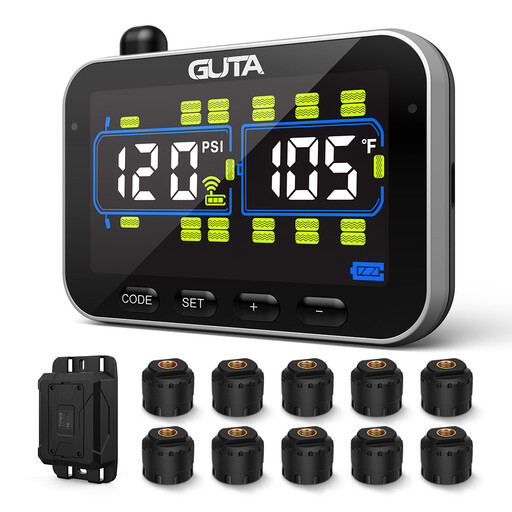
Why it stands out: This kit is an all-in-one solution for drivers of large vehicle combinations. With ten sensors and an included repeater, it is designed to reliably monitor even long towing rigs.
Advantages:
Who is it for? Ideal for owners of large RVs with a dual-axle trailer, semi-trailers, or small fleets who need comprehensive tire pressure and temperature monitoring for the entire rig.
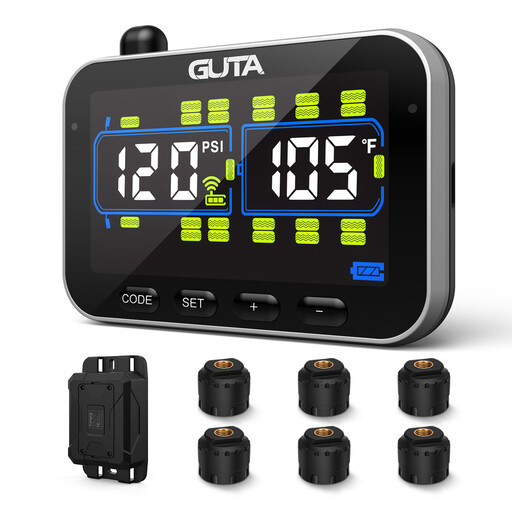
Why it stands out: This system offers the same reliable technology as the larger model but is tailored for standard RVs or vehicles with dual tires on the rear axle, featuring six sensors.
Advantages:
Who is it for? A suitable choice for drivers of three-axle RVs or those with dual rear tires who want reliable monitoring without unnecessary extra sensors.
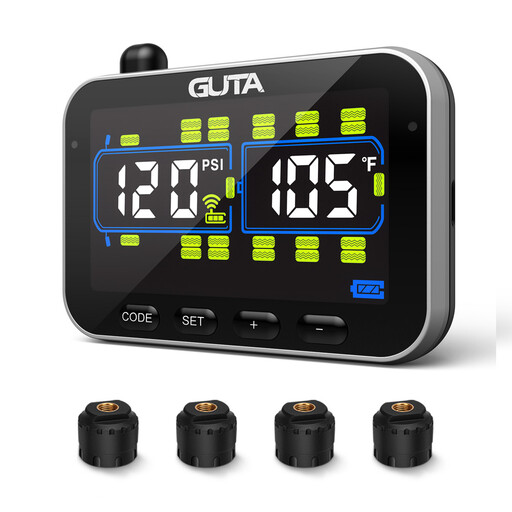
Why it stands out: The basic configuration for standard vehicles. This kit focuses on essential functions and offers a cost-effective solution for smaller RVs, caravans, or light-duty trucks.
Advantages:
Who is it for? Perfect for drivers of camper vans, smaller Class C motorhomes, single caravans, or light commercial vehicles looking for a reliable system for retrofitting a TPMS.
The models presented here cover common use cases. However, the market offers a wide variety of other solutions that differ in sensor count, display size, or additional features. If you are looking for a system for a special vehicle configuration or wish to compare more options, you may find the right product in our broader selection.
Discover more products in our Scooter Trailers category.
Yes, retrofitting a TPMS is straightforward for most RVs. Systems with external sensors are specifically designed for this purpose. The sensors are screwed onto the existing valves, and the display unit is placed in the cockpit and powered (usually via USB or a 12V socket). The entire process typically takes only a few minutes and requires no special tools.
External sensors continuously measure the pressure and temperature inside the tire. This data is transmitted wirelessly (usually on the 433.92 MHz frequency) to a receiver unit inside the vehicle. The display shows the values for each individual tire and triggers an audible and visual alarm as soon as a preset threshold is crossed. This ensures permanent tire pressure and temperature monitoring.
A repeater is highly recommended for vehicles or towing rigs longer than 7-8 meters. Metal structures, cargo, and other radio signals can weaken the signal from the rear sensors. A signal booster captures these signals and forwards them, amplified, to the monitor. This ensures stable and reliable data transmission, which is crucial for safety on long vehicles.