
Lieferung heute & morgen

Qualitätsgarantie

Willkommens-Angebote freischalten: KOSTENLOSE Lieferung | Bis zu 80 % RABATT | Kostenlose 30-Tage-JoyPlus-Testphase
App herunterladen
For owners of RVs, caravans, and trailers, safety on long journeys is paramount. Correct tire pressure is a crucial factor in this, yet it's often underestimated. A retrofittable Tire Pressure Monitoring System (TPMS) offers an effective solution. However, the market is crowded, and many products fail to deliver on their promises. This guide will help you identify common pitfalls and make an informed decision.
As a Joybuy Product Recommendation Officer, I analyse market information to provide you with objective, practical advice that protects you from expensive purchasing errors.
Many available systems are primarily designed for passenger cars and are unsuitable for the demands of RVs or towing setups. Pay special attention to these two weaknesses:
To avoid the problems mentioned above, you should check three technical specifications before buying. These determine the functionality and reliability of the system for your specific vehicle.
The most important parameter is the supported pressure range. For an RV TPMS or a light truck tire pressure system, the device should be able to monitor a pressure of at least 6 bar (approx. 87 PSI), but ideally up to 13 bar (approx. 188 PSI) or more. This ensures that even tires with high inflation pressure are monitored reliably. If you plan to use a system for a towing setup with a vehicle and caravan tire pressure monitoring, make sure the kit includes enough sensors (e.g., 6 or more) or is expandable.
For vehicle lengths over approx. 6-7 meters, a signal booster, also known as a repeater, is essential. This small additional device is usually placed in the middle of the vehicle and captures the signals from the rear RV tire pressure sensors to forward them, amplified, to the display unit in the cockpit. Systems that are explicitly equipped with a repeater offer significantly more stable and reliable data transmission over long distances.
When retrofitting a tire pressure monitoring system, you have the choice between internal and external sensors.
For the display unit, a dual power supply has proven effective: an integrated battery charged via USB-C and an additional solar panel. A solar-powered TPMS reduces cable clutter in the cockpit and ensures largely self-sufficient operation while driving.
Based on the criteria mentioned above, we have identified some products that are particularly suitable for specific user groups and vehicle types.
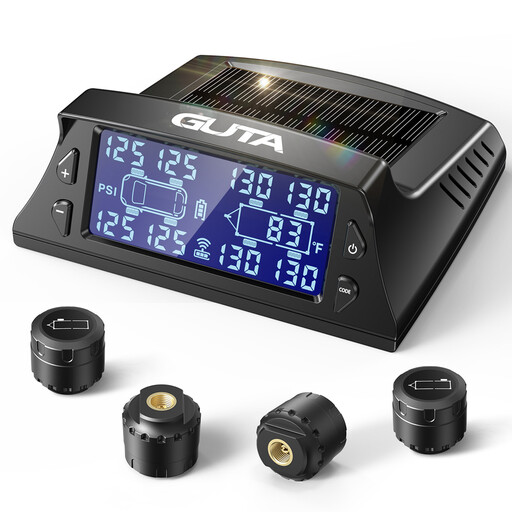
Why This Fits Their Persona: A solid solution for standard RVs and camper vans up to approx. 6 meters in length. With 4 sensors, the system covers the most common configuration and offers convenient handling for seasonal use and holiday trips with its solar charging feature.
It avoids the pitfall of an insufficient pressure range, as it can monitor pressures up to 13 bar (188 PSI) according to the manufacturer's specifications. This makes it suitable for tires that require significantly higher pressure than those on passenger cars.
High measurement range combined with a practical solar charging function for the display unit. The external sensors allow for quick, tool-free installation.
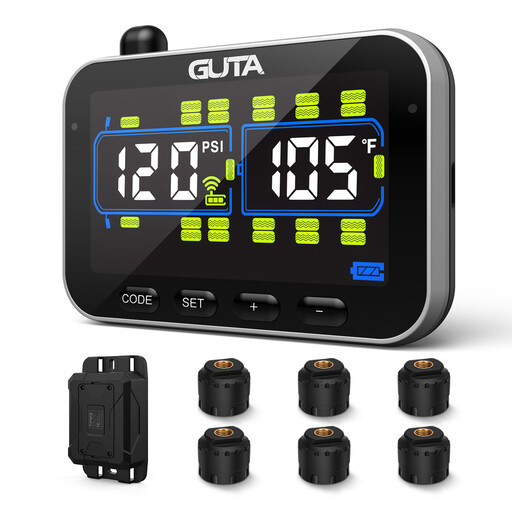
Why This Fits Their Persona: This kit is designed for the most demanding scenarios: large, integrated motorhomes, vehicles with dual-wheel setups, or combinations of a towing vehicle and a large caravan. The 6 sensors and the repeater are crucial here.
It solves the problem of unstable signal transmission with the included repeater. This ensures a reliable wireless connection even for vehicle lengths over 7 meters, where systems without a booster often fail.
Complete package for large vehicles: 6 sensors for dual axles or towing setups and a signal repeater included. The system is also expandable to up to 24 tires.
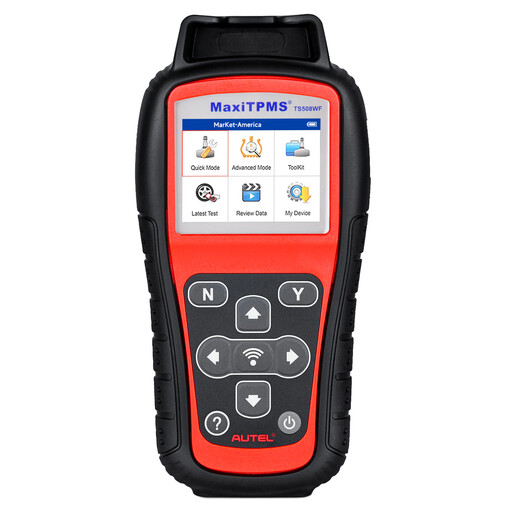
Why This Fits Their Persona: This is not just a monitoring system, but a professional diagnostic tool. It is ideal for users who want to program and relearn sensors themselves and read TPMS fault codes—whether for their own fleet or in a workshop context.
It gives the user full control. Instead of relying on a closed system, this tool allows users to clone, create, and relearn sensors (specifically Autel MX-Sensors) to the vehicle's ECU, simplifying maintenance and replacement.
Comprehensive diagnostic and programming functions. It can not only display data but also read/clear TPMS fault codes and relearn sensors via the OBD2 interface.
We have compiled a complete, up-to-date list of products that fully meet these strict selection criteria and relevant safety regulations.
Yes, installing external sensors is straightforward and does not require special tools or a visit to a workshop. The sensors are simply screwed onto the tire valves in place of the existing valve caps. Afterward, the display unit is placed in the cockpit and switched on. Most systems will then pair automatically.
The battery life depends on the sensor model and usage. According to manufacturer specifications, most external sensors have a battery life of 2 to 4 years. Typically, standard coin cell batteries (e.g., CR1632 or CR2032) are used, which are inexpensive and easy to replace.
A repeater is strongly recommended for vehicles with a total length of over 6-7 meters, as well as for all towing setups (a towing vehicle with a caravan or trailer). Without a repeater, signal loss can occur over longer distances, preventing data from the rear tires from reliably reaching the display unit. A repeater ensures a stable and continuous connection.