
Lieferung heute & morgen

Qualitätsgarantie

Willkommens-Angebote freischalten: KOSTENLOSE Lieferung | Bis zu 80 % RABATT | Kostenlose 30-Tage-JoyPlus-Testphase
App herunterladen
By Joybuy Product Recommendation Officer, July 29, 2026
On long journeys in an RV, caravan, or truck, safety is critically dependent on the condition of your tires. A correct Tire Pressure Monitoring System (TPMS) is therefore not a gimmick, but a critical component for accident prevention. However, the market offers a bewildering array of choices, and many products are unsuitable for the specific demands of heavy vehicles. Before you make a purchasing decision, you should be aware of the three most common pitfalls that lead to bad investments.
To ensure you purchase a suitable system for your vehicle, you should check three core technical features. These define the reliability and real-world usability of a TPMS for an RV or truck.
The most important technical parameter is the supported pressure range. For RVs, caravans, and light-duty trucks, the system should cover a range of at least 0 to 8 Bar (approx. 116 PSI). For heavy-duty RVs or trucks, systems with a range up to 14 Bar (approx. 203 PSI) are the safer choice. Also, ensure that the system monitors not only pressure but also tire temperature. A sudden increase in temperature can indicate developing tire failure or a problem with the brakes. Good systems allow you to set individual alert thresholds for under- and over-pressure, often as a percentage deviation from the target pressure (e.g., -15% / +25%).
The stability of the wireless connection is crucial. Most systems use the 433.92 MHz frequency. For standard RVs without a trailer, a direct connection may be sufficient. However, as soon as you use a TPMS for trailers or if your vehicle is longer than 7 meters, a signal booster (repeater) becomes essential. It is usually placed in the middle of the vehicle and ensures stable data transmission from the rear tires to the display. Some kits for caravan tire pressure monitoring already include such a repeater.
For retrofitting a TPMS, external sensors are the most practical solution. They are simply screwed onto the valves. Pay attention to the battery life. According to manufacturer specifications, CR2032 batteries often last longer (up to 4 years) than the smaller CR1632 type (approx. 2 years). Check if the batteries are easy to replace. The display unit in the cockpit should have flexible power options, ideally an integrated battery that can be charged via USB-C. Some models also offer a solar panel to extend battery life.
Based on the criteria above, we have compiled a selection of systems suitable for different vehicle types and usage scenarios.
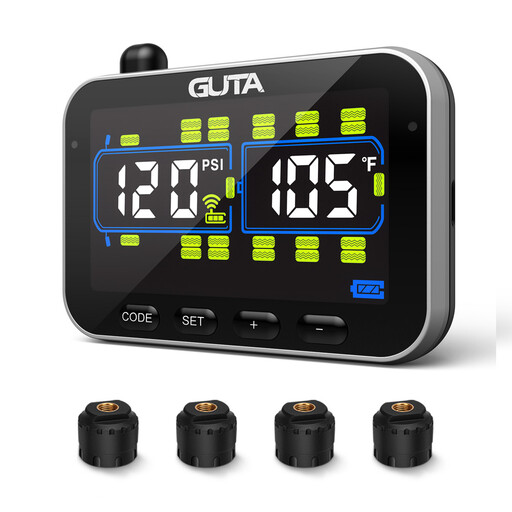
Why it's a match: This system provides a solid foundation for owners of standard RVs with up to four tires. It offers all essential monitoring functions in an easy-to-install package.
With a pressure range of up to 14 Bar (188 PSI according to the manufacturer), it is explicitly designed for the high pressures of RV tires, avoiding the inaccuracies of passenger car systems.
The sensors are pre-paired from the factory, which simplifies installation. The large color display provides a clear and intuitive view of all relevant data.
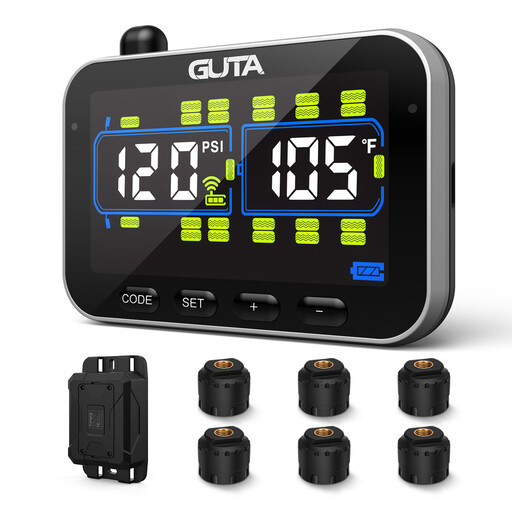
Why it's a match: Ideal for drivers of dual-axle RVs or towing setups (e.g., with a caravan or boat trailer) who need reliable monitoring of all tires.
The included signal booster (repeater) solves the problem of signal loss on long vehicle combinations, ensuring consistently stable data transmission.
The set is designed to monitor up to 6 tires and offers high signal stability thanks to the repeater, making it an all-in-one solution for towing setups.
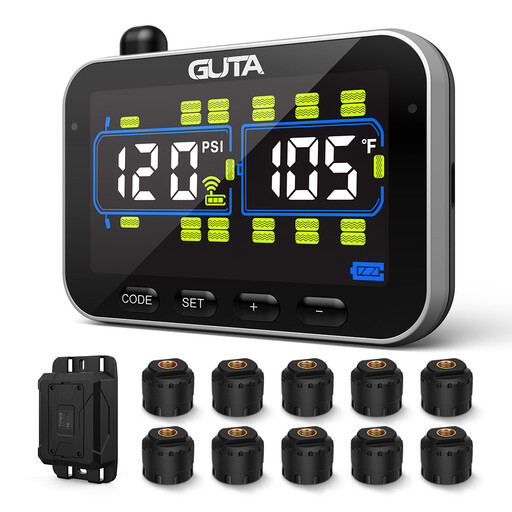
Why it's a match: This kit is aimed at owners of large RVs, multi-axle trailers, or small truck fleets. According to the manufacturer, it is expandable to up to 24 tires.
It combines a professional pressure range (up to 14 Bar) with high scalability, thus bypassing the limitations of standard systems for TPMS for trucks or complex towing setups.
The high number of included sensors and its expandability make it a future-proof solution for demanding private or semi-professional applications.
We've compiled a complete, up-to-date list of products that fully meet these strict selection criteria and German safety regulations.
A TPMS with external sensors can usually be retrofitted without a visit to the workshop. The sensors are screwed onto the tire valves in place of the valve caps. With most systems, the sensors are already paired with the display unit, so the system is ready for use immediately after installation.
The battery life depends on the sensor type and usage. According to manufacturer specifications, CR1632 batteries last about 2 years, while the CR2032 type can achieve a lifespan of up to 4 years. On the models presented here, the batteries can be replaced by the user.
Yes, for vehicle combinations or solo vehicles with a length of over approx. 7 meters, a signal booster (repeater) is strongly recommended. It captures the signal from the rear sensors and reliably forwards it to the display in the driver's cab to ensure seamless tire pressure monitoring.