
Lieferung heute & morgen

Qualitätsgarantie

Willkommens-Angebote freischalten: KOSTENLOSE Lieferung | Bis zu 80 % RABATT | Kostenlose 30-Tage-JoyPlus-Testphase
App herunterladen
Correct tyre pressure is fundamental to the driving safety and efficiency of any vehicle. For motorhomes, trailer combinations, or light trucks, this issue becomes even more critical. Long journeys, heavy loads, and a greater number of tyres increase the risk posed by a slow pressure leak or overheating. A retrofit Tyre Pressure Monitoring System (TPMS) offers a reliable solution for continuous monitoring.
This article serves as a practical guide. It explains the key features to look for when choosing a TPMS for your RV and introduces several models suitable for different vehicle types and requirements.
The market for retrofitting tyre pressure sensors is extensive. To make an informed decision, three technical aspects are particularly relevant.
On long vehicles, such as motorhomes with an over-cab bed or combinations of a towing vehicle and a TPMS-equipped trailer, the distance between the rearmost sensors and the receiver in the cockpit can be too great for a stable wireless connection. This leads to signal dropouts.
A Tyre Pressure Monitoring System with a repeater solves this problem. The repeater is typically mounted centrally on the vehicle (e.g., on the underbody or in the rear area) and amplifies the sensors' signal before it is forwarded to the display unit. For vehicles over 8 metres in length or when used with a trailer, such a system is highly recommended.
The number of sensors you need depends on your vehicle. A panel van can manage with four sensors, while a three-axle motorhome requires six. A car and caravan combination may require eight or more sensors.
Ensure the system supports the required number of sensors. Some models, like a TPMS with 10 sensors, are designed for large configurations right out of the box. Others offer the option to expand the base system with additional sensors later. This provides flexibility if you plan to add a trailer or another vehicle in the future.
The required tyre pressure for a motorhome or a tyre pressure monitoring system for a truck is often significantly higher than for a passenger car. Therefore, check the maximum monitoring pressure of the TPMS, which is specified in Bar or PSI. A system that only measures up to 6 Bar (approx. 87 PSI) is unsuitable for many heavy motorhomes that require higher pressure. Models that can measure up to 13 Bar (approx. 188 PSI) or more offer the necessary capacity.
Based on the criteria above, we have compiled a selection of systems suitable for various use cases.
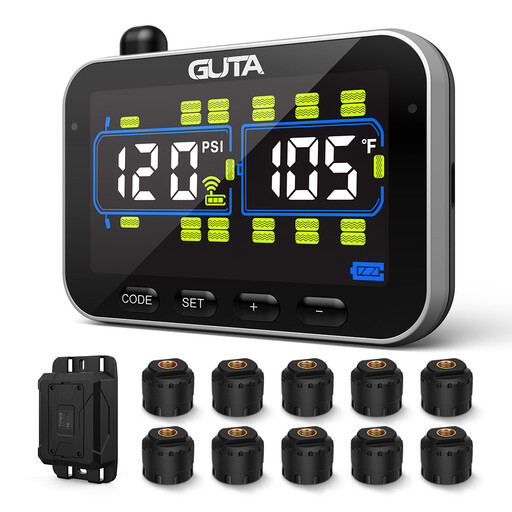
Why it stands out: This kit is an all-in-one solution for large vehicles or trailer combinations that require monitoring for up to 10 tyres and a high-pressure range.
Advantages:
Who it's for: Owners of large motorhomes, vehicle-trailer combinations, or fleet operators of light commercial vehicles who need reliable monitoring for many tyres.
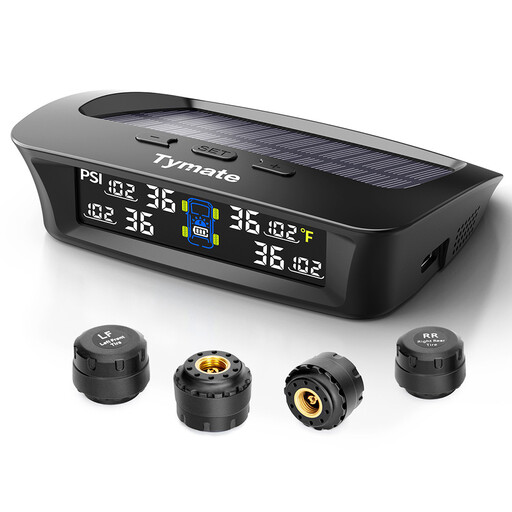
Why it stands out: A compact and easy-to-install system whose monitor can also be charged via a solar panel, reducing cockpit cable clutter.
Advantages:
Who it's for: Drivers of smaller motorhomes, camper vans, or SUVs looking for a straightforward base system to monitor four tyres without needing an extremely high-pressure range.
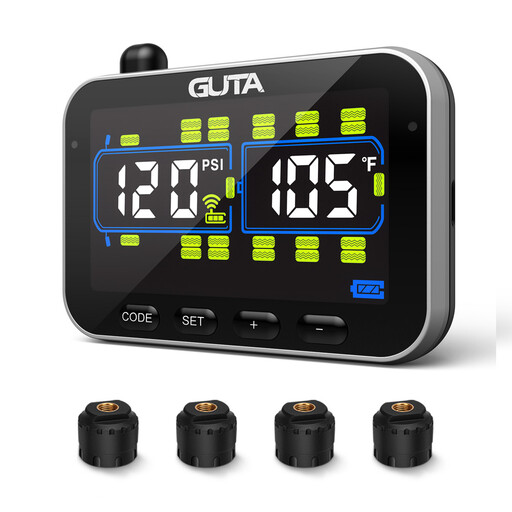
Why it stands out: This system combines the high-pressure range and large display of the 10-sensor model with a base configuration of four sensors, which can be expanded as needed.
Advantages:
Who it's for: Owners of motorhomes or light trucks who need a high-pressure range but initially only want to monitor four tyres. Its expandability makes it a future-proof option.
The products featured cover common use cases. If you are looking for more specific solutions or other accessories to enhance vehicle safety, you can find more products in our Safety Tape category.
1. Is retrofitting a TPMS on a motorhome complicated? No, installing systems with external sensors is generally straightforward. The sensors are screwed onto the tyre valve stems in place of the valve caps. The display unit is placed in the cockpit and connected to a power source. A trip to a workshop is not usually necessary.
2. Do I always need a repeater for my motorhome and trailer setup? For vehicle combinations (e.g., a motorhome with a trailer) or single vehicles over 8 metres long, a Tyre Pressure Monitoring System with a repeater is strongly recommended. It ensures that the wireless signals from the rear tyres reliably reach the monitor, even over long distances and with potential sources of interference.