
Lieferung heute & morgen

Qualitätsgarantie

Willkommens-Angebote freischalten: KOSTENLOSE Lieferung | Bis zu 80 % RABATT | Kostenlose 30-Tage-JoyPlus-Testphase
App herunterladen
An RV tyre pressure monitoring system can display pressure and temperature readings for several tyres while you’re on the move. But for motorhome owners, caravan drivers, trailer users and lorry operators, choosing the right system isn’t just about the number of sensors. Vehicle length, permitted tyre pressure, wireless signal and ongoing maintenance all matter.
A tyre pressure monitoring system with a wide measurement range isn’t automatically suitable for every tyre. First, check the information on the tyre sidewall, in the vehicle handbook and on the type plate. The permitted tyre pressure depends on the vehicle, axle load and tyres fitted.
The GUTA systems specify a range of 0 to 14 bar. The product information also gives figures of 188 and 203 PSI. As these figures don’t fully match, check the relevant unit and specific measurement range for your vehicle against the product page and tyre approvals before buying.
With a long vehicle and trailer combination, signals from the rear tyres need to reach the display. Bodywork, the trailer structure and the distance between the towing vehicle and trailer can all affect transmission. A tyre pressure monitoring system with a signal booster is therefore a practical option for longer vehicles, but it doesn’t remove the need for correct installation.
A set with four sensors is suitable for monitoring four tyres. For a twin-axle caravan, a trailer with a spare wheel or a multi-axle commercial vehicle, that may not be enough. So check the actual number of tyres you want to monitor. A TPMS with 4 to 10 sensors can accommodate different vehicle configurations; the system’s maximum capacity isn’t the same as the number of sensors included.
A good shortlist starts with two figures: the tyre pressure range and the temperature range. Motorhomes, caravans and lorries can run at higher pressures than many cars, so tyre pressure and temperature monitoring should be suitable for the tyres you use.
The GUTA models specify a temperature range of -40 to 105 °C. The Tymate model is rated from -20 to 85 °C and, according to the manufacturer’s information, is more suited to cars, SUVs and shorter vehicles. These figures are useful objective criteria when choosing a system, but they don’t guarantee that it will identify the specific cause of an unusual reading.
Check which alerts the system actually supports. Useful features include:
A tyre pressure warning system with an LCD display should clearly identify which tyre is affected. The GUTA sets are specified with six types of alert, a 78 × 44,5 mm colour display and automatic backlighting. According to the product description, alert thresholds are set relative to the calibrated average pressure: -15 % for low pressure and +25 % for high pressure.
External tyre pressure sensors screw onto the valve and can usually be fitted without a visit to a garage. Check that your valves are suitable. GUTA recommends metal valves in its product information. The sensors in the GUTA sets use CR2032 batteries, with a stated life of around four years. The Tymate system uses CR1632 batteries, with a stated life of around two years.
Battery life depends on factors including temperature, transmission intervals and usage. It’s worth keeping a spare battery in your travel kit. After fitting the sensors, also check that they and the valve caps are secure.
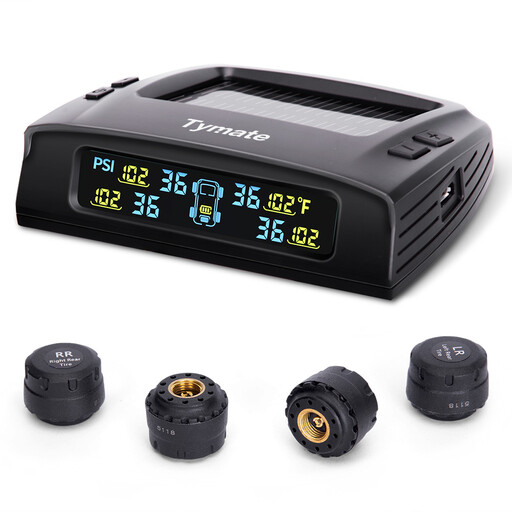
Why it suits this user: This set monitors four tyres and offers a compact solution for cars, SUVs and shorter motorhome or trailer configurations.
The stated measurement range of 0 to 8 bar makes it easier to assess whether the system is suitable for many cars. For higher pressures, check your vehicle’s specifications first.
Four sensors, colour LCD, automatic backlighting and stated pressure accuracy within 2 PSI.
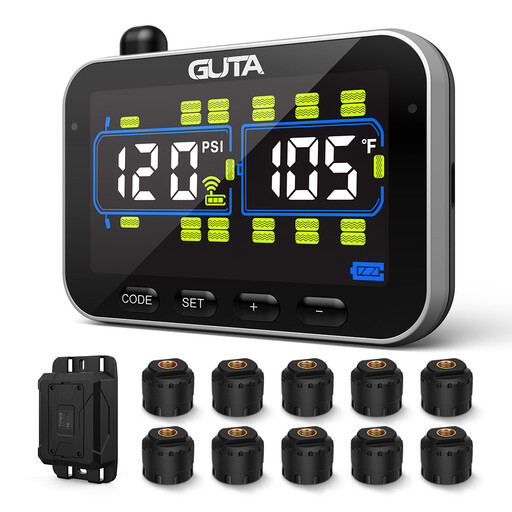
Why it suits this user: For anyone who wants to monitor several tyres on a long vehicle and trailer combination, and check pressure and temperature on a central display.
The ten included sensors reduce the risk of having too few monitoring points for multi-axle combinations. A signal booster is included.
433,92-MHz communication, signal booster, six types of alert and support for up to 24 tyres, according to the product description.
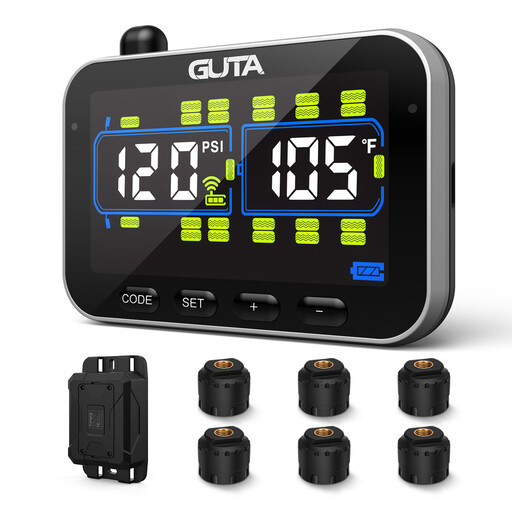
Why it suits this user: The six-sensor version is suited to anyone who wants to monitor a towing vehicle and trailer, or an additional axle.
With more sensors than a basic four-sensor set but fewer than a larger ten-sensor set, you can match the system more closely to the number of tyres you need to monitor.
0 to 14 bar according to the specifications, temperature display from -40 to 105 °C, 850-mAh display battery and signal booster.
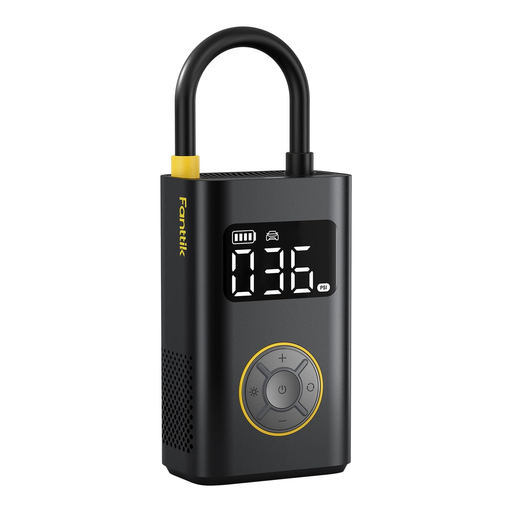
Why it suits this user: As a complement to tyre pressure monitoring, this electric inflator with a pressure gauge is designed for use on the go when a tyre needs adjusting.
The integrated digital pressure gauge and automatic shut-off mean you don’t have to keep checking the target pressure manually. However, the inflator isn’t a substitute for a TPMS.
Stated maximum pressure of 150 PSI, 7,4 V and 2,5 Ah battery, plus four preset modes and a manual setting.
We’ve put together a complete, regularly updated list of products that meet these strict selection criteria and fully comply with the safety regulations in force in the EU.
Before fitting the sensors, inflate all tyres to the pressure specified by the vehicle manufacturer. Then assign the sensors to their respective tyre positions. Pre-paired sets can be easier to set up, but it’s still worth checking that each reading corresponds to the correct tyre.
Also remember to:
A TPMS for a motorhome or trailer provides readings and alerts. It doesn’t replace visual checks or inspections of tread depth, valves and tyre age.
A four-sensor set may be enough for a single-axle caravan with four wheels to monitor. For a twin-axle caravan, a spare wheel or monitoring the towing vehicle as well, six, eight or ten sensors may be more suitable. What matters is what you want to monitor, not just the number of axles.
Stated battery life varies by model. The GUTA sets are listed with CR2032 sensor batteries lasting around four years, while the Tymate system’s CR1632 batteries are listed at around two years. Temperature and usage conditions can affect actual battery life. Include spare batteries in your regular maintenance plans.
Aside from the purchase price, the main costs are replacement batteries and, if needed, extra sensors. With external sensors, you can often replace the battery yourself. A portable tyre inflator doesn’t usually have running costs, but it needs a charged battery and should be stored somewhere dry and protected from temperature extremes.