
Lieferung heute & morgen

Qualitätsgarantie

Willkommens-Angebote freischalten: KOSTENLOSE Lieferung | Bis zu 80 % RABATT | Kostenlose 30-Tage-JoyPlus-Testphase
App herunterladen
An RV tyre pressure monitoring system monitors tyre pressure and temperature while you are driving. This can be particularly useful for motorhomes, caravans, trailers, SUVs and lorries, as additional axles and heavy loads make choosing and checking tyres more difficult. However, the key factor is not simply whether a product is labelled “TPMS”, but whether its technical specifications are suitable for your vehicle.
A TPMS designed for cars or SUVs may not be suitable for a caravan, articulated lorry or trailer. Commercial vehicle tyres sometimes operate at significantly higher pressures. If you choose a system with too narrow a measurement range, you may not receive usable readings.
For lighter vehicles, a range of up to around 116 PSI may be sufficient. For motorhomes with a high axle load, trailers or lorries, however, tyre pressure monitoring up to 188 PSI or beyond may be advisable, provided it matches the actual tyre specifications. The values stated on the tyre, vehicle and in the manufacturer’s documentation should always take priority.
A wireless system transmits sensor data by radio. However, the vehicle body, trailer, metal components and overall vehicle length can affect signal transmission between the sensor and display. A system that is sufficient for a car is therefore not automatically suitable for a long vehicle combination.
A repeater may be useful for a motorhome with a trailer or for a lorry. Buyers should also check the vehicle length for which the particular system is designed and whether the sensors can be assigned to the tyre positions in advance.
A tyre pressure warning system displays readings and triggers an alarm when certain thresholds are reached. It does not replace a visual inspection or regular checks of valves, tyre tread and damage. A sensor may also have a flat battery or provide inaccurate readings because it has been fitted incorrectly.
You should therefore look for specific information about pressure deviation, temperature range, sensor battery, alarm thresholds and maintenance. A low sensor voltage indicator is useful in everyday use because it signals when the battery needs to be replaced.
An TPMS for a motorhome or tyre pressure monitoring system for a caravan should cover the full recommended tyre pressure. Systems with four sensors are often suitable for a vehicle with four monitored tyres. For a caravan or trailer, you should be able to assign the sensor positions clearly.
Many devices calibrate the current tyre pressure as a reference. The product specifications provided here state relative alarm ranges of -15 per cent for low pressure and +25 per cent for high pressure. These figures should be understood as device functions and checked against the individual vehicle requirements.
A tyre pressure and temperature monitoring system can display the measured tyre temperature as well as pressure. This is relevant for long journeys, high outside temperatures and heavily loaded vehicles. Systems differ in their temperature ranges and in the high-temperature alarm setting.
An elevated reading is initially an indication that the tyre should be checked. Possible causes include incorrect inflation pressure, heavy loads, heat from the brakes or external conditions. This does not provide a remote diagnosis, nor does it have any medical or therapeutic benefit.
A TPMS with 4 sensors is sufficient for many cars, SUVs and smaller motorhomes. For lorries, articulated lorries, large motorhomes or vehicles with multiple axles, a TPMS with 10 sensors may be suitable. According to the product specifications, the GUTA system with ten sensors is designed for up to 24 tyres and includes a repeater.
You should also check:
External tyre pressure sensors for trailers can be easily attached to the valves. Before use, however, make sure they are firmly secured and protected against accidental loosening. Compatibility should be checked particularly carefully when using metal valves.
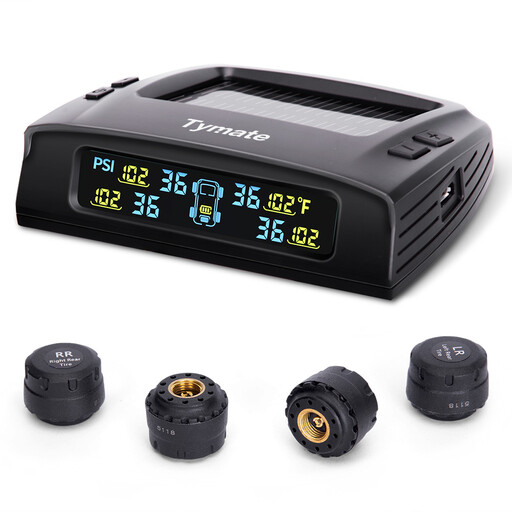
Why this product suits this profile: The system is designed for four tyres and a pressure range of 0–116 PSI, making it suitable for many cars, SUVs and smaller vehicles used for everyday driving and travelling.
The stated measurement range and vehicle length of up to 20 feet make the system’s operating limits clear. Pressure and temperature alarms, together with a low sensor voltage indicator, support continuous monitoring.
Four external sensors, colour LCD display, automatic sleep and wake-up function, and a temperature range of -20 to 85 °C.
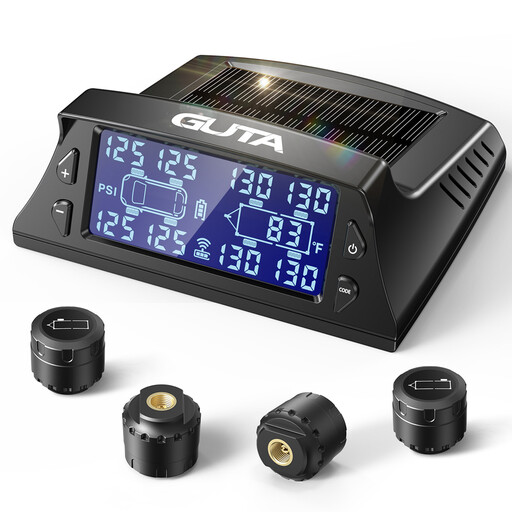
Why this product suits this profile: The measurement range up to 188 PSI also covers higher tyre pressures and is designed for motorhomes, trailers and semi-trucks.
The wider pressure range prevents an overly narrow selection based on car specifications. Automatic calibration, temperature monitoring and a low sensor voltage indicator make set-up and maintenance steps clear.
0–188 PSI, temperature monitoring from -20 to 105 °C, four CR2032 sensors and a stated sensor battery life of approximately four years.
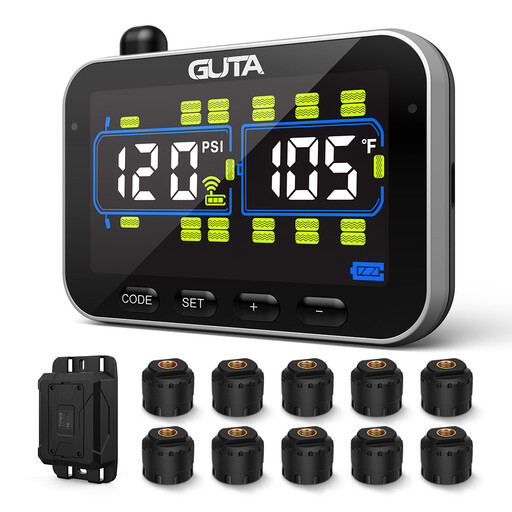
Why this product suits this profile: The combination of ten sensors, a repeater and support for up to 24 tyres is designed for long vehicles, lorries, articulated lorries and fleets with multiple monitored positions.
The number of sensors and the repeater address the signal and assignment challenges associated with long vehicles. Pre-labelled and paired sensors reduce the amount of manual set-up required.
0–188 PSI, six stated alarm types, repeater, ten sensors and a colour LCD display with adjustable orientation.
We have put together a complete, regularly updated list of products that fully meet these strict selection criteria and the safety regulations applicable in the EU.
Before installation, check the tyre pressure when the tyres are cold and record the position of each sensor. After screwing them on, check that the display assigns each sensor to the correct tyre. For a caravan, a short function test with the towing vehicle and trailer is recommended before setting off on a longer journey.
Ongoing costs mainly include:
The stated battery life is a guideline and depends on usage, temperature and radio activity. Check the sensor battery before longer journeys and replace it when prompted by a corresponding warning.
External sensors are generally screwed onto the valves. The sensor positions are then checked on the display and calibrated if necessary. For metal valves, special valve extensions or high pressures, compatibility should be clarified before purchase.
Their service life depends on the battery type, usage and environmental conditions. For the systems mentioned, CR1632 or CR2032 batteries are stated to last approximately two to four years, depending on the model. This is not a guaranteed period; a low sensor voltage warning should be acted on promptly.
Not every lorry needs ten sensors. The key factors are the number of tyre positions to be monitored, the vehicle length and the pressure range. For multiple axles, articulated lorries or fleets, a TPMS with 10 sensors and a repeater may be a more suitable configuration than a four-sensor system.