
Lieferung heute & morgen

Qualitätsgarantie

Willkommens-Angebote freischalten: KOSTENLOSE Lieferung | Bis zu 80 % RABATT | Kostenlose 30-Tage-JoyPlus-Testphase
App herunterladen
A children’s scooter can make everyday life more varied, both outdoors and indoors. At the same time, models differ considerably in terms of steering, number of wheels, weight capacity and adjustment options. If you focus only on colour, light-up wheels or a low price, it is easy to overlook important details.
Three common buying misconceptions are particularly widespread:
Motor skills develop very differently among children aged between 3 and 8. That is why a kick scooter for children should not be selected based solely on the stated age range. You should also check:
A 3-wheel children’s scooter often combines two front wheels with one rear wheel. On many models, direction is controlled by shifting body weight. This so-called lean-to-steer steering can be easier for younger children to understand than a freely turning handlebar. However, it does require a short familiarisation period.
A 4-wheel children’s scooter distributes the rider’s stance across four contact points. This can be practical when riding slowly or getting on. Nevertheless, parents should make sure that the scooter is not unnecessarily heavy and that the child can move the handlebar easily. The number of wheels alone is not objective proof that a scooter is suitable.
A height-adjustable children’s scooter can be used for longer if the handlebar offers several positions. The adjustment should lock securely and be checked before every ride. A handlebar that is too high or too low makes the scooter harder to control.
A children’s scooter with a seat is intended for children who would like to sit from time to time while riding. Check whether the seat is securely attached, how changing between sitting and standing works, and whether the construction can support the child’s weight according to the product information.
A wide standing area can make getting on easier. A non-slip surface and enough room for both feet are also important. With lean-to-steer steering, the handlebar is not turned sharply to the side; instead, body weight is used to change direction.
Before ordering, compare the product dimensions with the child’s height. If complete measurements are not provided, caution is advisable. A height-adjustable handlebar does not replace checking whether the size is suitable.
A foot brake should be easy to reach and operate smoothly. With an outdoor children’s scooter, wheel size and material are relevant because small wheels can transmit bumps more strongly. Braking distance may increase on wet surfaces.
Children’s scooters with light-up wheels often use integrated lights that are activated by the movement of the wheels while riding. This can improve visibility, but it should not be mistaken for full lighting suitable for road traffic. Children’s scooters should preferably be used on suitable, open areas and under supervision.
Look for clear German-language instructions, manufacturer or importer details, and a comprehensible age and weight specification. A CE marking is a legally required declaration of conformity by the manufacturer or importer for certain product requirements. It is not an independent quality mark and does not provide a blanket statement about quality.
The load capacity must match how the scooter will actually be used. A high number in the product description should not lead adults to use the children’s scooter as well, unless this is expressly intended.
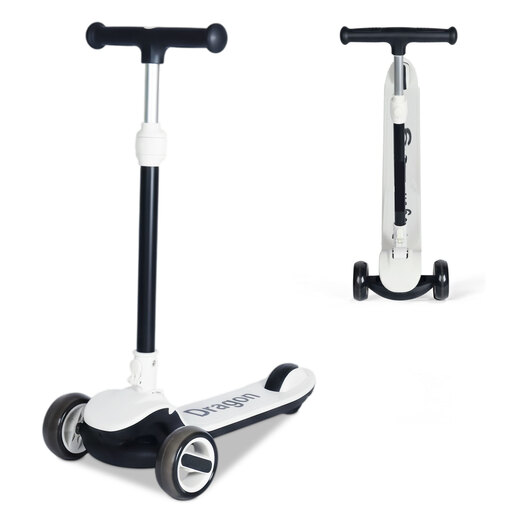
Why this product suits the profile: According to the product information, this model is intended for children aged 3 and over and combines a 3-wheel platform with an extra-wide deck. The stated weight limit is 30 kg.
The stated age and load limit help prevent overloading. The foot brake is listed as a specific control feature; light-up wheels should nevertheless be regarded as an additional feature only.
3-wheel platform, extra-wide deck, foot brake and light-up wheels according to the product information.

Why this product suits the profile: For families looking for several adjustment options, the product information lists four wheels, a swivelling seat, adjustable height settings and lean-to-steer steering.
The adjustable height allows for a more precise fit. Before buying, check the locking mechanism, seat changeover and actual dimensions instead of focusing solely on the high load capacity.
4 wheels, swivelling seat, height-adjustable construction and lean-to-steer steering according to the product information.

Why this product suits the profile: These features are aimed at families who want to use a children’s scooter regularly in different situations, such as in a courtyard, on paved paths or during short breaks when a seat is useful.
The combination of four wheels, a seat and adjustable height makes use more predictable. Check the attachments, handlebar and seat before every ride.
Four-wheel design, seat function, height adjustment and lean-to-steer steering according to the product information.
We have put together a complete, regularly updated list of products that fully meet these strict selection criteria and the safety regulations applicable in the EU.
The lifespan of a children’s scooter depends on the surface, frequency of use, storage and load. The following routines can help extend its service life:
A children’s scooter is generally not intended for use on public roads. Suitable, level and open areas help reduce the risk of accidents. Children should initially practise slowly, especially when using lean-to-steer steering.
For a scooter for children aged 3 and over, a suitable handlebar height, an easy-to-reach brake and controllable steering are important. A 3-wheel model with a wide standing area may be suitable for beginners. The manufacturer’s specifications and the child’s physical abilities remain decisive.
This depends on the maximum handlebar height, the load limit and the child’s growth. The adjustment should offer several positions that lock securely into place. If the child can only reach the handlebar with raised shoulders or the standing area becomes too small, the scooter is no longer suitable.
No. Light-up wheels are an additional feature. Design, brake, dimensions, load capacity and age-appropriate operation should come first when choosing a scooter. The colour can be selected independently for a scooter for girls and boys.