
Lieferung heute & morgen

Qualitätsgarantie

Willkommens-Angebote freischalten: KOSTENLOSE Lieferung | Bis zu 80 % RABATT | Kostenlose 30-Tage-JoyPlus-Testphase
App herunterladen
A wooden puzzle for babies from 12 months should not overwhelm little hands, while encouraging children to grasp, match and explore independently. At this age, traditional puzzles with lots of small pieces are generally unsuitable. Better options include one-piece peg puzzles, grasp puzzles with large knobs or simple shape sorters.
However, choosing the right product involves more than animal pictures and colours. Some products use the recommended age rather generously, while important details about the material, edges or piece size are missing. The following criteria can help parents, grandparents and other family members narrow down their options.
“From 12 months” does not mean that a child should use the toy without supervision. If a puzzle contains small, loose pieces, children under three are generally at risk of swallowing them. The manufacturer’s instructions, the actual size of the pieces and the recommendation for supervision should therefore always be considered together.
A suitable wooden peg puzzle from 1 year should have elements that are easy to grip. Large wooden knobs or sufficiently wide grip areas make it easier for children to pick up and insert the pieces.
A smooth finish alone says little about the overall construction. Before the first play session, check for splinters, sharp edges, cracks or loose knobs. Rounded shapes can reduce the risk of injury during normal use, but they do not replace regular checks.
Wood is not automatically FSC-certified or sourced transparently. If FSC wooden toys are important to you, look for an explicit certification statement. Care instructions are also important: many wooden puzzles should only be wiped clean and not soaked in water, as moisture can warp the material.
A grasp puzzle for babies should be designed so that a toddler can pick up the pieces with their whole hand or several fingers. Large handles are particularly useful when fine motor skills are still developing. With a classic animal peg puzzle, individual figures are placed directly into matching cut-outs. A toddler shape puzzle with a few clearly distinguishable shapes is generally easier to understand at first than a puzzle with lots of pieces.
Look for the following information:
Animal designs can support matching and naming objects in everyday situations. An animal puzzle for children is therefore suitable for shared play, where adults can introduce words such as “fox”, “lion” or “turtle”. However, the toy should not be marketed as having guaranteed developmental benefits. It simply provides an age-appropriate opportunity to practise grasping, matching and concentration through play.
A classic wooden motor-skills toy, such as a shape sorter, expands the play concept: the child matches shapes and colours to different openings. This makes it different from a simple peg puzzle and may appeal to families who want to offer several ways of grasping and sorting.
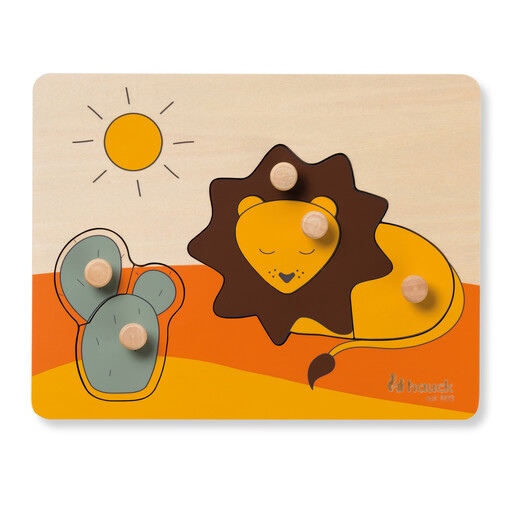
Why this product suits this profile: The animal design and the parts that can be assembled in several ways offer an accessible introduction to the world of puzzles. Practical wooden handles make the pieces easier to pick up.
The product information states that it is suitable from 12 months and features wooden handles and rounded edges. A visual inspection is still required before every use.
FSC-certified wood, lion design, wooden handles and dimensions of 22 × 17 × 1 cm according to the product information.
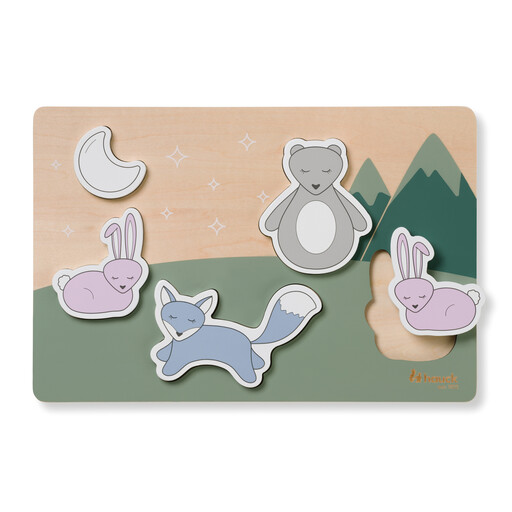
Why this product suits this profile: The larger board, measuring 30 × 20.5 × 2 cm, provides a stable play surface on the floor or table. The woodland theme features several animal shapes.
The details state that it is made from FSC-certified wood, with rounded edges and a recommended age from 12 months. Clean it without soaking, using a dry method.
FSC-certified wood, rounded edges, six pieces according to the specification and a weight of approximately 0.38 kg.
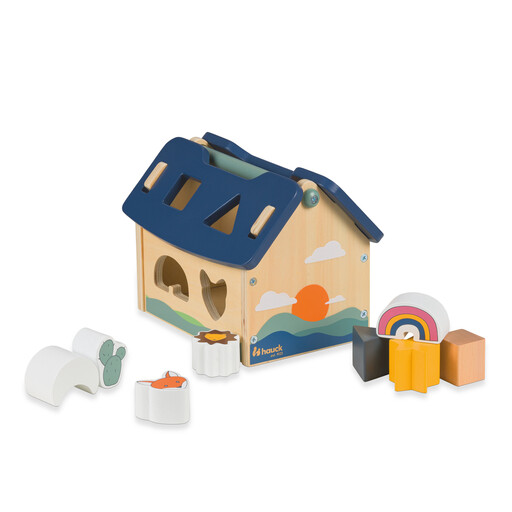
Why this product suits this profile: This shape sorter is an alternative to a traditional puzzle and offers several stages of play: matching shapes, stacking them and then taking them out again.
The eight blocks are stored inside the house, making individual pieces easier to find between play sessions. Check them for damage before use.
FSC-certified wood, eight shapes, a removable roof and a carry handle according to the product description.
We have put together a complete, regularly updated list of products that fully meet these strict selection criteria and the safety regulations applicable in the EU.
A wooden peg puzzle from 1 year, a grasp puzzle with large handles or a simple shape sorter are suitable for beginners. Look for a small number of clearly recognisable pieces, a sturdy baseboard and an explicit recommended age from 12 months. The child should be supervised closely while playing.
The lifespan depends on the quality of the construction, how often it is used and how well it is cared for. FSC-certified wood and rounded edges are objective product features, but they do not guarantee unlimited durability. Wipe the puzzle according to the manufacturer’s instructions, avoid prolonged contact with water and check the knobs, edges and surfaces before every use.
The price depends on factors including the type of wood, size, number of pieces, construction quality and brand. A higher price alone does not prove that a product is the right choice. Instead, compare the material information, dimensions, recommended age, handle design and safety details. This makes it easier to choose a Montessori puzzle or another wooden motor-skills toy based on its actual intended use.