
Lieferung heute & morgen

Qualitätsgarantie

Willkommens-Angebote freischalten: KOSTENLOSE Lieferung | Bis zu 80 % RABATT | Kostenlose 30-Tage-JoyPlus-Testphase
App herunterladen
When you’re out and about with a baby or toddler, you’ll often need two different solutions: pushchair reflectors to make you more visible in traffic, and a baby car rear-view mirror when your child is travelling rear-facing. Both types of product can make everyday life easier when you choose the right option and fit it correctly.
However, there are a few common pitfalls to watch out for when buying. Eye-catching advertising is no substitute for clear information about dimensions, attachment methods or materials. The following criteria can help you avoid unsuitable safety accessories for pushchairs and cars.
Reflectors with adhesive backing are quick to fit, but can come loose in damp or cold conditions, or if they’re removed frequently. If your pushchair has tubes of different diameters, it’s also important to check whether the attachment is flexible enough.
A mirror for an infant carrier or child seat must also be suitable for your car. A mirror designed for specific headrests may not be stable when used with a different seat model.
Reflective strips bounce light back towards its source, but they don’t produce light themselves. Pushchair reflectors are therefore no substitute for lights when visibility is very poor. When going for a walk at dusk, you should also check the legal requirements and the pushchair’s equipment.
When choosing a baby car rear-view mirror, size isn’t the only thing that matters. A mirror that’s too large or poorly positioned can affect your view behind you. Look for a stable attachment, a clear viewing angle and a material that won’t break into sharp-edged pieces if it cracks.
Before ordering, measure the diameter of your pushchair’s frame tubes. The Zamboo model is designed for tubes up to 3 cm thick. According to the product information, two reflectors can be fastened together for larger tubes.
Other useful features include:
The Zamboo set’s dimensions of 12 × 12 cm give you a clear idea of the visible area. However, how well the reflectors work still depends on their position, the light source, the weather and the surroundings. They shouldn’t hang loose or get in the way of any moving parts on the pushchair.
A rear-view mirror should only be fitted in a position where it won’t distract the driver. Take a quick glance using the existing interior rear-view mirror, and avoid turning around while driving.
Look for:
A rear-view mirror for children is an aid to keeping an eye on them, not a substitute for installing the child seat correctly. Before every journey, check the harness, the seat’s position and its attachment independently.
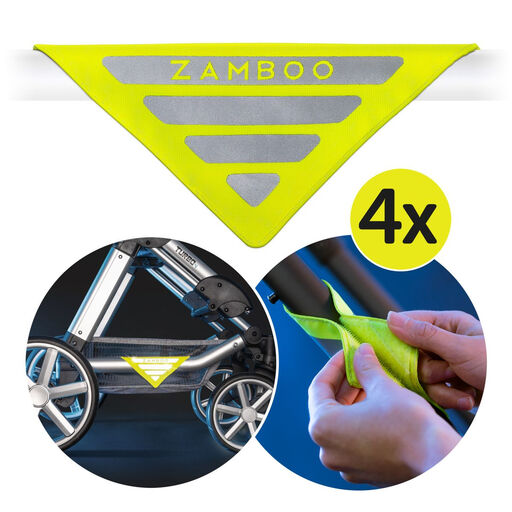
Why this product suits this profile: This set of four is a good choice for parents who want to make their pushchair visible from several sides using just a few accessories. The hook-and-loop fastening lets you fit and remove the reflectors repeatedly without leaving adhesive residue.
The fastening doesn’t rely on permanent adhesive. The stated suitability for tubes up to 3 cm thick makes it easier to check the fit before buying.
Four reflectors, a neon colour with silver strips, and machine washable at 30 °C, according to the product description.
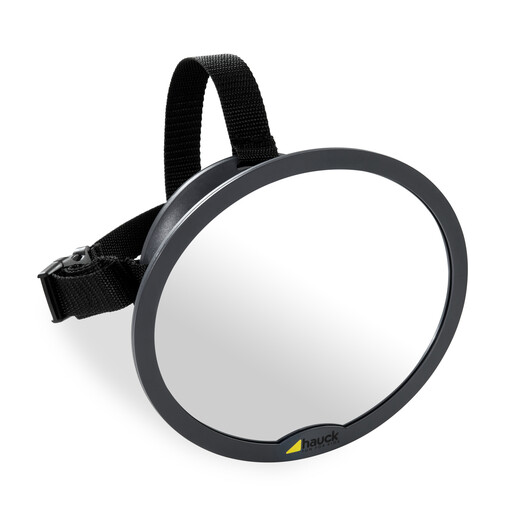
Why this product suits this profile: This model is designed for rear-facing infant carriers and child seats. Its four straps attach to the headrest and provide several fixing points.
The product information specifically states that it’s suitable for rear-facing seats. You can adjust the mirror horizontally and vertically.
Wide field of view and shatter-resistant material, according to the product description; model number 618370.
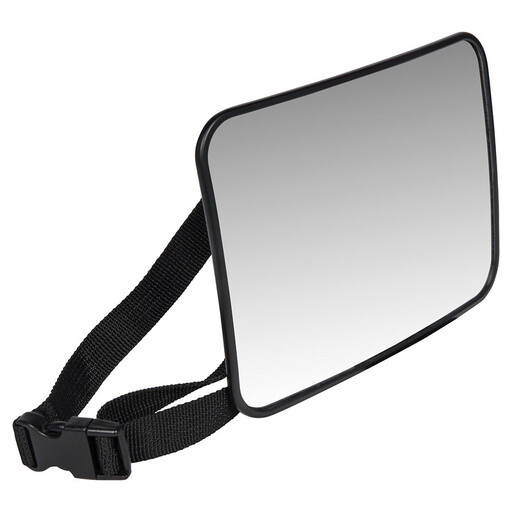
Why this product suits this profile: This compact rear-view mirror is a good option for parents looking for a space-saving way to keep an eye on their child while travelling with a rear-facing seat.
Its compact design takes up less space. Even so, before use, check that the mirror can be secured firmly to the seat and headrest you intend to use.
Measures 18,5 × 13,5 cm and is easy to attach, according to the product description.
We’ve put together a comprehensive, regularly updated list of products that meet these strict selection criteria and fully comply with the safety regulations in force in the EU.
Attach reflectors to stable, clearly visible parts of the frame. With hook-and-loop models, make sure the fastening is fully closed. After fitting them, check that no strap can come loose and that the brakes, wheels and folding mechanism can move freely.
There’s no set lifespan that applies to every reflector. It depends on exposure to UV light, dirt and moisture, as well as how often the reflectors are put on and taken off. Check the reflective surface and fastening regularly. Replace the product if it develops cracks, fades significantly or starts to lose its grip.
No. Suitability depends on the direction the seat faces, the headrest, the available attachment points and the distance to the mirror. Many models are specifically designed for rear-facing infant carriers or child seats. Before buying, check the manufacturer’s information against your car and child seat.