A family-sized portion in one go
You want to prepare the amount of salsa you’ve planned with as few batches as possible. Compare the bowl’s stated capacity with the filling guidance for the specific appliance.


For salsa to serve with a family meal, a larger chopper is an obvious choice if you mainly want to chop ingredients. A food processor may suit you better if you also regularly want to slice or grate. For chunky salsa, KitchenAid recommends using short pulses; Rommelsbacher says that holding the button down for longer produces a finer result with the MZ 400 and MZ 500. Don’t assume the bowl’s stated capacity is the same as the usable amount of salsa it can hold. Check the filling guidance for the specific model, and factor in storage and cleaning.
You want to prepare the amount of salsa you’ve planned with as few batches as possible. Compare the bowl’s stated capacity with the filling guidance for the specific appliance.
You want visible pieces of tomato and other ingredients, rather than a fine purée. KitchenAid recommends using the pulse function for a coarse result; Rommelsbacher says that holding the button down for longer produces a finer chop with the MZ 400 and MZ 500.
For busy family life, it matters which parts are removable and which the manufacturer says are dishwasher-safe. Check the cleaning instructions for the specific model and its accessories.
A good fit if: You mainly chop ingredients for salsa, dips and similar dishes.
The trade-off: A dedicated chopper offers fewer slicing and grating options than a food processor with the right accessories.
A good fit if: You regularly want to slice or grate vegetables as well as make salsa.
The trade-off: Extra discs and attachments take up storage space and need cleaning after use.
A good fit if: You tend to prepare small portions or individual ingredients and have limited worktop space.
The trade-off: You may need to work in several batches to prepare a larger family-sized portion.
When choosing a chopper for family-meal salsa, consider four things: portion size, how chunky you want it, cleaning and what else you do in the kitchen.
| Consideration | What to check when buying | Who is this important to? |
|---|---|---|
| Portion size and number of batches | Compare the bowl’s stated capacity with the filling guidance for the amount of ingredients you plan to use; stated capacity is not a guaranteed usable amount for salsa. | If I want to prepare a family-sized portion in as few batches as possible, I’ll check the capacity against the instructions. Portion size is the top buying consideration for around 36% of consumers. |
| Chunky or smooth consistency | Check whether the appliance has a pulse or momentary setting, and check how finely the ingredients are chopped between short bursts. | If I want the tomato pieces to remain visible, I want to control the chopping step by step. Around 29% of consumers put their preferred texture first. |
| Cleaning and food handling | Compare the removable parts and the manufacturer’s cleaning instructions. The German Federal Institute for Risk Assessment advises avoiding the transfer of germs between foods. | If I use the appliance often, I want to know how to clean the parts that come into contact with food. Easy cleaning is the top buying consideration for around 21% of consumers. |
| Other kitchen tasks | Check whether slicing and grating attachments are included and whether you’ll use them regularly. | If I often want to slice or grate vegetables as well as make salsa, extra functions may be useful. Around 14% of consumers put other kitchen tasks first. |
The manufacturer’s stated bowl capacity doesn’t tell you how much salsa the specific appliance can process at once.
Estimate the amount of ingredients you’ll use beforehand, then check the filling and usage guidance in the instructions for your chosen model.
You may need to prepare a larger portion in several batches.
According to Rommelsbacher, holding the button down for longer produces a finer chop with the MZ 400 and MZ 500. KitchenAid recommends using the pulse function for a coarse result.
Start with short pulses and check the consistency between bursts.
The Bosch MCM3PM38S comes with several discs and other attachments, as well as a universal blade.
Choose a food processor with extra functions if you’ll actually use it for slicing or grating.
More accessories also mean more parts to store and clean.
The MZ 500 is a larger chopper for chopping ingredients and making dips.
The HR1503/00 is a chopper with a glass bowl for making dips and sauces.
The MultiTalent 3 Plus MCM3PM38S combines chopping with other slicing and grating tasks.
The 5KFC3516EOB is a mini chopper for smaller quantities; the manufacturer lists salsa as one of its uses.
According to the manufacturer, the Easy Chop CHP61.100WH is designed for small quantities.
The Kult X Chopper Edition sits between mini appliances and larger choppers in terms of size.
The Joybuy products below are electric choppers described in the available product information as suitable for vegetables or sauces. They vary in features such as stated bowl capacity and available speed or pulse settings; check the filling guidance for each model.
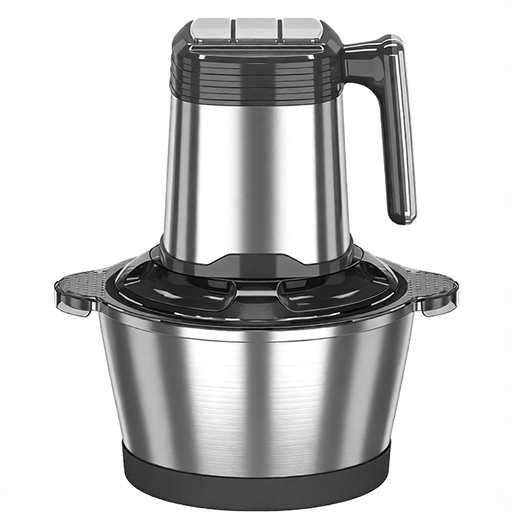 No image available
The product information lists vegetables and sauces among its uses.
Features include a 2-l stainless steel bowl, four blades and several speed settings. The removable accessories are described as dishwasher-safe.
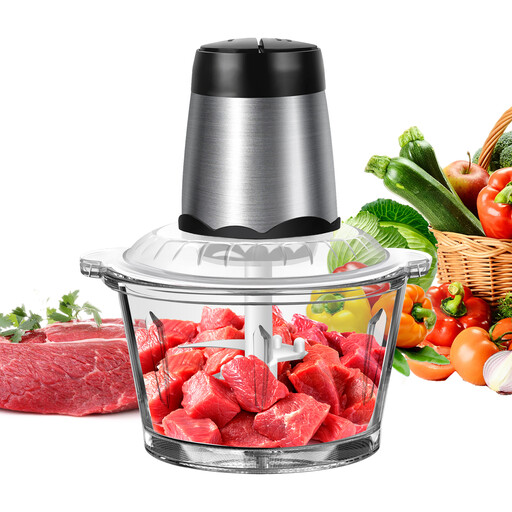 No image available
The product description lists vegetables and fruit among its uses.
Features include a 2-l glass bowl, two speed settings and a pulse function. Removable parts are described as dishwasher-safe.
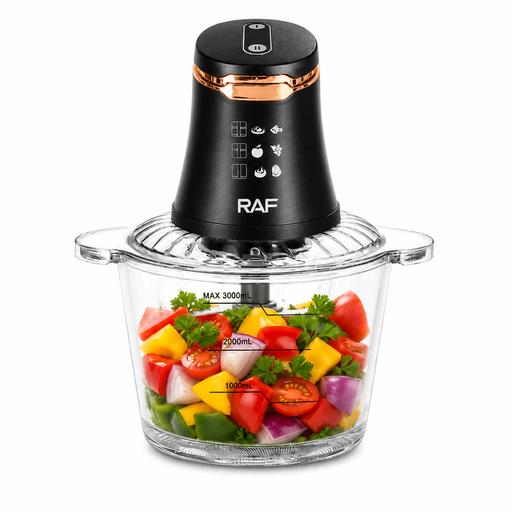 No image available
The appliance is described as suitable for chopping vegetables.
The product title lists a 3-l capacity and two speed settings. Bowl capacity doesn’t indicate the permitted amount of salsa; check the model’s usage guidance.
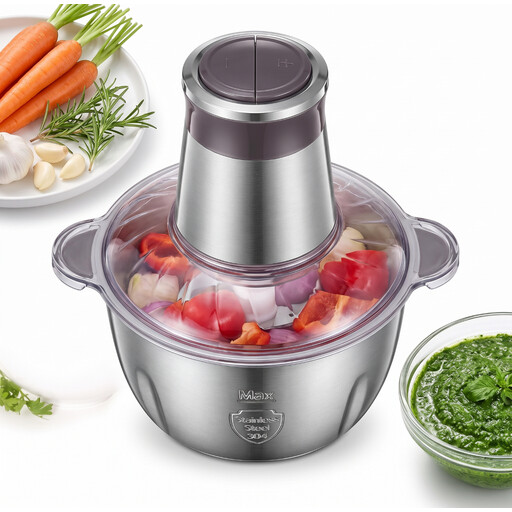 No image available
The product information lists vegetables among its uses.
The title lists 350 W, a 2,5-l stainless steel bowl and three blades. It also has two speed settings, a transparent lid and a dishwasher-safe bowl.
 No image available
The product description lists chopping vegetables and making sauces among its uses.
Features include three stackable 304 stainless steel bowls with capacities of 2,5 l, 2,2 l and 1,8 l, as well as two speed settings and pulse operation.
Process the ingredients in short pulses, checking the size of the pieces in between. KitchenAid recommends using the pulse function on the 5KFC3516EOB for a coarse result; Rommelsbacher says that holding the button down for longer produces a finer chop with the MZ 400 and MZ 500. The result also depends on the ingredients and quantity.
No. You can’t use the bowl’s stated capacity to work out the permitted filling amount for salsa. Check the instructions for the specific model against the portion you plan to make.
It depends on the amount of ingredients you plan to use and the model’s filling guidance. A mini chopper may suit small portions, but you may need several batches for a larger quantity. A larger appliance won’t necessarily be suitable either, as its stated capacity is not a guaranteed usable amount for salsa.
Clean the parts according to the instructions for the appliance. Rommelsbacher lists removable, dishwasher-safe parts for the MZ 500; the manufacturer says the bowl and blade of the Philips HR1503/00 are dishwasher-safe. The German Federal Institute for Risk Assessment recommends keeping chopped vegetable salads chilled until they are eaten and avoiding the transfer of germs between foods.
EU rules on food contact materials also cover food-processing appliances. For appliances that require CE marking, the manufacturer takes responsibility for confirming that the relevant requirements are met by applying the mark. The German Federal Network Agency notes that CE marking is not an independent quality seal for chopping performance.