Salt-conscious diners
You want to make a warm oat-based meal and know how much salt is in the base you choose. The salt per 100 g and the ingredients you add when preparing it are what matter most.


For a warm, salt-conscious dinner, you could choose oats or a porridge base if you want to decide on the ingredients and seasoning yourself. When comparing similar products, check the salt per 100 g. For protein porridge, also consider the protein content, ingredients and allergens in the specific variety.
You want to make a warm oat-based meal and know how much salt is in the base you choose. The salt per 100 g and the ingredients you add when preparing it are what matter most.
You want to choose the flavour and texture yourself rather than use a ready-made flavour mix. Oats or a porridge base designed for customising leave room for your own additions, whose nutritional values will then contribute to the finished meal.
The protein content of a warm meal is an important factor in your choice. If you opt for protein porridge, also check the salt content and ingredients in the specific variety, especially if you need to avoid certain allergens.
For a warm dinner, the main difference between these three options is how much the mix decides for you and which ingredients you can choose yourself.
A good choice if: you want to add your own ingredients to a prepared oat mix.
Bear in mind: “No added salt” does not tell you the exact salt content of every variety; the nutrition information is what counts.
A good choice if: protein content is a priority in your product choice.
Bear in mind: The added ingredients may include other allergens, and a high protein content does not tell you how much salt the product contains.
A good choice if: you want to choose the liquid, texture and savoury ingredients yourself.
Bear in mind: The salt content of the finished meal also depends on all the ingredients you add.
| Factor | What to check | Who it matters to |
|---|---|---|
| Salt content | Compare the salt per 100 g in similar products, and distinguish the nutritional value from claims such as “no added salt”. | I want a warm oat-based meal whose salt content I can check before seasoning. For around 40 % of consumers, comparing salt content comes first. |
| Room to customise | Check whether you’re buying oats, a base to customise yourself or a ready-made flavour mix. | In the evening, I want to decide for myself whether my porridge is savoury and what texture it has. This freedom is the most important consideration for around 30 % of consumers. |
| Protein and ingredients | Check the protein and salt per 100 g, as well as the ingredients list and allergen information for the specific variety. | If the protein content of my meal is particularly important to me, I still want to know what else is in the mix. Around 30 % of consumers put this first. |
These phrases do not mean the same thing. “No added salt” on its own does not tell you the exact salt content; a claim such as “less salt” also needs a clear basis for comparison.
Compare the salt per 100 g in similar products and check any salt claim against the nutrition table.
Product information shows different values: Kölln lists 0.04 g salt per 100 g for its fruit oat porridge; Seitenbacher lists 0.2 g salt and 30 g protein per 100 g for its strawberry protein porridge. This does not provide a general comparison between the two brands or all their varieties.
Always check the protein, salt and ingredients for the specific variety you’re planning to buy.
An oat base and protein porridge can contain different additional ingredients. For example, Seitenbacher lists milk protein and flaked almonds in its strawberry protein porridge.
Check the ingredients, highlighted allergens and any may-contain warnings on the current packaging.
Kölln offers a range of oat porridge varieties, as well as a base you can customise yourself.
Seitenbacher offers, among other products, wholegrain and protein porridge varieties.
Brüggen makes oat and cereal products, and includes oats and porridge in its product ranges.
This selection includes oats for making your own porridge and a porridge base for a warm dinner. Choose between different types of oats and a prepared mix, and check the information on the current packaging before deciding what else to add.
 Image unavailable
A good option if you want to make your own porridge with oats and choose the other ingredients yourself.
Pack size: 500 g. Check the salt and allergen information on the current packaging.
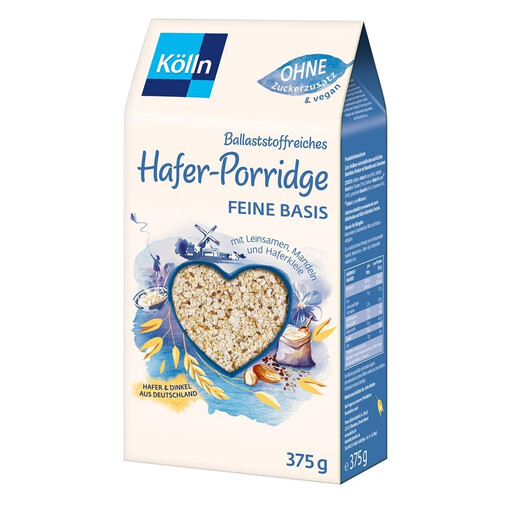 Image unavailable
This porridge mix is worth considering if you’d prefer a prepared base to individual oats.
Pack size: 375 g. Compare the salt and ingredients in this variety with other porridge products.
 Image unavailable
Fine rolled oats for anyone who wants to choose the liquid, seasoning and other ingredients in their warm porridge.
Pack size: 400 g. Check the nutrition information and allergen details on the packaging before buying.
 Image unavailable
These oats are an alternative to fine rolled oats if you want to choose the type of oats for your homemade porridge.
Pack size: 500 g. Choose your cooking method and other ingredients to suit the meal you want to make.
 Image unavailable
A fine rolled oat option for homemade porridge, with gluten-free labelling as one of the factors to consider.
Pack size: 500 g. If you need a gluten-free product, check the label and allergen information on the current packaging.
Compare the salt per 100 g in products with a similar use. If a product claims to have “less salt”, it also matters which product it is being compared with; “no added salt” does not replace the actual nutritional value.
No. On its own, the claim does not tell you the salt content of the specific variety. Kölln lists 0.04 g salt per 100 g for its fruit oat porridge. For other varieties, check their own nutrition tables and remember to account for the ingredients you add to your finished meal.
Yes. You can cook a warm oat porridge with oats and milk or another liquid. EDEKA describes stirring the oats into hot liquid and leaving them to swell. You can choose the savoury ingredients and seasoning yourself.
Always check the ingredients and allergen information for the specific variety. Seitenbacher lists milk protein and flaked almonds as ingredients in its strawberry protein porridge; other mixes may have a different composition.
If shown, the Nutri-Score can help you compare products within a similar product group. The Verbraucherzentrale recommends comparing products with a similar use. The salt content, ingredients and allergens are still important to check separately.