Self-caterers who are mindful of salt
You want to check the salt content of your breakfast on the packaging and take the rest of your holiday meals into account too.


For a salt-conscious breakfast, compare the salt content of the specific porridge mix per 100 g, before preparation. ‘No added salt’ does not mean that the nutrition table will show zero salt. For a holiday let, it’s also important to check whether you can prepare your chosen mix with the equipment available, and whether its ingredients and allergens meet your needs. The German Nutrition Society’s guideline of up to 6 g of table salt a day applies to your overall diet, not to one breakfast portion.
You want to check the salt content of your breakfast on the packaging and take the rest of your holiday meals into account too.
You’re looking for a preparation method that works with the bowl and liquid available, and possibly a kettle, without relying on a hob.
Protein content, a vegan recipe or particular allergens may matter to you. That’s why it’s worth checking the ingredients and information for each individual variety, alongside its salt content.
Start with the nutrition information on the specific pack. Then consider the preparation method and ingredients to decide whether the porridge suits your holiday let and your breakfast.
| What matters | What to check | Who it matters to |
|---|---|---|
| Salt content | Compare salt per 100 g using the same basis, preferably before preparation. Also consider the ingredients in your other meals. | If I want to keep an eye on salt at breakfast, I need a comparable figure from the label rather than a general claim on the front of the pack. For around 42% of shoppers, this comparison comes first. |
| Preparation | Read the instructions for the specific mix and check whether you have the liquid, bowl and any equipment you need. | Without reliable cooking facilities, I need to be able to make breakfast using what’s available in the holiday let. Around 33% of shoppers prioritise this practical consideration. |
| Ingredients and allergens | Check the ingredients list, declared allergens and precautionary statements for each variety individually. | If I need to avoid certain ingredients or follow a particular diet, the exact recipe determines what I choose. For around 25% of shoppers, this is the priority. |
Kölln describes its Hafer-Porridge Früchte as having no added salt, but the nutrition information still lists 0.04 g of salt per 100 g.
Compare the salt figure on the specific pack, using the same serving basis.
Seitenbacher Protein Porridge Himbeere lists 30 g of protein and 0.2 g of salt per 100 g, and contains milk protein. A focus on protein tells you nothing about the salt content or allergens.
Compare protein mixes with the base variety you’re considering, using their own nutrition information and ingredients lists.
Depending on the recipe, a product may contain almonds, gluten-containing cereals or milk protein. Other allergens may also be listed as possible traces.
Check the current label for each flavour, especially if you need to avoid particular ingredients.
Instructions that call for hot liquid are only useful if you can heat it where you’re staying. Milk or plant-based drinks may also need to be kept chilled.
Before you shop, check which appliances and utensils are available, then choose a preparation method to suit.
Kölln offers oat porridge in plain and fruit varieties.
The range includes products such as Bio Hafer Porridge Kakao.
According to the product page, REWE Bio Basis Porridge can be made with hot or cold liquid.
The Haferhimmel Porridge Beeren variety combines oats with a fruit recipe.
Alongside wholegrain porridge, Seitenbacher offers protein varieties.
Brüggen lists porridge among its products.
This selection includes a porridge and fine rolled oats that could work as the basis for a breakfast you put together yourself. Rolled oats aren’t the same as a ready-made porridge mix, so check the preparation instructions and current nutrition and ingredient information for each product.
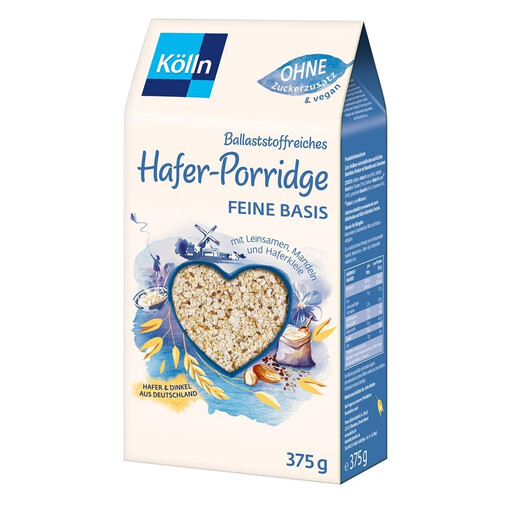 No image available
A porridge base for choosing the other ingredients in your breakfast yourself. Check the current pack carefully for allergen and precautionary information.
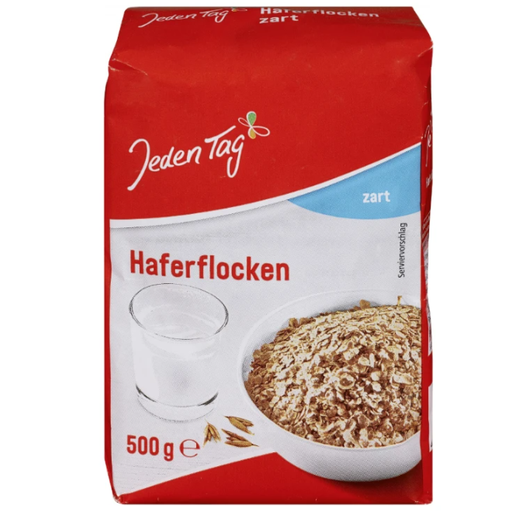 No image available
An oat base for making your own porridge from rolled oats. Choose a preparation method that suits the facilities in your holiday let, and check the pack for ingredient and allergen information.
 No image available
Fine rolled oats for anyone who wants to choose the ingredients in their oat-based meal. Before you travel, check what you can prepare with the kitchen facilities available.
 No image available
A finely rolled organic oat base for putting together your own breakfast. If you have allergies, pay particular attention to the current information on the pack.
Compare the salt figures per 100 g on the same basis, for example, the unprepared mix in each case. The figures for the varieties discussed here apply only to their specific recipes; you can’t assume that figures for one product apply to every product from the same brand.
No. Kölln describes its Hafer-Porridge Früchte as having no added salt, but lists 0.04 g of salt per 100 g. Check the nutrition information on the pack to compare quantities.
It’s possible with a mix designed for this. REWE says Bio Basis Porridge can be made with hot or cold liquid, while EDEKA24 says Herzstücke Haferhimmel Porridge Beeren can be made with water or milk. Check the instructions on your chosen pack and make sure you have the utensils you need.
No. Sugar, ingredients and allergens can vary between porridge recipes. Take these details and any extras you plan to add into account when choosing. The German Nutrition Society’s guideline of up to 6 g of table salt a day applies to your overall diet.