If an advertised reduction in fat matters to you when visiting the market, check the exact product variant and compare the nutrition information per 100 g too. According to Kaufland, Lorenz Saltletts Mini Pretzels with Sea Salt and Less Fat are sold with 30% less fat than conventional pretzels. A similar-looking fat value on classic salt pretzels, however, does not prove that their fat content has been reduced. Salt, ingredients and pack size are separate factors to consider when choosing what to buy.
Which pretzels are right for you?
For visitors looking to cut down on fat
You want a savoury snack to enjoy with mulled wine, with a clearly stated reduction in fat. Even so, check the fat, energy and salt per 100 g: a reduction claim does not tell you everything about a product’s nutritional value.
For visitors watching portion size
For a quick stroll around the market, you’d rather take a small bag than open a large pack. Lorenz says its Saltletts Mini Pretzels are also available in a 40 g on-the-go pack.
For buyers focused on ingredients and salt
You check the salt content, wheat and any possible traces of other allergens before buying. That’s still important with a reduced-fat variety; always check the information on the specific pack.
What to look for when buying
First decide what matters most to you: a clearly stated reduction in fat, the nutrition and ingredients information, or a handy pack size. Then compare similar salt pretzels using the same measure: per 100 g.
| Factor |
What to check |
Who it matters to |
| Advertised reduction in fat |
Check the exact product variant and what it is being compared with; also compare fat and energy per 100 g. |
I’m choosing salt pretzels specifically because their fat reduction is substantiated, not because they simply seem like a lighter option. This is the main consideration for around 36% of consumers. |
| Salt and ingredients |
Check salt and other nutritional values per 100 g, as well as the ingredients and allergen information on the pack. |
When choosing a savoury snack, I want to know what ingredients it contains and what its nutritional values are. This is the main buying consideration for around 29% of consumers. |
| Pack size |
Check the pack weight and packaging against the number of people you plan to share it with. |
For a stroll around the market, I only want to pack a manageable amount, rather than open a big bag. This is the first priority for around 21% of consumers. |
| Alternative variety |
Check the pack available in store if you’re considering classic or wholegrain pretzels instead of a reduced-fat variety. |
If my preferred variety isn’t available, I look for another product range with information that matches my priorities. This flexibility comes first for around 14% of consumers. |
Common buying misconceptions
-
Confusing “less fat” with an overall health rating
The claim relates to a comparison between products. On its own, it tells you neither how much energy or salt the pretzels contain nor whether the snack is healthy overall. The consumer advice centre Verbraucherzentrale recommends checking the nutrition table when you see claims like this.
Compare fat, energy and salt per 100 g with a similar salt pretzel, and check what the reduction claim refers to.
-
Overlooking salt content because of the fat figure
A reduction in fat does not automatically change the salt content. Lorenz Saltletts Mini Pretzels with Sea Salt and Less Fat are listed as containing 4,1 g of salt per 100 g; EDEKA lists 4,4 g per 100 g for GUT&GÜNSTIG Salt Pretzels.
Check the salt figure on the specific pack and think about how much you plan to eat.
-
Assuming online information applies to every pack
ALDI SÜD notes that SUNSNACKS Salt Pretzels may vary between suppliers, which can affect the nutritional information. EDEKA also advises checking the details on the specific pack of GUT&GÜNSTIG Salt Pretzels.
In store, check the pack size, nutrition information, ingredients and allergen details on the bag you’re actually buying.
Brands and product ranges to help you choose
The product ranges mentioned here have different strengths: an advertised reduction in fat, a classic multipack or wholegrain are not the same buying consideration.
Lorenz Saltletts
The Mini Pretzels with Sea Salt and Less Fat are an option if a specific reduction claim and a small pack to take with you matter.
- Kaufland states that this variety has 30% less fat than conventional pretzels; Lorenz also offers the Mini Pretzels in a 40 g on-the-go pack.
- This variety is listed as containing 7,3 g of fat and 4,1 g of salt per 100 g. It contains wheat and barley malt extract; check the pack for possible traces of other allergens.
GUT&GÜNSTIG (EDEKA)
Classic salt pretzels in a 250 g bag for buyers who value a standard pack size more than an advertised reduction in fat.
- EDEKA lists 7,2 g of fat, 408 kcal and 4,4 g of salt per 100 g.
- This variety contains wheat. EDEKA notes that it may contain traces of milk and advises that the information on the pack should be treated as definitive.
SUNSNACKS (ALDI SÜD)
Classic salt pretzels in a 250 g bag, not presented as a specifically reduced-fat variety.
- ALDI SÜD lists the product as containing 7,3 g of fat and 4,51 g of salt equivalent per 100 g.
- According to ALDI SÜD, different suppliers may affect the nutritional information. So check the current pack.
Alnatura
Wholegrain pretzels for buyers who prefer this type of product to a variety specifically labelled as reduced-fat.
- Alnatura states that its wholegrain pretzels contain 81% wholemeal wheat flour.
- The recipe contains wheat, barley malt extract, palm oil and 4% table salt. The wholegrain content does not prove that the fat or salt content has been reduced.
Products at Joybuy
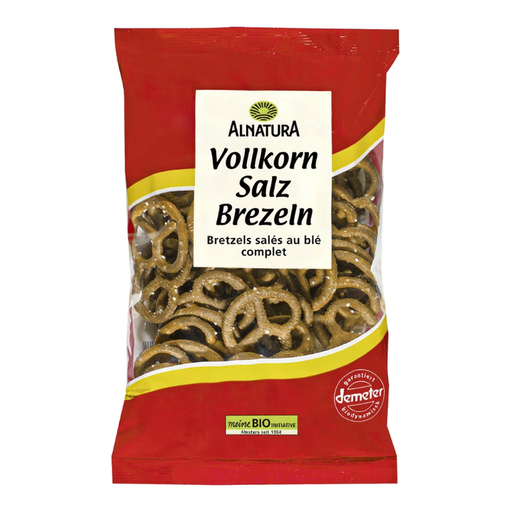
These wholegrain pretzels are an option for a visit to the market if the product type and a 125 g bag matter more to you than a specifically advertised reduction in fat.
 No image available
Alnatura Wholegrain Salted Pretzels, 125 g
This 125 g bag is a handy choice for a visit to the market if you’re looking for wholegrain pretzels rather than a variety specifically labelled as reduced-fat. Alnatura states that they contain 81% wholemeal wheat flour; wholegrain alone does not prove a reduction in fat. The recipe contains wheat and barley malt extract.
View at Joybuy
Frequently asked questions
Are salt pretzels labelled “30% less fat” automatically low in fat?
No. The claim made by Kaufland for Lorenz Saltletts Mini Pretzels with Sea Salt and Less Fat compares them with conventional pretzels; this variety is still listed as containing 7,3 g of fat per 100 g. Check the energy and salt figures in the nutrition table too.
What should I compare besides the fat content?
For salt pretzels, pay particular attention to salt, energy, ingredients and pack weight. Check the nutritional values per 100 g so that different pack sizes don’t skew the comparison.
Are the salt pretzels mentioned here gluten-free?
The Lorenz and GUT&GÜNSTIG varieties described here contain wheat; the Lorenz variety also contains barley malt extract. If you’re shopping for gluten-free products, check the relevant label on the specific pack rather than assuming it from the term “salt pretzels”.
How can I keep leftover pretzels crisp after visiting the market?
Seal the bag as tightly as possible after opening and store it somewhere dry and away from heat. If the pack doesn’t have a suitable seal, transfer the remaining pretzels to an airtight container.


