
Lieferung heute & morgen

Qualitätsgarantie

Willkommens-Angebote freischalten: KOSTENLOSE Lieferung | Bis zu 80 % RABATT | Kostenlose 30-Tage-JoyPlus-Testphase
App herunterladen
A salt and pepper mill is a staple in many home kitchens and quality-conscious households. It allows you to season food with salt, peppercorns or other spices directly at the hob or dining table. However, mills vary considerably in terms of their grinding mechanism, filling, cleaning and durability. An attractive casing alone says little about how practical a mill really is.
A pepper mill with adjustable grind size can adapt the texture to different dishes. However, what matters is how the adjustment mechanism is designed and whether it can change unintentionally while the mill is being turned. An imprecise setting can produce inconsistent results: pepper may remain too coarse for a sauce, while salt may be ground too finely for vegetables.
Before buying, check that the product clearly states whether the grind size can genuinely be adjusted and how the adjustment works. With a manual mill, it is also important that the turning mechanism feels comfortable and secure in your hand.
Pre-filled products are convenient for immediate use. However, some models have a grinding mechanism designed exclusively for the filling supplied. This applies, for example, to certain disposable mills containing salt or pepper. If you want to use the same mill over the long term, look specifically for the term “refillable”.
A refillable salt mill needs a sufficiently wide opening and a closure that can be removed without causing damage. With a salt and pepper mill set, each mill should also be clearly suitable for its respective filling.
Salt absorbs moisture more easily when stored in damp conditions and can form clumps. This is particularly true of coarse crystals such as sea salt or Himalayan salt. Although a transparent container shows the fill level, it does not automatically protect the contents from humid kitchen air. A securely closing casing, dry storage and suitable cleaning are therefore important selection criteria.
The grinding mechanism determines which spices can be processed and how evenly they are ground. A spice mill with a ceramic grinding mechanism is often used for salt, as ceramic does not react with moisture containing salt in the same way as certain metals. Nevertheless, the product description should clearly state whether the mechanism is designed for salt, pepper or both types of spice.
For a peppercorn mill, it is essential that the chamber and mechanism can accommodate whole peppercorns. With a mill for coarse sea salt or Himalayan salt crystals, the crystal size should match the manufacturer’s specifications. A manual salt grinding mechanism is ideal for households that want to work without batteries and control the amount directly through the turning motion.
An adjustable grind size is particularly useful if one mill is used for a variety of dishes. Fine textures are suitable, for example, for salad dressings or soups, while coarser pieces work well for many table applications. The adjustment should be easy to access without having to take the entire casing apart.
You should also look for:
Glass makes the fill level visible, but it can break and should not be put in the dishwasher unless this is expressly permitted. Bamboo creates a warm, homely look and is lightweight, but it requires dry cleaning and should not be soaked in water. Acrylic or plastic is lightweight and transparent; here, you should check the material used for the parts that come into contact with the product.
A height of around 14 to 18 centimetres is easy for many hands to handle. Taller models can hold more, but need to stand securely. Slim designs save space on the dining table, while a larger capacity in the kitchen can reduce the frequency of refilling.
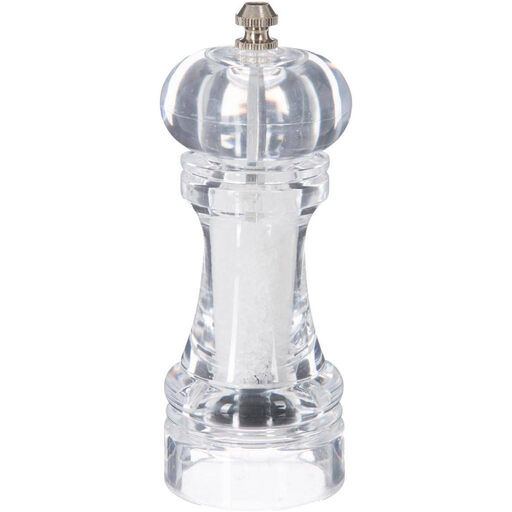
Why this product suits this profile: This 15 cm-high manual mill is designed for salt, pepper and other spices. The transparent casing makes the fill level visible, while the adjustable grind size lets you customise the texture.
The product details specify manual operation, an adjustable grind setting and suitability for several spices. Care instructions recommend using a damp cloth rather than harsh cleaning products.
15 cm height, a 5 × 5 cm base, a weight of 200 g and a visible fill level. The grinding mechanism contains ceramic and stainless steel, among other materials.
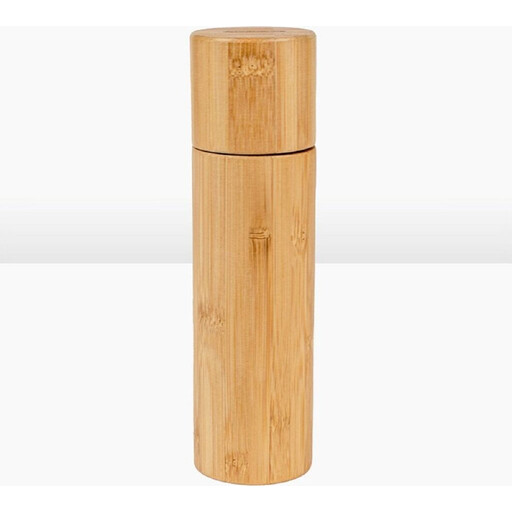
Why this product suits this profile: This 18 cm-high bamboo model is designed for use in the kitchen and at the dining table. It can be filled with salt, pepper or spices and is operated using a turning mechanism.
The care instructions rule out soaking and dishwasher use. Cleaning the bamboo with a dry cloth and then allowing it to dry completely meets the material requirements.
Bamboo casing, 18 cm height and a stated base of 5 × 5 cm. The mill is designed to be filled with different spices.
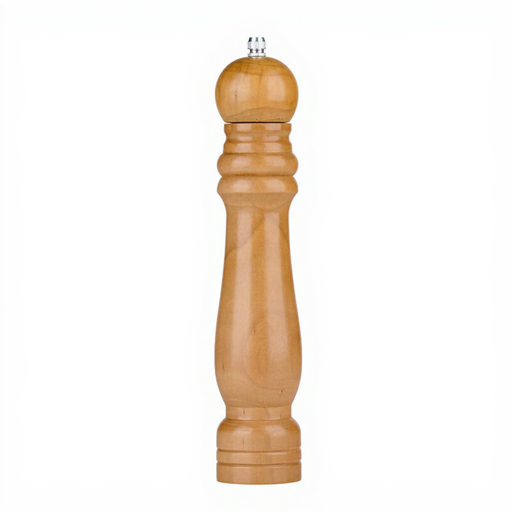
Why this product suits this profile: This set of two mills, each 25 cm high, is designed for households that want to store salt and pepper separately and use them regularly at the table or in the kitchen.
The separate containers prevent peppercorns and salt crystals from mixing. According to the product description, the grind can be adjusted from fine to coarse.
Two mills, 25 cm height and adjustable grind size. Designed for whole peppercorns and salt crystals.
We have put together a complete, regularly updated list of products that fully meet these strict selection criteria and the safety regulations applicable in the EU.
If you want to get started without refilling the mill separately, Kotányi offers pre-filled options. The Kotányi Iodized Sea Salt Mill 92g contains 92 g of iodised sea salt and has a ceramic grinding mechanism. The glass casing is approximately 14.5 cm high and, according to the product details, is not designed to be refilled.
The Kotányi Pink Himalayan Salt Mill 88g contains 88 g of pink Himalayan salt and also features a ceramic grinding mechanism. Both models should be stored in a dry place and cleaned with a damp cloth. Glass containers require careful handling.
For pepper, you can choose between the Kotányi Black Peppercorns Grinder Mill 36g and the Kotányi Colourful Peppercorns Grinder Mill 35g. They contain whole black or mixed peppercorns and are equipped with a ceramic grinding mechanism and light-protective glass casing. According to the product description, these mills are not refillable either.
A Himalayan salt mill should be explicitly suitable for coarse salt crystals. A ceramic grinding mechanism and dry storage are practical selection criteria. With pre-filled models, you should also check whether they are refillable.
The casing is generally wiped with a slightly damp cloth and then dried. Water, harsh cleaning products and the dishwasher can damage wooden, glass or mechanical parts unless the manufacturer expressly permits their use. Salt residue should not be rinsed away with water, as moisture can encourage clumping.
Its lifespan depends on the grinding mechanism, filling, frequency of use and care. The right type of spice, dry storage and gentle cleaning are particularly important. With disposable mills, use ends when the pre-filled contents have run out; refillable models can be used for longer with suitable care.