What should you look for when buying?
If you’re looking for long-life salted pretzels to keep in your cupboard, first decide what matters most to you: calories, salt, ingredients or a pack size that suits you. You can then compare the nutritional information on the same basis.
| What to consider |
What to check |
Who is it relevant to? |
| Calories and snack portion |
Compare the kcal per 100 g and check the pack weight against the portion you plan to eat. |
If I want to spread a pack over several snacks, I need to distinguish between the value per 100 g and the amount I actually eat. For around 33% of shoppers, calories would be the top priority. |
| Salt content |
Check the grams of salt per 100 g; don’t use the visible salt topping as a guide. |
If I also eat other salty foods, I want to be able to gauge how much salt the pretzels add to my diet. For around 33% of shoppers, salt would be the main buying consideration. |
| Ingredients and allergens |
Read the ingredients list, allergen information and, where relevant, any may-contain warnings for the variety you’ve chosen. |
If I need to avoid certain ingredients, the label on the specific pretzels determines which ones I choose. This would be the most important factor for around 17% of shoppers. |
| Stocking up and pack size |
Check the pack size, storage instructions and availability at your preferred store. |
For my cupboard, I need a pack size that suits how much I eat and can be stored as directed on the packaging. Around 17% of shoppers would consider this first. |
Salted pretzels at Joybuy
These two packaged Alnatura pretzels could both be suitable for keeping in your snack cupboard. To make a calorie-conscious choice, compare their current nutritional information and the amount you plan to eat before buying. Wholemeal or spelt ingredients alone don’t mean a product has fewer calories.
 No image available
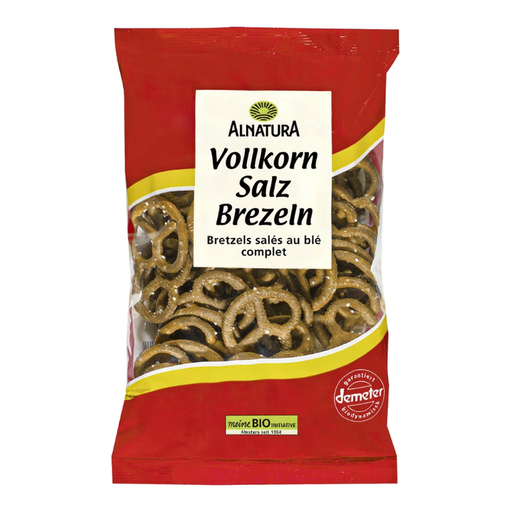
Alnatura organic wholemeal salted pretzels, 125 g
An option for your pretzel cupboard if you’re specifically looking for wholemeal salted pretzels.
Pack size: 125 g. To compare with your snack portion, check the current nutritional information per 100 g on the packaging.
View at Joybuy
 No image available
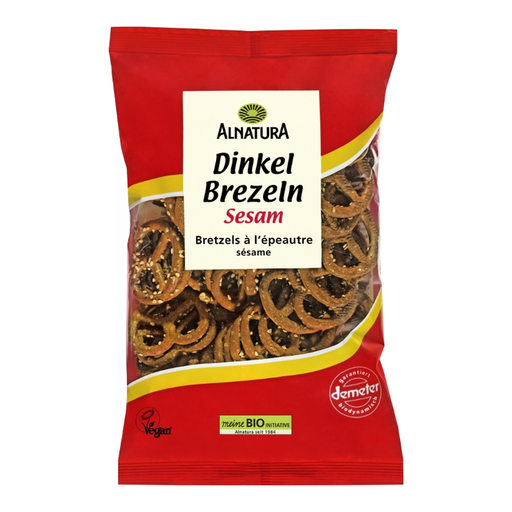
Alnatura organic spelt pretzels with sesame, 125 g
An option for your pretzel cupboard if you’re looking for spelt pretzels with sesame.
Pack size: 125 g. If you need to avoid certain ingredients, check the current ingredients list and allergen information, and compare the nutritional information per 100 g.
View at Joybuy
Frequently asked questions
How do I compare the calories in different salted pretzels?
First compare the kcal per 100 g, then take into account how much you plan to eat as a snack. A smaller pack can make portioning easier, but it doesn’t automatically mean its contents have fewer calories per 100 g.
Do pretzels without a salt topping have fewer calories?
You can’t tell from the lack of a salt topping. According to dm, its spelt pretzels without salt topping contain 421 kcal and 2.7 g of salt per 100 g, while the gluten-free dmBio Mini Salt Pretzels contain 380 kcal and 3.7 g of salt per 100 g.
Are gluten-free salted pretzels lower in calories?
Not necessarily: dm lists 380 kcal per 100 g for its gluten-free dmBio Mini Salt Pretzels and 482 kcal per 100 g for Schär Salinis, which are also gluten-free. The gluten-free label and calorie content answer different buying questions.
Where can I check allergens in salted pretzels?
Check the current ingredients list and allergen information for the specific product. Lebensmittelklarheit, run by the Federation of German Consumer Organisations, explains the labelling of the 14 most common allergens; a may-contain warning should be distinguished from ingredients that have been deliberately added.
How should I store pretzels for my snack cupboard?
Follow the storage instructions on the pack. For the dmBio spelt pretzels featured here, dm recommends storing them in a dry place away from heat; when you buy them, also check the best-before date on the pack you’ve chosen.


