
Lieferung heute & morgen

Qualitätsgarantie

Willkommens-Angebote freischalten: KOSTENLOSE Lieferung | Bis zu 80 % RABATT | Kostenlose 30-Tage-JoyPlus-Testphase
App herunterladen
When sanding furniture, smoothing wood or removing paint and rust, the result is not determined by motor power alone. Unnecessary costs often arise when the sander, sandpaper and surface are not suited to one another. Choosing the right combination of tool, grit and dust extraction makes it easier to plan the work and helps prevent damage to materials.
A high speed may sound convincing at first, but it is not automatically an advantage when working in tight corners or on delicate edges. Removing material too aggressively can create dips, burn marks or uneven transitions. For detailed work on furniture, frames and mouldings, a compact delta sander or detail sander is often easier to control.
Coarse-grit sandpaper removes material quickly but leaves visible sanding marks. Fine paper smooths surfaces, but is often too slow for thick layers of paint or rust. A sandpaper set with several grits is therefore more practical than a single sheet.
Fine sanding dust settles on the workpiece, tool and work surface. Additional protective measures may be necessary when working on painted or metal surfaces. Integrated dust extraction, a dust bag or a vacuum cleaner adapter reduces the spread of particles, but does not replace personal respiratory and eye protection.
A wood electric sander with a triangular base plate can reach corners and narrow areas more effectively than a large orbital sander. For sanding larger pieces of furniture, however, a sufficiently large sanding surface saves time.
A mini rotary tool is suitable for very small areas, engraving, drilling, polishing and deburring. The accessory chuck size must be checked. A tool with a 2.3 mm chuck is not automatically compatible with all commonly available attachments.
The grit indicates the size of the abrasive particles. As a practical guide:
When working with delicate wood, first test the paper on an inconspicuous area to see how aggressively it removes material. For sandpaper for wood and metal, it is also important to check whether the backing material is designed for hand sanding or machine use.
Hook-and-loop sanding sheets allow for quick changes, but must match the shape and hole pattern of the sanding plate. With a triangular plate, dimensions such as 105 × 152 mm are relevant. If the extraction holes do not line up, dust collection may be less effective.
Sandpaper rolls are more flexible: they can be cut to size, folded or used for various hand-sanding tasks. Before buying, compare the width, length and suitability for the sander in question.
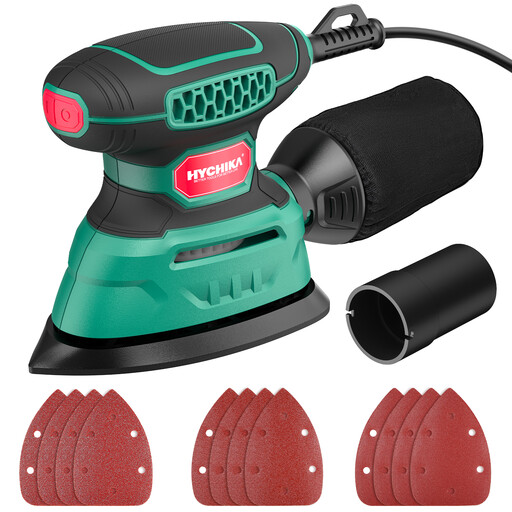
Why this product suits this profile: This compact delta sander is designed for smaller wood, metal and plastic surfaces, as well as tight areas. The package includes three grits for different stages of the job.
The choice of P80, P120 and P240 helps prevent relying solely on an unsuitable grit. According to the product details, a dust bag and vacuum cleaner adapter are included.
140 W motor, 13,000 OPM, ergonomic grip area and hook-and-loop fastening for quick sheet changes.
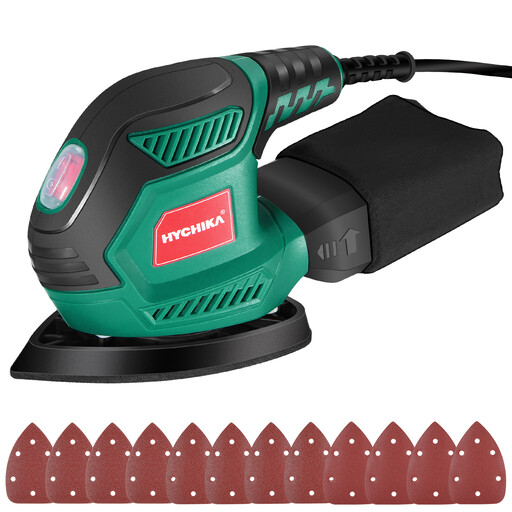
Why this product suits this profile: This model is aimed at users who value controlled work and integrated dust collection when working on furniture, corners and smaller metal surfaces.
The 6-hole base plate is designed for dust collection. The three included grits allow you to work progressively from material removal through to smoothing.
200 W motor, stated speed of 14,000 RPM, soft-grip handle and hook-and-loop sanding sheets in P80, P120 and P240.
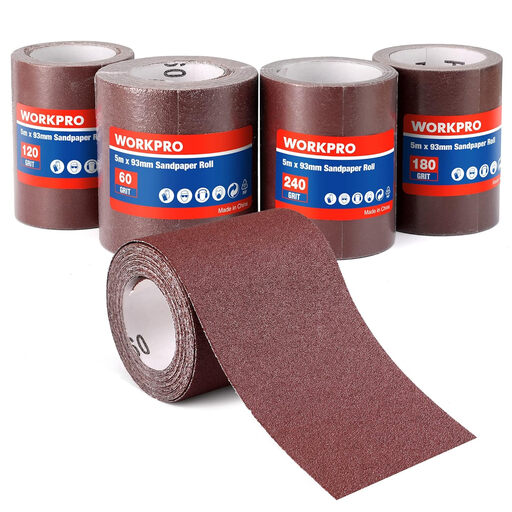
Why this product suits this profile: The rolls can be cut to size for hand sanding or use with compatible hand-held or random orbital sanders. This is practical when working on different surfaces and materials.
The four clearly marked grits – 60, 120, 180 and 240 – make selection easier. Before cutting, check the width and length against the sanding plate.
Four rolls, each 5 m long and 93 mm wide, with aluminium oxide abrasive grain according to the product details.
Start with the lowest grit that makes sense and only move to a finer grade once coarse scratches or old coatings have been removed. Move the tool across the surface without applying heavy pressure. The motor and abrasive should do the material removal.
With triangular plates, the holes in the triangular sanding paper should line up as closely as possible with the extraction system. If the sheet becomes clogged with paint or wood residue, sanding performance decreases. Replacing it promptly is usually more effective than applying extra pressure with a clogged sheet.
Good ventilation, safety goggles and suitable respiratory protection are important when working on painted surfaces. For metalwork, also check whether sparks may be produced and whether there are flammable materials nearby.
We have put together a complete, regularly updated list of products that fully meet these strict selection criteria and the safety regulations applicable in the EU.
Grit 40 to 80 may be suitable for the initial removal of old paint. P100 to P120 is often used for intermediate sanding, while P180 to P240 provides a smoother surface for preparation. The right grade depends on the thickness of the paint, the type of wood and the desired surface finish.
Its lifespan depends on the material, pressure applied, dust extraction and contamination. A sheet may last considerably longer on wood than when removing stubborn paint or rust. Replace the paper as soon as the abrasive grain is visibly worn or the sheet becomes clogged.
Power consumption is given in watts. A 140 or 200 W tool uses correspondingly less electrical power during operation than a significantly more powerful model. Running costs depend primarily on how long the tool is used and your electricity tariff. With a cordless rotary tool, charging frequency is an additional factor.