
Lieferung heute & morgen

Qualitätsgarantie

Willkommens-Angebote freischalten: KOSTENLOSE Lieferung | Bis zu 80 % RABATT | Kostenlose 30-Tage-JoyPlus-Testphase
App herunterladen
Whether you are sanding wood, removing paint and rust, preparing walls or polishing car paintwork, sanders and polishers differ considerably in their design, speed, power supply and accessories. A high wattage alone says little about whether a tool is suitable for your application.
If you focus only on marketing claims, you can easily end up with a tool that has an unsuitable sanding pad, short battery life or inadequate dust extraction. The following criteria will help you compare models objectively and avoid common buying mistakes.
A high speed can be useful for small, detailed tasks. However, when polishing car paintwork or working on sensitive materials, it can generate too much heat. What matters is whether the speed can be adjusted and which applications the manufacturer specifies for that range.
For sanders, speed is often given in OPM, meaning oscillations per minute. Polishers generally use revolutions per minute, abbreviated to RPM. These two values cannot be compared directly.
A sandpaper set with many grits is only practical if the shape, hole pattern and size match the backing plate. For example, you may need 125-mm sanding discs, triangular sanding sheets or sheets measuring 93 × 185 mm. You should therefore check the dimensions and attachment method before buying.
Hook-and-loop fastenings allow for quick changes. Clamp attachments, on the other hand, can be more flexible if you want to cut sandpaper to size yourself.
A dust box reduces visible dust, but it does not automatically replace external extraction. Check the number and position of the extraction holes, as well as whether there is a suitable adapter for your vacuum cleaner. Particularly when sanding wood, working on drywall and removing old paint, suitable respiratory and eye protection is also essential.
For corded tools, wattage and speed are important comparison points. For example, a HYCHIKA detail sander with 140 W and 13,000 OPM is designed for smaller sanding areas. According to the product information, another HYCHIKA model operates at 200 W and 14,000 OPM.
For cordless tools, you should consider voltage, battery capacity and runtime together. A specification of 12 V or 2.0 Ah alone does not describe the actual working time. Replaceable batteries can be more practical for longer projects, while integrated batteries require fewer separate parts.
The grit determines the rate of material removal:
Different abrasives may be required for metal, wood, plastic or painted surfaces. Aluminium oxide abrasives are common in many sandpaper sets and sanding discs. The workpiece should be securely fixed in place; damaged sanding sheets or discs should not be used.
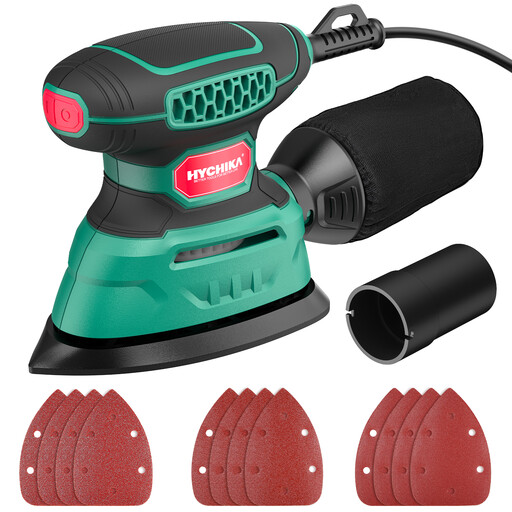
Why this product suits this profile: This compact detail sander is designed for smaller woodworking projects, corners, and removing paint and rust from suitable surfaces.
The specifications list 140 W, 13,000 OPM, six extraction holes, a dust bag and a vacuum cleaner adapter. This makes it possible to check the relevant performance and extraction details before buying.
Three grits with a total of 12 sanding sheets, plus hook-and-loop fastening for quick sheet changes.
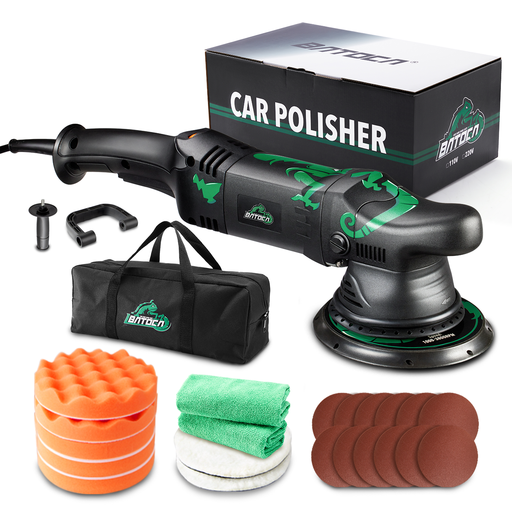
Why this product suits this profile: This corded car polisher is aimed at users planning vehicle care with adjustable speed and a 125-mm backing plate.
Six speed settings from 2,500 to 5,500 RPM allow adjustment for waxing, polishing and other applications specified by the manufacturer.
1100-W motor, D-handle and removable side handle; compatible foam pads are listed as included in the set.
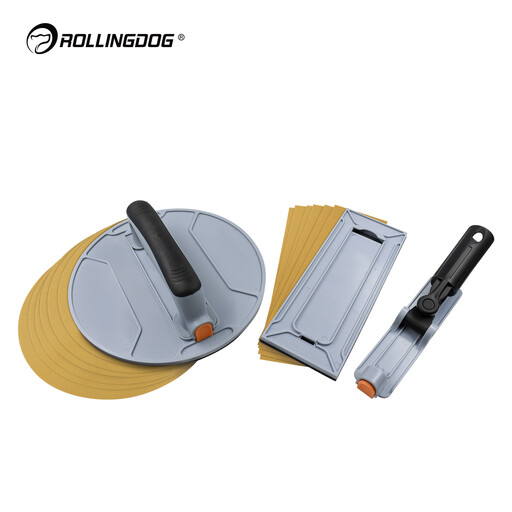
Why this product suits this profile: This set is designed for renovators and tradespeople who manually work on walls, ceilings, edges and larger drywall areas.
Two sanding heads measuring 220 mm and 225 × 85 mm respectively cover large areas and more precise edge sections. A removable handle supports use with an extension pole.
16-piece set with 12 aluminium oxide sanding sheets in grits 80, 120 and 240.
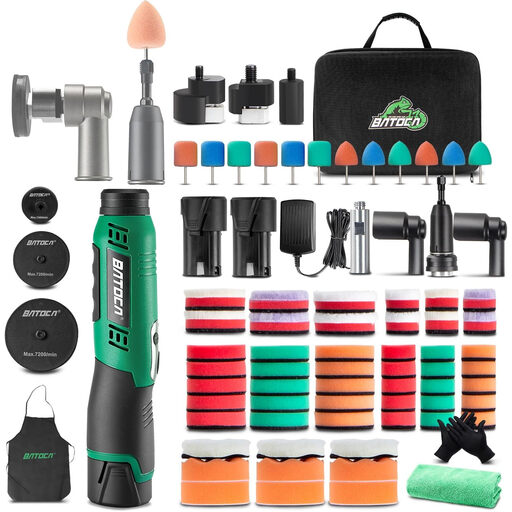
Why this product suits this profile: This mini polisher is designed for detailed work on vehicles, alloy wheels, headlights and hard-to-reach areas.
The model offers both rotary and random orbital operation, as well as three backing plate sizes of 25, 50 and 75 mm. This means it is not limited to a single detailing size.
Two 12-V batteries with 2.0 Ah; the product information states approximately 30 minutes of no-load runtime per battery, as well as six speed settings in the mini system.
We have put together a complete, regularly updated list of products that fully meet these strict selection criteria and the safety regulations applicable in the EU.
For an even finish, you should change the grit gradually. For example, a WORKPRO set with 125-mm sanding discs offers nine grits from P60 to P600 and an 8-hole design for compatible random orbital sanders. For detail sanders, triangular 105 × 152 mm sanding sheets are available in grits from P40 to P180.
For longer jobs, sandpaper rolls are practical because you can cut them to the length you need. Always check the following before use:
For furniture, edges and small workpieces, a detail sander or multi-sander is a practical choice. For larger, flat surfaces, a random orbital sander can save time. The right grit depends on the condition of the wood and the finish you want to achieve.
That depends on the battery capacity, charging time and scope of the work. Two replaceable batteries reduce interruptions. For large areas, a corded model may be a sensible choice, while a mini polisher is better suited to details and tight spaces.
Use suitable sanding sheets, avoid applying excessive pressure and clean the extraction openings regularly. With corded tools, the ventilation slots should remain clear. Store batteries in a dry place and follow the manufacturer’s instructions. Particularly when polishing, it is sensible to start at a low speed and use smooth, even movements.