
Lieferung heute & morgen

Qualitätsgarantie

Willkommens-Angebote freischalten: KOSTENLOSE Lieferung | Bis zu 80 % RABATT | Kostenlose 30-Tage-JoyPlus-Testphase
App herunterladen
A children’s sandpit should provide plenty of enjoyment in the garden, on the patio or on the balcony. In practice, though, it’s not just the material and design that can lead to a disappointing purchase. Unclear age recommendations, inadequate weather protection or water areas that are difficult to clean can quickly make a product impractical.
Shovels, moulds, slides and water channels look appealing in product photos. What matters most, however, is whether the sandpit stands securely, has rounded edges and can be cleared of sand and water after play. An extensive sand toy set is no substitute for a well-designed construction.
A product may be described by the manufacturer as suitable from 12 or 18 months, but may also contain small parts or require close supervision. So check the age recommendation, warnings and the actual size of the play area. Take particular care with small accessories when children under three are involved.
A sandpit without a suitable cover can get dirty more quickly from leaves, animals and rain. Any water should be removed completely after every use. If it is left standing in containers or recesses, it creates unnecessary cleaning work and a slip hazard.
Measure the space you have in mind, including room for children to move around. A sandpit with a canopy needs space not only for the sand area, but also enough clearance from walls, railings and garden furniture.
Plastic is usually lightweight, easy to wipe clean and ready to use without assembly. A sandpit shell for children is also relatively easy to move or put away. Wood looks sturdy and often blends in well with the garden, but needs regular checks for damp, cracks, loose joints and weather-related wear.
Look for:
The CE mark and information on toy safety, such as compliance with the EN 71 series of standards, should be clearly identifiable on the product or packaging. They do not replace checks before every use. Sand should be clean, dry and suitable for its intended play use.
A children’s sand and water table is particularly suitable if you want to combine sand and water play. A low table height is important for toddlers. Older children may enjoy extra shelves, taps or storage, or a children’s mud kitchen to extend the play area.
A water play table for toddlers should be emptied, rinsed and dried after every use. With wooden models, check whether the containers can be removed and whether the surface can be cleaned with a damp cloth.
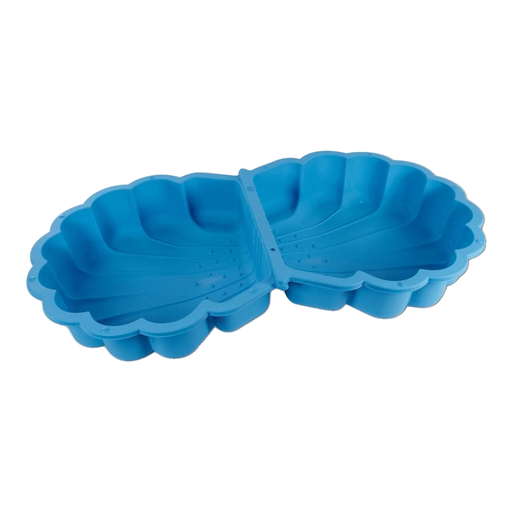
Why this product suits this profile: This plastic sandpit shell requires no assembly and, at around 87 × 78 × 20 cm, offers a compact solution for the garden, patio or smaller outdoor spaces.
Its simple design reduces the risk of assembly mistakes. The smooth plastic surface can be cleaned with water; remember to plan for a separate, suitably sized cover.
No assembly required; made from plastic; stated by the manufacturer as suitable from 18 months.
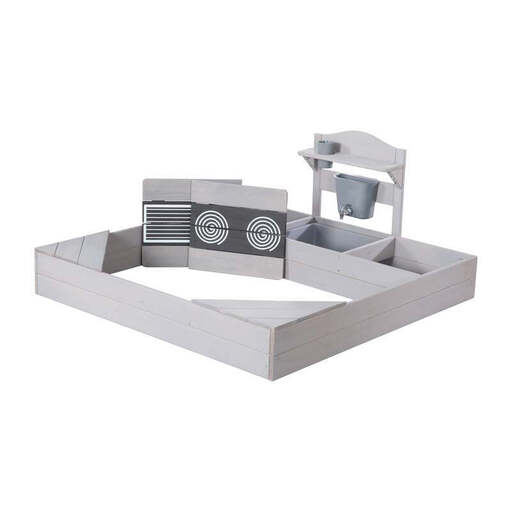
Why this product suits this profile: This model combines a sandpit, seating and a children’s mud kitchen in one structure made from stained solid wood.
The included water-resistant cover helps protect it from the weather. The water container with tap needs to be emptied after play.
Measures 113 × 113 × 54 cm, with two storage compartments and two removable panels printed with hob rings.
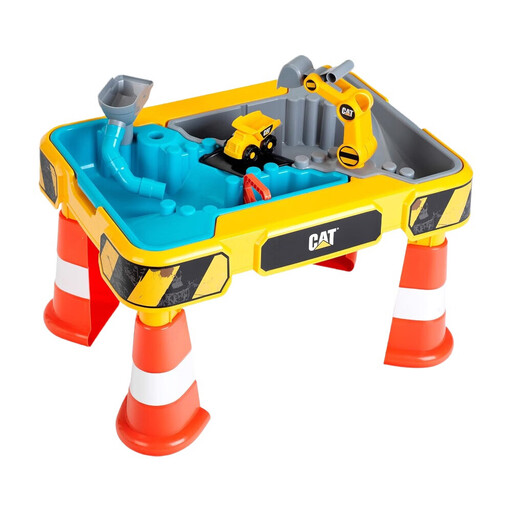
Why this product suits this profile: This compact table is designed for families who want to combine sand and water play with accessories in a small space.
The water containers are removable and can be cleaned separately. After use, remove the sand and water, then dry all the parts.
Measures 64 × 48 × 40 cm, with removable tubs and accessories including an excavator arm, a dumper truck, pipes and stoppers.
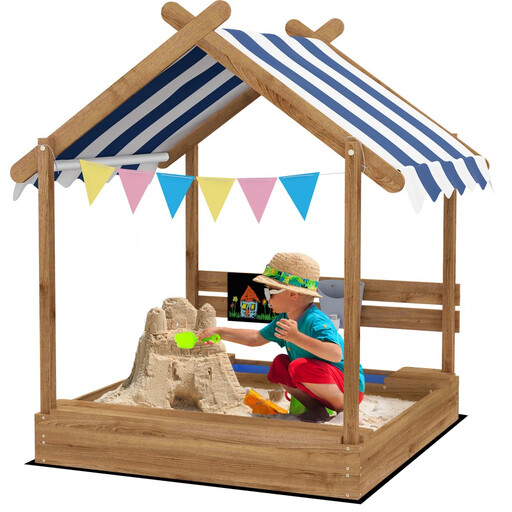
Why this product suits this profile: The combination of a wooden frame, canopy, two tubs and a blackboard is ideal for families who want to bring sand play and imaginative play together.
The canopy provides the sheltered play area you may be looking for. Before buying, make sure you have enough space, allow for assembly time and consider how you’ll clean the tubs.
Overall dimensions stated as 124 × 116 × 146 cm, with two tubs and a blackboard for extra play options.
We’ve put together a complete, regularly updated list of products that meet these strict selection criteria and fully comply with the safety regulations in force in the EU.
Place the sandpit on as level a surface as possible. Wooden models must be assembled by an adult. Before every use, check the screws, joints, edges and accessories for damage.
For everyday care:
A sandpit with accessories is only practical for everyday use if the parts have a designated storage spot after play. Models with a shelf, storage space or removable tubs can make tidying up easier.
It depends on the internal dimensions and how deep you want the sand to be. A shallower layer is usually enough for younger children to scoop and mould. Don’t fill it to the brim, or sand will keep spilling out during play. Work out the exact amount using the manufacturer’s guidance and the internal dimensions.
This depends on the product’s age recommendation. Some models are described by the manufacturer as suitable from 12 or 18 months, while others are intended for children aged three and over. Always follow the age guidance and warnings, take accessories into account and ensure an adult supervises play.
Its lifespan depends on the material, location, cover and care. Protect plastic from unnecessary, prolonged exposure to sun and frost. Wooden sandpits need regular checks and should be stored somewhere dry when the weather is unsuitable. A cover helps keep dirt out, but does not replace cleaning or safety checks.