
Lieferung heute & morgen

Qualitätsgarantie

Willkommens-Angebote freischalten: KOSTENLOSE Lieferung | Bis zu 80 % RABATT | Kostenlose 30-Tage-JoyPlus-Testphase
App herunterladen
Warm, melted cheese oozing from a golden-brown toasted sandwich—a simple meal that's quick to prepare. A sandwich maker might seem like a straightforward purchase for the job. Yet, the reality in many kitchens is quite different: burnt-on residue that’s impossible to remove, or an appliance that gives up the ghost after just a few months. Before you make a decision, it's crucial to understand the typical weak points that often only become apparent after you buy.
As your Joybuy Product Recommendation Officer, I'm here to help you separate the wheat from the chaff. We'll focus on the facts and the critical features to ensure you find an appliance that reliably does its job, rather than just taking up space on your counter.
Marketing promises often sound tempting, but the devil is in the details. These three issues are the most common sources of user frustration:
To avoid these pitfalls, you should check three technical features before buying. These are the primary determinants of your appliance's functionality and longevity.
The power, measured in watts (W), is a direct indicator of the heating time and the appliance's ability to maintain a consistent temperature.
An automatic temperature control with an indicator light is standard today. It signals when the appliance is ready for use.
The plates define what you can prepare with the appliance.
Regardless of the type, a high-quality non-stick coating is essential. It prevents food from sticking and makes cleaning significantly easier.
Look for details that indicate a sturdy design. A solid locking system, ideally made of metal or robust plastic, ensures the appliance closes securely and distributes pressure evenly. Heat-insulated handles are an important safety feature to prevent burns. A stable base, often provided by rubberised feet, prevents the appliance from slipping during use.
Instead of a one-size-fits-all recommendation, we present appliances tailored to specific needs and household types.
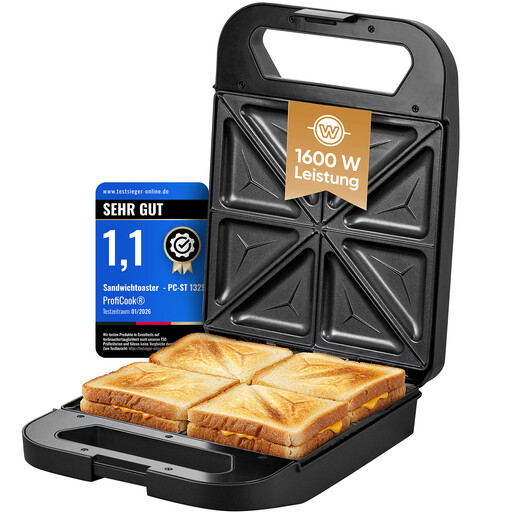
Why It's a Match: Ideal for households where several people want to eat at the same time. This XXL sandwich maker prepares four sandwiches (eight triangles) at once, saving valuable time in a busy family or shared kitchen.
The high power of 1600 watts counteracts the pitfall of uneven browning. Even when fully loaded, the large cooking surface heats up quickly and evenly, ensuring consistently crispy results.
High capacity for preparing four sandwiches simultaneously. Robust construction with a stainless steel insert and a secure locking system.
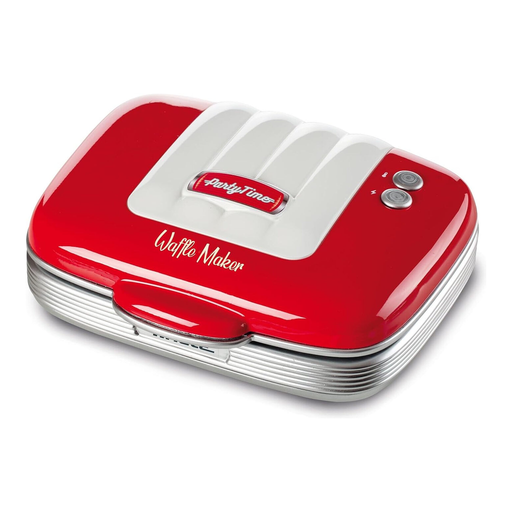
Why It's a Match: For anyone who wants to make more than just sandwiches and values a space-saving appliance. This 3-in-1 model combines a sandwich toaster, waffle iron, and grill in one.
This appliance avoids the cleaning trap with its removable plates. They can be easily taken out and cleaned separately, which significantly simplifies maintenance compared to fixed plates.
Multi-functional thanks to three interchangeable plate sets (sandwich, waffle, grill). This saves space and expands your culinary options.

Why It's a Match: For users seeking a powerful and versatile appliance that goes beyond the function of a simple sandwich maker. Perfect as a panini press, for steaks, burgers, or grilled vegetables.
With 2000 watts of power and dual-sided heating, this appliance avoids the pitfall of insufficient heating power. It delivers the necessary force for a proper sear and ensures a consistently crispy texture that's not possible with less powerful devices.
High power and large grill plates (28x22 cm) for versatile use as a contact grill. The food-grade non-stick coating simplifies cleaning.
We have compiled a complete, up-to-date list of products that fully meet these strict selection criteria and German safety regulations.
Allow the appliance to cool completely after use. Then, wipe the plates with a damp cloth or paper towel. For stubborn residue, a soft brush can help. Never submerge the appliance in water. Models with removable, dishwasher-safe plates offer the most convenient cleaning.
A classic sandwich toaster has pre-formed plates that seal and often cut slices of toast. It is specifically designed for this one task. A contact grill typically has flat or ridged plates and is more versatile. Thanks to higher power and often adjustable hinges, it is also suitable for grilling meat, fish, vegetables, and thick paninis.
For standard sandwiches, 750 to 900 watts is a good guideline. If you regularly prepare thicker sandwiches, use an XXL model for the family, or value an especially fast heat-up time, appliances with 1200 watts or more are a sensible choice. True contact grills for versatile grilling often start at 1800 watts.