
Lieferung heute & morgen

Qualitätsgarantie

Willkommens-Angebote freischalten: KOSTENLOSE Lieferung | Bis zu 80 % RABATT | Kostenlose 30-Tage-JoyPlus-Testphase
App herunterladen
A great Santoku knife can transform kitchen work from a tedious chore into a precise and satisfying activity. However, the market is flooded with options whose marketing promises often obscure more than they clarify. Before you make a purchase, it's crucial to understand the common pitfalls that can lead to disappointment and unnecessary expense.
As your Joybuy Product Recommendation Officer, I'll help you identify objective criteria for your choice. We will focus on the facts that truly matter and debunk common marketing traps.
The 3 Most Common Traps When Buying a Santoku Knife:
To find a durable and functional Japanese chef's knife, you should focus on verifiable technical specifications rather than marketing slogans.
The steel is the heart of any knife. Most quality knives available from brands like Zwilling or WMF use stainless steel such as X50CrMoV15. This steel offers a good compromise between sharpness, corrosion resistance, and ease of resharpening.
A crucial value is the steel's hardness, measured in Rockwell (HRC).
The classic blade length for a versatile Santoku is 17 to 18 cm (approx. 7 inches). This size is an ideal compromise for most tasks in the home kitchen. The wide blade and the slightly downturned tip are characteristic of the Santoku, making it an excellent knife for vegetables, fish, and boneless meat. Unlike the European chef's knife with its curved blade, the Santoku's edge is relatively straight, which makes it perfect for push cuts and chopping.
A Santoku knife with a Granton edge is recognizable by the oval indentations on the blade. These are not purely a design element. The Granton edge (also called a hollow edge) creates small air pockets between the blade and the food being cut. This reduces food from sticking, especially with starchy vegetables like potatoes or moist ingredients like cucumbers, and allows for a smoother workflow.
Instead of making a one-size-fits-all recommendation, we have identified products that suit specific needs and budgets.
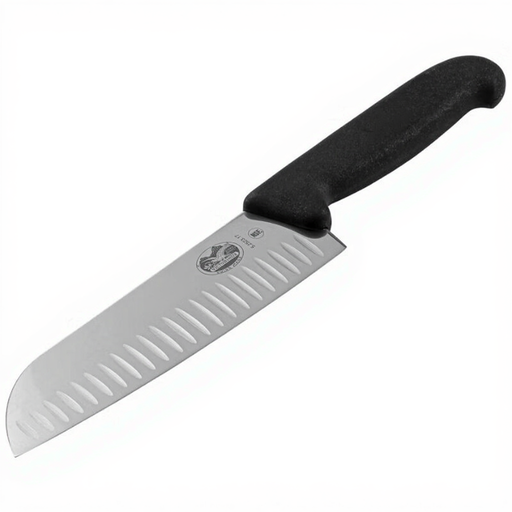
Why This Fits Their Persona: Ideal for anyone seeking a functional, sharp, and durable tool without a high investment. The knife focuses on performance over aesthetics and is a proven workhorse in many kitchens.
This Victorinox Santoku knife forgoes a "Damascus look" in favor of an honest, stamped blade with a functional Granton edge. The focus is clearly on cutting performance.
Excellent out-of-the-box sharpness and edge retention for this price point. The non-slip Fibrox synthetic handle is hygienic and very robust.
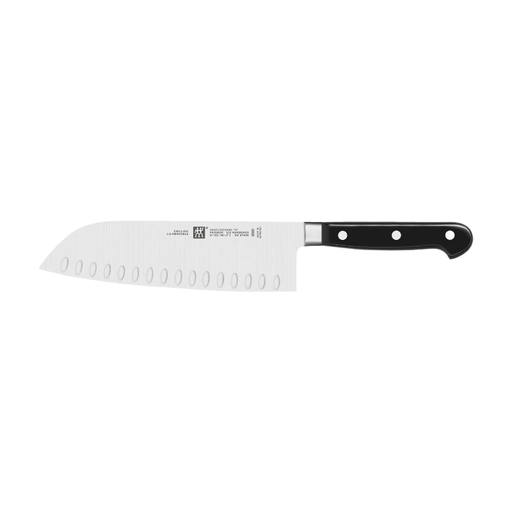
Why This Fits Their Persona: For users who are ready to invest in a forged, high-quality tool made in Germany. It offers precision, durability, and an excellent feel for ambitious cooking.
The full-tang construction ensures perfect balance, avoiding the trap of unbalanced knives. The weight is optimally distributed between the blade and the handle.
SIGMAFORGE blade, forged from a single piece of steel for stability and precision. The classic three-rivet handle sits securely and comfortably in the hand.
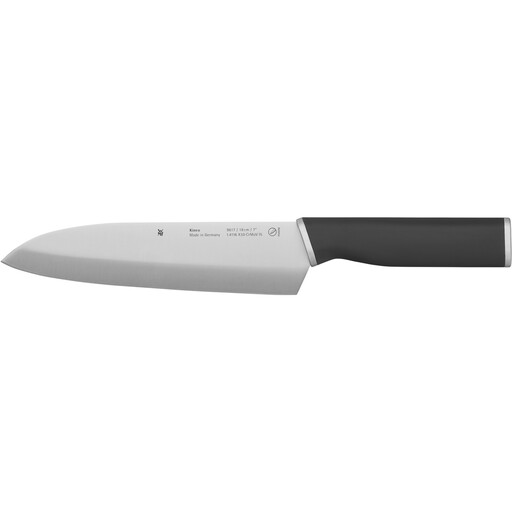
Why This Fits Their Persona: For users looking for a modern, reliable knife from an established brand for daily use. The design is contemporary, and the performance is geared towards long-lasting sharpness in everyday life.
This WMF Santoku knife bypasses vague promises with a concrete, proprietary technology: The "Performance Cut" technology, according to the manufacturer, promises a sharpness that exceeds standard requirements.
Made from specially hardened blade steel for high stability and corrosion resistance. The kinetic handle design ensures comfortable and secure handling.
We have compiled a complete, up-to-date list of products that fully meet these strict selection criteria and safety regulations.
1. What is the difference between a Santoku knife and a chef's knife? The main difference lies in the blade shape and the resulting cutting technique. The European chef's knife has a curved blade that allows for a rocking motion. The Santoku has a straighter edge and a wider blade, making it ideal for quick chopping and push cuts. It is often considered the more versatile knife for preparing vegetables.
2. Is a Santoku knife with a Granton edge really necessary? A Granton edge is a functional feature that reduces food from sticking. This is particularly helpful with moist or starchy ingredients like cucumbers, zucchini, or potatoes and can noticeably improve workflow. However, it is not an absolute necessity. A knife without a Granton edge can also deliver excellent results if it has the right quality and sharpness.
3. How do you sharpen a Santoku knife correctly? The method depends on the steel and the grind angle. Knives made of softer, German steel (up to approx. 58 HRC) can often be maintained with a honing steel. Harder Japanese blades should ideally be sharpened on a whetstone to preserve the finer grind angle (often 15 degrees per side) and avoid material damage. A honing steel would be more likely to damage the edge of these hard blades.