
Lieferung heute & morgen

Qualitätsgarantie

Willkommens-Angebote freischalten: KOSTENLOSE Lieferung | Bis zu 80 % RABATT | Kostenlose 30-Tage-JoyPlus-Testphase
App herunterladen
A Santoku knife combines a broad, relatively short blade with a straight or gently curved cutting edge. It’s particularly suited to slicing, dicing and chopping vegetables, herbs, fish and boneless meat. For home cooks and fans of Asian cuisine, a Santoku knife can be a useful addition to the classic chef’s knife.
However, some product claims can lead to unrealistic expectations. A striking blade design, a “dishwasher-safe” label or claims of exceptionally hard steel don’t, on their own, tell you whether a knife will suit your everyday cooking.
A Santoku knife with a Granton edge has small indentations along the blade. These can reduce contact between the food and the steel, helping ingredients such as potato slices and soft vegetables to stick less. However, the edge doesn’t replace regular care, nor does it make a knife suitable for every task.
Santoku knives are generally not designed for cutting bones, frozen food, hard skins or very firm ingredients. These tasks can damage the blade.
According to the product information, a dishwasher-safe Santoku knife can go in the dishwasher. However, heat, detergent and contact with other cutlery can put stress on the blade. Several models therefore come with a recommendation to hand-wash them, even when the technical specifications say they’re dishwasher-safe.
To keep the knife sharp for as long as possible, wash it with mild washing-up liquid, dry it straight away and don’t leave it loose in the cutlery drawer.
A Damascus Santoku knife can stand out thanks to its patterned blade. But there are other details to consider when choosing a knife: the actual blade material, edge geometry, handle construction, blade length and care instructions. The word “Damascus” alone tells you neither how practical the knife is for everyday use nor how long it will last.
The most common sizes are 17 cm and 18 cm:
Blade length isn’t the only thing that matters: weight is important too. For example, a Victorinox model with a 17 cm blade is listed at 103 g, while the ZWILLING Gourmet Santoku, at 18 cm, has a net weight of 163 g. These details can help you judge how comfortable a knife will be to handle.
A rust-resistant Santoku knife is often made from stainless steel or specially treated steel. Look for specific information about the type of blade and how it’s made:
A broad blade supports controlled cutting and gives your fingers more room. The handle should be dry, easy to grip and a comfortable size for your hand. A finger guard can provide extra protection, but it’s no substitute for proper cutting technique.
Use a wooden or plastic chopping board. Stone, glass and ceramic surfaces can blunt the blade more quickly. A knife block, magnetic strip, drawer insert or blade guard are all suitable storage options.
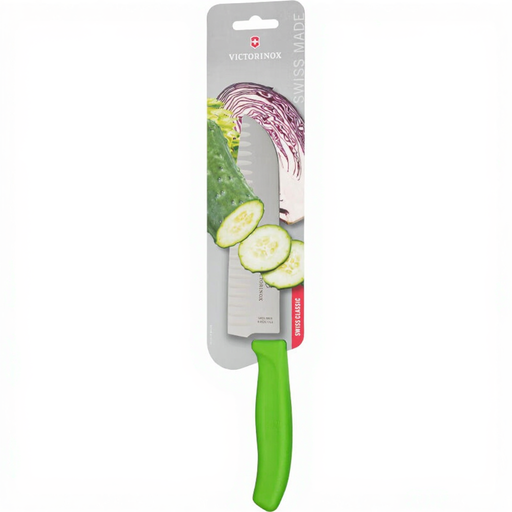
Why this product suits this user: The 17 cm blade, plastic handle and stated weight of 103 g make it a good fit for everyday cutting tasks and smaller kitchens.
The product details clearly specify the blade length, stainless steel, Granton edge and dishwasher-safe rating, rather than relying on a vague description of its design.
17 cm blade, stainless steel and plastic handle; the blade is listed as rust-resistant and dishwasher-safe.
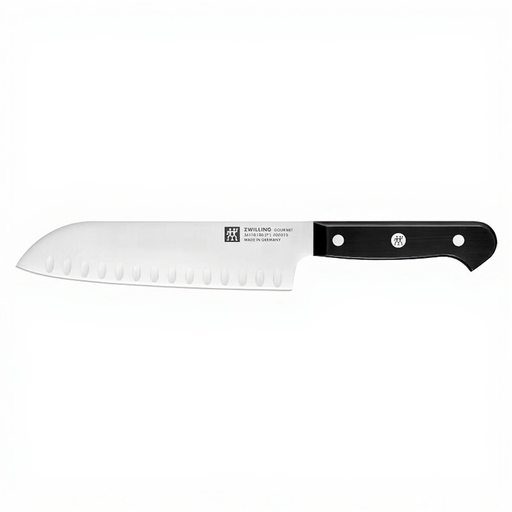
Why this product suits this user: This model combines an 18 cm blade made from FRIODUR ice-hardened special-melt steel with an ergonomic plastic handle. It’s made in Germany.
The material and care information is clearly stated. Although the knife is classed as dishwasher-safe, hand-washing is recommended to protect the blade.
18 cm blade, FRIODUR processing, V-edge and plastic handle with a seamless transition.
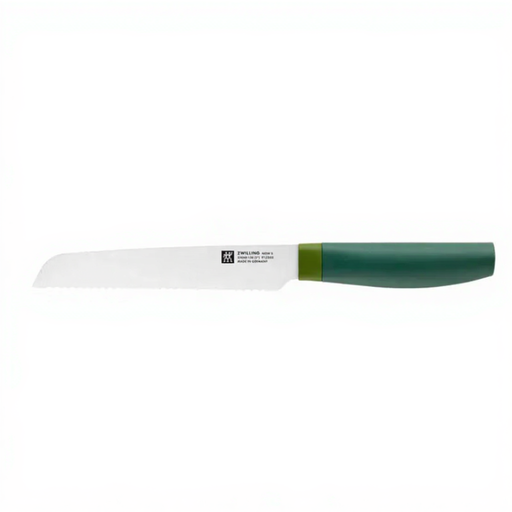
Why this product suits this user: The Granton edge may appeal to anyone who regularly slices vegetables, fish and meat and wants ingredients to stick less to the blade.
The Granton edge is listed as a specific feature. At the same time, the product description notes that hand-washing is the preferred care method, despite the knife being dishwasher-safe.
18 cm stainless steel blade, ice-hardened finish, full-tang construction and stated rust resistance.
We’ve put together a complete, regularly updated list of products that meet these strict selection criteria and fully comply with the safety regulations in force in the EU.
A single knife is enough if you already have a chef’s knife and a small paring knife. A Santoku knife set or kitchen knife set may be a better choice if you want to cover a range of cutting tasks. The ZWILLING Pro Series set includes an 18 cm Santoku knife, a Chinese chef’s knife, a paring knife and a cleaver, as well as a bamboo block. The block has four knife slots and an extra slot for scissors; according to the product information, scissors aren’t included.
A two-piece set with a Santoku knife and paring knife may be enough for smaller households. Before buying, check whether you’ll actually use each knife regularly. A larger set isn’t automatically better value if some of the pieces go unused.
Its lifespan depends on the steel, edge geometry, how often you use it and how well you care for it. Don’t use a knife on glass, stone or ceramic surfaces. Regular honing and professional sharpening can help keep it in good working order. Visible chips or a loose handle are signs that you should stop using it.
Yes, Santoku knives are generally suitable for boneless meat, fish, vegetables and herbs. Avoid bones, frozen food and hard objects, as these can damage the blade. A longer chef’s knife may be more practical for very large cuts.
The price depends on factors such as the blade material, manufacturing process, handle, Granton edge and what’s included. Don’t compare prices alone: check the exact blade length, care requirements, dishwasher-safe rating and the items included in a set.