
Lieferung heute & morgen

Qualitätsgarantie

Willkommens-Angebote freischalten: KOSTENLOSE Lieferung | Bis zu 80 % RABATT | Kostenlose 30-Tage-JoyPlus-Testphase
App herunterladen
A sharp, reliable kitchen knife is the cornerstone of meal preparation. Among the many types of knives, the Santoku knife, a versatile Japanese chef's knife, has earned a firm place in many kitchens. Its characteristic shape is ideal for slicing, dicing, and mincing vegetables, fish, and meat.
However, with so many different materials, blade shapes, and brands available, choosing the right model can be a challenge. This guide will explain the essential features of a Santoku knife and present a selection of models to help you make an informed purchasing decision.
To find the right knife for your needs, several technical aspects should be considered. These criteria will help you objectively evaluate a knife's performance and durability.
The quality of the steel is crucial for a knife's sharpness and edge retention. Many high-quality knives, including models from WMF or Zwilling, use specially hardened steel alloys. The hardness is often specified in Rockwell (HRC). A higher HRC value (typically between 55 and 60 HRC) indicates a blade that will hold its edge longer, but it also requires more careful sharpening. Corrosion resistance is another important factor that makes the knife easier to maintain.
Many Santoku knives feature a Granton edge. These are the oval indentations on the blade. These hollows create small air pockets between the blade and the food being cut. This reduces the sticking of thin or starchy slices, such as potatoes or cucumbers, allowing for smoother and faster work.
A good knife should feel secure and comfortable in your hand. The handle, whether made of plastic, wood, or stainless steel, must provide a non-slip grip. The balance between the blade and the handle is also important. A well-balanced knife reduces hand fatigue and allows for more precise control—a key feature for anyone who does a lot of cutting regularly.
Here, we present three models that stand out for their specific features and craftsmanship.
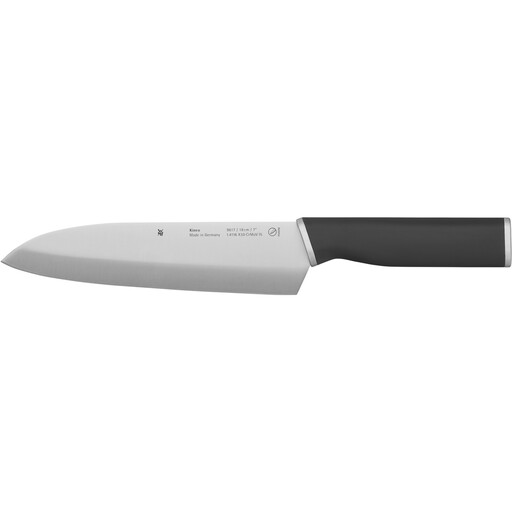
What sets it apart: The WMF Santoku knife from the KINEO series is made in Germany and combines modern design with functional technology. According to WMF, its Performance Cut technology ensures long-lasting sharpness that exceeds industry standards. The specially hardened blade steel offers high resistance to corrosion. The kinetic design of the handle is engineered for comfortable and balanced handling.
Advantages:
Who it's for: This knife is an excellent choice for home cooks who value modern design, "Made in Germany" quality, and reliable, long-lasting cutting performance for everyday tasks.
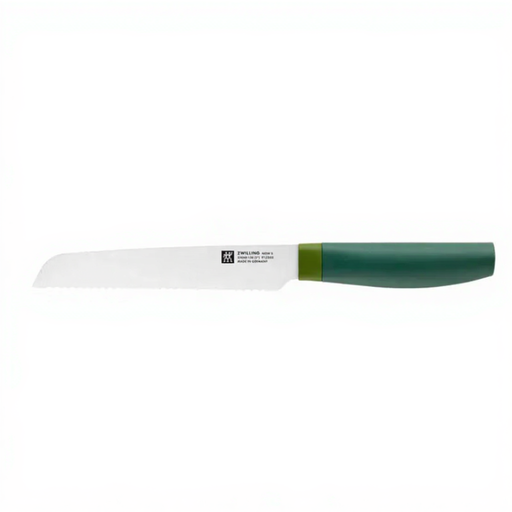
What sets it apart: The Zwilling Santoku knife from the Cuisine series is a precision-forged tool. The blade is crafted from a special steel alloy and refined using the patented FRIODUR ice-hardening process. According to Zwilling, this process results in exceptional hardness, edge retention, and corrosion resistance. The full tang (the extension of the blade into the handle) provides excellent balance, while the seamless transition from the bolster to the blade ensures safe handling.
Advantages:
Who it's for: Ambitious home chefs looking for a classic, robust, and exceptionally well-balanced sharp kitchen knife for a variety of cutting tasks will find this model to be a solid addition to their kitchen.
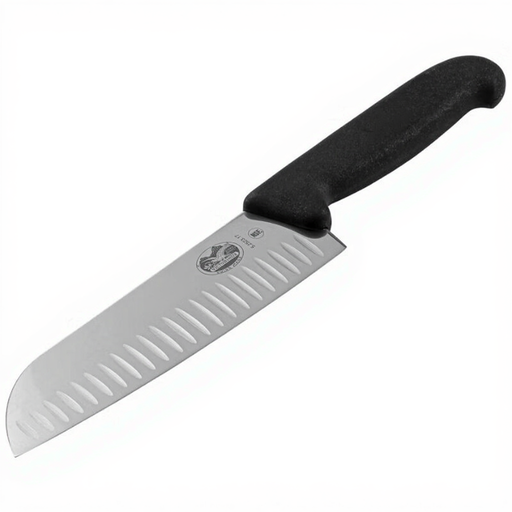
What sets it apart: Victorinox is renowned for its functional and durable tools, and the Santoku knife from the Fibrox series is no exception. It focuses on the essentials: a sharp, stainless steel blade and an ergonomic, non-slip synthetic handle. At 17 cm, the blade is slightly shorter, making the knife very agile. The Granton edge also helps to ensure clean cuts.
Advantages:
Who it's for: This knife is ideal for pragmatists and anyone seeking a straightforward, lightweight, and reliable tool for daily use. It is especially suitable as a knife for vegetables and fish, where agility is key.
If our selection doesn't include the right model for you, or if you're looking for other blade shapes, you can find a wider range of high-quality tools for your kitchen in our ergonomic kitchen knives category.
The main difference lies in the blade shape. A classic European chef's knife has a curved blade, which is suitable for a "rocking" cut. The Santoku knife has a straighter cutting edge and a rounded, "sheep's foot" tip. The blade is often wider, which makes it easier to scoop up cut ingredients. It is designed for push and pull cuts.
The name "Santoku" means "Three Virtues," referring to its suitability for three main tasks: slicing, dicing, and mincing. It is an all-purpose knife that is particularly well-suited for preparing vegetables, cutting boneless meat, and filleting fish.
To maintain their sharpness, high-quality knives should be washed by hand and dried immediately. Cleaning them in a dishwasher can damage the steel and the handle material. For sharpening, honing steels (for daily edge alignment) or whetstones (for creating a new primary edge) are suitable. With a Granton edge, be careful to sharpen only the cutting edge and not the flat side of the blade, to avoid damaging the indentations.