Travellers with limited kitchen space
You want to cook eggs for one or two people and then put the appliance away easily. Capacity and actual dimensions matter more than the ‘mini’ label alone.


If your holiday apartment has a suitable saucepan and hob, and you only cook eggs occasionally, you don’t necessarily need your own egg cooker. For regular group breakfasts, the key consideration is how many eggs you need to cook at once. If storage space is limited, a compact model may be an option, while larger appliances take up more room. Controls or a measuring cup alone won’t guarantee a particular result: check the instructions for hard-boiled eggs, and take care when opening and cleaning the appliance.
You want to cook eggs for one or two people and then put the appliance away easily. Capacity and actual dimensions matter more than the ‘mini’ label alone.
You want to cook several hard-boiled eggs in one go, so you compare the stated capacity with the space the appliance takes up.
You’re weighing up an extra appliance against using the saucepan already provided, and want to consider ease of use, cleaning and safe operation in an unfamiliar kitchen.
A good choice if: You only cook eggs occasionally and your holiday apartment has a suitable saucepan and hob.
The trade-off: You won’t need to store another appliance, but you’ll have to keep an eye on the cooking time and remove the eggs yourself. The German Consumer Advice Centre recommends cooking eggs in a saucepan with a lid and a small amount of water.
A good choice if: One to three eggs are usually enough for breakfast and a small appliance is easier to fit in.
The trade-off: Models with a smaller capacity require additional cooking cycles for larger quantities.
A good choice if: You regularly want to cook more than three eggs at once; the manufacturer states that the Severin EK 3166 can cook up to six eggs.
The trade-off: Allow for the extra space it will take up in the holiday kitchen and when stored away.
When choosing an appliance, the main things to consider are storage space, the number of eggs, your preferred level of doneness and how easy it is to use in an unfamiliar kitchen.
| Priority | What to check when buying | Who this matters most to |
|---|---|---|
| Limited space | Compare the external dimensions, storage options, cord storage and capacity of each model. | If I need to pack the appliance in my luggage and store it in a small holiday kitchen, its actual dimensions matter more to me than the ‘mini’ label. Around 36% of consumers put a small storage footprint first. |
| Number of eggs per cycle | Check the stated maximum number of eggs against how many you usually need to cook at once. | For a group breakfast, I want to cook all the eggs we need in one go if possible. That’s why around 29% of consumers put sufficient capacity first. |
| Level of doneness | Check the instructions for the ‘hard’ setting, egg size and starting temperature; guidance applies to the specific model. | If hard-boiled eggs matter to me, I want to know the conditions a setting is based on. Around 21% of consumers prioritise their preferred level of doneness. |
| Handling and cleaning | Check the handle positions, removable parts and cleaning instructions in the manual for the specific model. | In an unfamiliar kitchen, I want to remove hot parts carefully and be able to clean the appliance properly. Around 14% of consumers put ease of use and care first. |
CHIP’s practical test, published on 26 October 2026, shows that electronic controls alone don’t guarantee a better result. A simple control system can also achieve your preferred level of doneness.
Check the instructions for the specific model, and don’t assume test results apply to other appliances.
According to the manufacturer, the Gastroback 42800 is designed for up to three eggs, while the Severin EK 3166 can cook up to six. A capacity that’s too small may mean extra cooking cycles for a group breakfast.
First decide how many eggs you usually want to cook at once, then compare that with the appliance’s size and the storage space available.
The German Consumer Advice Centre’s recommendation to cook eggs in a saucepan with a lid and a small amount of water doesn’t provide a comparison with a particular egg cooker.
If energy consumption matters to your decision, only compare figures measured under the same conditions and for the same number of eggs.
CHIP’s practical test warns of a scalding risk if certain lids are removed carelessly. Handles and cleaning instructions vary from model to model.
Open the lid as instructed, remove hot parts carefully and let the appliance cool down before cleaning.
According to the manufacturer, the Design Mini Egg Cooker 42800 is designed for one to three eggs and has a slim profile.
According to WMF, the KÜCHENminis 2-Egg Cooker is designed for small portions and limited storage space.
According to the manufacturer, the EK 3166 is designed for up to six eggs.
According to the manufacturer, the ER 300 is designed for one to three eggs, with a timed doneness setting.
According to the manufacturer, the Cloer 6021 is a compact option for up to three eggs.
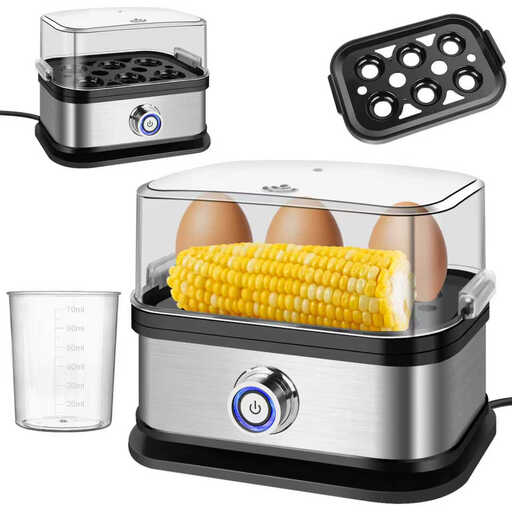
The Joybuy models featured here are designed to cook several eggs at once. Compare the stated capacity with your needs, and check that you have enough worktop and storage space in your holiday kitchen.
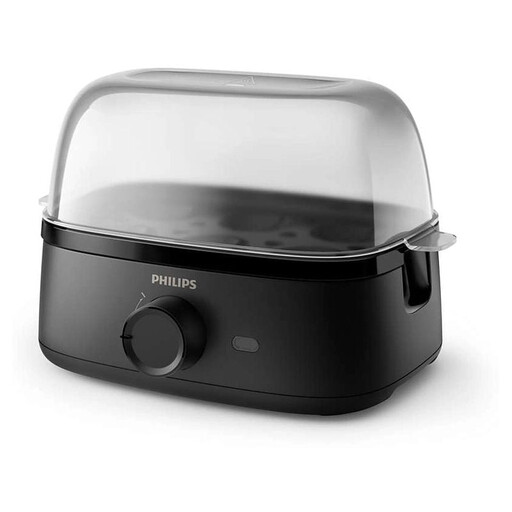 No image available
The stated capacity is a good fit if you want to cook several eggs in one go; hot steam may escape when you open it.
Capacity: up to 6 eggs; insert for up to 3 poached eggs; buzzer; 400 W.
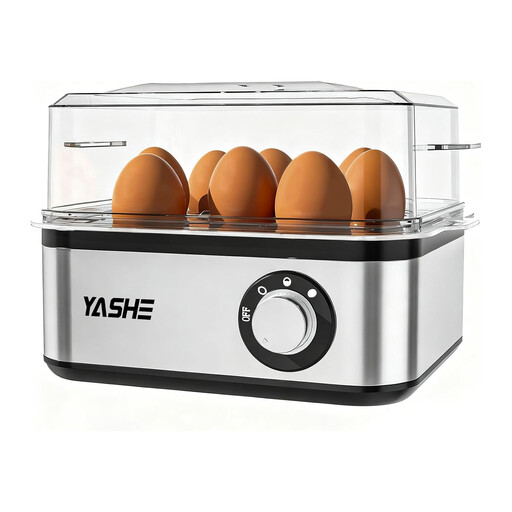 No image available
Its capacity is suited to a breakfast with several eggs; compare the quantity you need with the worktop space available.
Up to 8 eggs; 3 cooking settings: soft, medium and hard; includes a steaming insert, omelette pan and measuring cup.
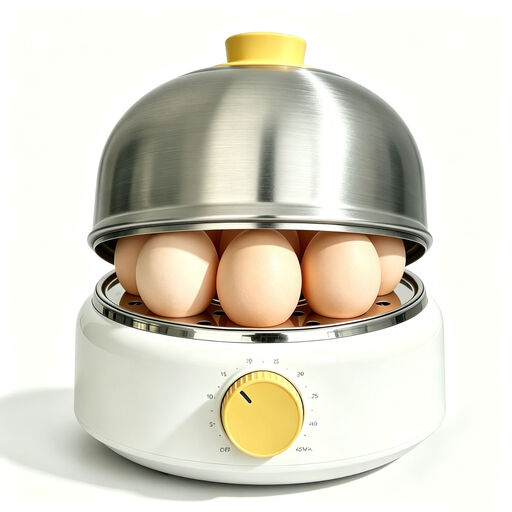 No image available
The stated capacity may suit you if you want to cook up to seven eggs at once.
Capacity: up to 7 eggs; doneness setting; 45-minute timer; overheat protection.
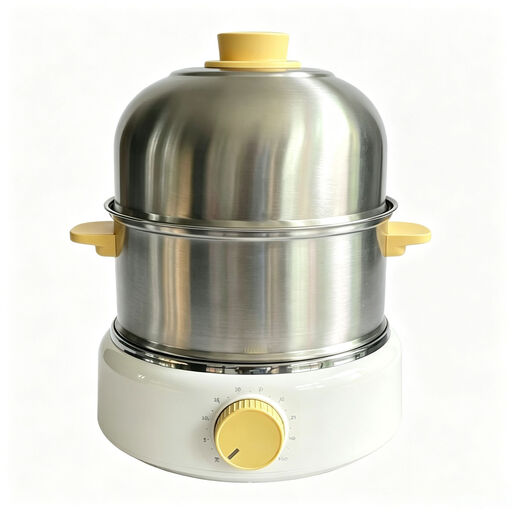 No image available
The high stated capacity may be useful for larger breakfast gatherings; check how much space the multi-tier appliance will take up first.
Up to 18 eggs on 2 stackable tiers; 400 W; doneness setting and timer; steaming function.
 No image available
The stated capacity is a useful point of comparison if you want to cook several eggs at once.
Up to 6 eggs; 350 W; steaming function; dry-boil protection with automatic shut-off, according to the product description.
Use the ‘hard’ setting as instructed, and note the conditions it’s based on: the markings are for size M eggs straight from the fridge. Severin says you can adjust the setting for other egg sizes or eggs at room temperature; don’t apply it to other models.
For the EK 3166, the manufacturer’s instructions require a properly installed earthed socket and a mains voltage that matches the rating plate. Severin recommends unplugging the appliance before cleaning and letting it cool down; the cooking bowl should only be wiped with a damp cloth. If you have a different appliance, check its own instructions.
You can’t assume it will be cheaper in every case. If a saucepan and hob are available and you only cook eggs occasionally, you can avoid buying an extra appliance in the first place. The German Consumer Advice Centre recommends cooking eggs in a saucepan with a lid and a small amount of water; this doesn’t provide a comparison of electricity costs across different models.
The EU Low Voltage Directive applies to electrical equipment within the scope of 50 to 1,000 V AC. According to the German Federal Network Agency, the manufacturer uses the CE marking to declare that the relevant requirements have been met under its own responsibility; it isn’t an independent quality mark. If you’re buying in Germany, also check that the required instructions and safety information are provided in German.
The German Consumer Advice Centre recommends keeping eggs refrigerated and points out that eggs cooled rapidly in cold water don’t keep as long as eggs that haven’t been cooled this way. If the shell is damaged or the egg has an unusual smell, don’t rely on a general storage-life estimate.