One-pot batch-cookers
You cook several lunches in the same pan and need a cooking zone that fits, as well as a heat setting you can adjust for simmering.


For regular batch cooking, a portable single induction hob is an obvious choice if your pan has a suitable ferromagnetic base and fits the cooking zone. If your pan is not suitable for induction, consider a ceramic-glass hob with radiant heating or a cast-iron hotplate. A double hob is most worthwhile if you often prepare your stew and a side dish at the same time. According to EUR-Lex, new mains-powered hobs in Germany that fall under the EU Low Voltage Directive require a conformity assessment, an EU Declaration of Conformity and CE marking. A CE image in a product listing alone does not prove that the product complies.
You cook several lunches in the same pan and need a cooking zone that fits, as well as a heat setting you can adjust for simmering.
You want to keep using your stew pot. Whether its base is suitable for induction will help determine the right heating technology.
You regularly prepare a side dish alongside your stew and need to weigh up whether a second cooking zone is worth the extra space.
A good fit if: your pan has an induction-compatible base, fits the hob and you only heat the stew at the same time.
Consider: you’ll need cookware with a ferromagnetic base. A timer is no substitute for keeping an eye on your food while it cooks.
A good fit if: you want to keep using a pan you already own that is not suitable for induction, and prefer a smooth cooking surface.
Consider: the cooking surface itself gets hot and may retain residual heat. Ceramic glass describes the surface, not necessarily the heating technology.
A good fit if: simple dial controls and using your existing pan matter more to you than fast heating and a smooth cooking surface.
Consider: Rommelsbacher says cast-iron hotplates take longer to heat up, retain heat and are more difficult to clean.
| Priority | What to check when buying | Who it matters most to |
|---|---|---|
| Simmer stew under control | Check the power settings, timer function and suitable pan diameter for the specific model. | If I want to keep the stew simmering at a controlled heat after bringing it to the boil, I look for suitable controls. Around 40% of consumers make this a key factor in their choice. |
| Use a pan I already own | Check that it is suitable for induction and compare the pan base and cooking zone diameters; ceramic glass alone tells you nothing about the heating technology. | If you want to keep using your usual stew pot, first check that it is suitable for the hob in question. Around 30% of consumers give pan compatibility particular weight. |
| Cook stew and a side dish at the same time | Check the number of cooking zones, appliance dimensions, space required and connection details for the specific model. | If I want to prepare stew and a side dish at the same time, I make sure there’s room for two pans and enough space on the worktop. Around 20% of consumers base their choice mainly on cooking in parallel. |
| Controls and cleaning | Compare the controls, cleaning surface and information on residual heat and repair options for each model. | If you use a hob often, look for easy-to-use controls and a cooking surface that’s practical to clean day to day. Around 10% of consumers make this their main consideration. |
Ceramic glass can also be used with radiant heating. The Rommelsbacher CT 2010/IN requires a ferromagnetic pan base, while the CT 2203/TC uses HiLight radiant heating.
Check the exact model’s specifications for its heating technology and pan requirements.
The Severin DK 1031 measures 59 × 35,5 cm, while the single-zone KP 1071 measures 28,1 × 35 cm. A double hob therefore takes up more worktop space.
Think about whether you regularly cook stew and a side dish at the same time, and make sure there’s room for both pans.
The wattage indicates the appliance’s rated power, not how much electricity your stew uses. A timer is a feature, not permission to leave food cooking unattended.
Compare the controls and safety instructions in the manual for the specific model. To work out your electricity costs, you’ll need comparable consumption figures and your own electricity tariff.
The CT 2010/IN and CT 2203/TC illustrate two heating technologies available in portable single hobs.
The range includes a single induction hob, a single cast-iron hotplate and a double induction hob.
The ProMenu 2100 is a portable single induction hob with several adjustable settings.
The EKP 3788 E is a portable single hotplate with cast-iron heating and a rotary control.
The IK 35 is a portable single induction hob with a stated control range and timer.
The following products include portable single hobs for one pan, including induction and infrared models, as well as a hotplate with a heating ring.
 No image available
For one pan, if you want to adjust the temperature continuously.
The heating surface has a diameter of 18 cm and the stated power is 1,500 W. The product specifications list continuous temperature control.
 No image available
For one pan, if five power settings are enough and your cookware is suitable for induction.
The product specifications list 1,000 W and five power settings.
 No image available
For one pan, if your magnetic cookware is within the stated size range.
The product specifications list a 28-cm glass surface, nine heat settings and an 8-hour timer. Magnetic cookware with a diameter of 12–26 cm is specified.
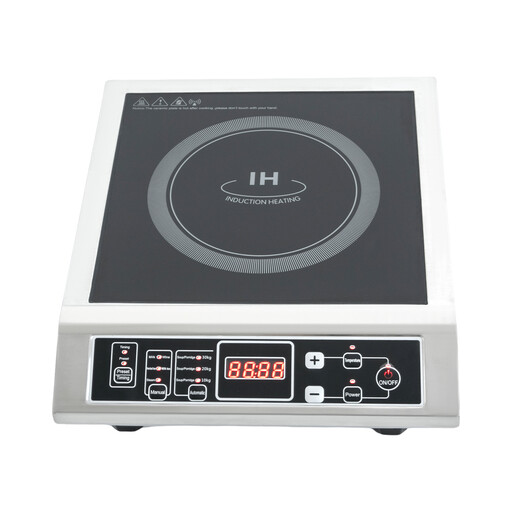 No image available
For one pan, if you want several power settings and a timer; your pan must be suitable for induction.
The description lists ten power settings from 400 to 3,500 W, as well as timer and preset functions.
 No image available
For a heat-resistant pan you already own; the product description lists cookware made from various materials.
Features include four preset cooking programmes, a manual mode, a timer with automatic shut-off and overheating protection.
Yes. For the Rommelsbacher CT 2010/IN, the manufacturer specifies a ferromagnetic pan base and a cooking zone of 120–230 mm. For another model, check its requirements and compare them with your pan.
No. A timer or automatic shut-off function does not mean you can leave food cooking unattended. Follow the safety and operating instructions for the specific appliance, and keep an appropriate eye on your food while it cooks.
The German Federal Institute for Risk Assessment points out that the risk of microbial contamination increases the longer prepared food is stored. Make sure you have access to refrigeration at home and at work, and transport your food containers in a cool bag. According to the BfR, meal prep is less suitable for people whose immune defences are weakened by pregnancy, old age or pre-existing conditions.
New mains-powered electric hobs that fall under the EU Low Voltage Directive must undergo a conformity assessment, have an EU Declaration of Conformity and carry CE marking. EUR-Lex explains manufacturers’ obligations, while Your Europe explains CE marking. A CE symbol in a product listing alone does not prove that the specific model complies.
The Verbraucherzentrale clarifies that an EU energy label for a cooker rates the oven, not the hob. You can’t work out how much electricity a stew uses from the wattage alone.