For a sausage bake in a small oven dish, a freestanding mini oven is an obvious choice, provided the dish fits, the oven offers the heat setting you need and you can leave the required clearance around it. An air fryer could also work if a suitable dish really does fit in the basket. An existing built-in oven makes sense if you don’t want a second appliance or you also cook larger dishes. What matters is the size of your dish, the installation requirements for the specific model and the heat settings you need – not just the oven’s capacity.
Which option suits you?
A single portion in an oven dish
If you want to use a particular dish for your sausage bake, first check that it fits in the oven cavity or basket and that the heat setting you want is available. Rommelsbacher gives a maximum dish diameter of 25 cm for the BG 1055/E; Philips recommends checking the model number when choosing baking accessories.
Limited worktop space
If you’re looking for a freestanding appliance, remember to allow for the clearances specified in its manual as well as its external dimensions. The manufacturer’s guidance for the Steba KB M19 and Rommelsbacher BG 1055/E differs, and applies only to the model in question.
A versatile one-person household
If you cook other dishes too, weigh up the available heat settings, whether your dish will fit and how useful an existing oven might be. A second appliance takes up worktop space; a built-in oven requires a suitable space for installation.
What to consider when buying
Freestanding mini oven
A good fit if: you often bake small casseroles in a dish and want conventional top and bottom heat; Rommelsbacher and Steba list these heat settings for specific models.
Consider: the appliance needs worktop space and model-specific ventilation clearances. Capacity in litres alone doesn’t prove that your dish will fit.
Air fryer with a suitable baking dish
A good fit if: you want to cook small portions in the basket and have a suitable dish that fits inside. Philips lists baking sets and recommends using the model number when searching for accessories.
Consider: the basket and dish dimensions limit your options. Manufacturer claims about saving time or energy aren’t an independent comparison of energy use for this dish.
An existing or planned built-in oven
A good fit if: you already have a suitable oven, don’t want to give up more worktop space or regularly cook larger dishes.
Consider: the EU energy label gives figures for standard cycles, not the energy use for this individual dish. A new oven also needs a suitable space for installation.
| What matters |
What to look for when buying |
Who should pay particular attention |
| Will the oven dish fit? |
Compare the dish, including its handles, with the interior dimensions, shelf position and door clearance of the specific appliance. |
If I want to keep using my existing dish, I’ll measure it fully before choosing an appliance. Around 36% of consumers put oven-dish fit first. |
| Will the appliance fit safely in my kitchen? |
Check the external dimensions and the clearances specified in the manual for the model in question; don’t treat a freestanding oven as a built-in appliance. |
With limited worktop space, I also need to allow for the clearance around the appliance. Around 29% of consumers prioritise a suitable, safe place to put it. |
| Which heat settings and level of effort suit me? |
Check the heat settings you want, how easy it is to use and clean, and which accessories are compatible with the model. |
If I want to use the oven for casseroles and other small meals, the right features and ease of cleaning matter to me. Around 21% of consumers put everyday convenience first. |
| What do energy figures tell me about one portion? |
Don’t treat standard-cycle figures as the energy use for a recipe; for a comparison, measure the same dish under comparable conditions. |
If I often cook single portions, I want a better idea of the electricity costs rather than relying on wattage or the energy rating alone. Around 14% of consumers put energy costs first. |
Common assumptions to avoid
-
Assuming the oven’s capacity tells you how much room there is for your dish
A capacity figure doesn’t tell you whether the width, depth, height and handles of your oven dish will fit inside a specific appliance.
Measure your dish and compare it with the interior dimensions or an explicit statement of the maximum dish size for the model.
If your existing dish doesn’t fit, you may need to buy a smaller, suitable oven dish.
-
Squeezing a freestanding mini oven into a tight alcove
Rommelsbacher warns against installing the BG 1055/E as a built-in appliance and specifies clearances. These requirements don’t apply to other models as a rule.
Before buying, compare the manual for the specific appliance with the place you have in mind. Steba requires a 10 cm gap between the back of the KB M19 and the kitchen wall.
-
Taking wattage or the energy rating as proof of savings per casserole
Verbraucherzentrale and the German Environment Agency describe oven energy figures in terms of standard cycles. Rated power isn’t a measurement of the electricity used for this recipe.
If energy use matters, compare appliances by measuring the kWh used to cook the same recipe under comparable conditions.
A second appliance takes up space and means another purchase, without guaranteeing a saving on this dish.
-
Assuming baking accessories fit every air fryer
Philips lists baking sets for specific models and recommends checking the model number when choosing accessories.
Check the model number, the insert’s dimensions and what’s included in the box before buying.
You may need to buy a suitable baking dish separately.
Brands to consider
Rommelsbacher
Freestanding mini ovens for small dishes and casseroles.
- Rommelsbacher says the BG 1055/E has an 18 l capacity, suits dishes up to 25 cm in diameter, and offers conventional top and bottom heat, with optional fan-assisted cooking.
- Rommelsbacher says not to install the BG 1055/E as a built-in appliance and specifies 4 cm of clearance at the sides and 1 m above it. These figures apply to this model.
Steba
Compact ovens with published interior dimensions that can make it easier to check whether a dish will fit.
- Steba says the KB M19 has a 19 l capacity, separately switchable top and bottom heat and fan-assisted cooking. Its interior dimensions are 23,5 × 31 × 25,5 cm (H × W × D).
- Steba’s manual does not describe the KB M19 as a built-in oven and requires a 10 cm gap between the back of the appliance and the kitchen wall.
Severin
A further category of freestanding appliance: baking and toasting ovens.
- Severin gives the TO 2068 a capacity of around 20 l and four shelf positions.
- The oven’s capacity and number of shelf positions don’t prove that a particular oven dish will fit.
Philips
Air fryers with model-specific baking accessories, as an alternative for suitable small dishes.
- Philips gives the NA221/00 a 4,2-l basket and lists baking sets for casseroles.
- Philips recommends checking the model number when choosing accessories; basket capacity alone doesn’t confirm that any dish will fit or be compatible.
Bosch
Built-in ovens for households with a suitable installation space or an appliance already in place.
- Bosch gives the HBA572BM3 a usable capacity of 71 l, with conventional top and bottom heat and hot-air cooking.
- The EU energy label covers standard cycles and doesn’t show the energy use for an individual casserole.
Joybuy products
The Joybuy products below include built-in ovens and freestanding mini ovens. For a sausage bake, the size of your dish and the heat setting you need are still what matter most.
 No image available
Bosch HBA571BB4 Series 2 built-in oven
Could be a good option if you have a suitable space for installation and also want to cook other dishes in the oven.
71 l; 3D hot air; pyrolytic self-cleaning; AutoPilot 10; LED touch controls.
View at Joybuy
 No image available
Comfee built-in oven, 60 cm, 70 l
A built-in option for households with a suitable installation space who want to cook more than casseroles in their oven.
60 cm; 70 l; 3 kW; grill and pizza functions; AquaClean steam cleaning; LED display with timer; energy rating A.
View at Joybuy
 No image available
Bosch HBG578ES3 Series 6 multifunction oven
Could suit you if you have a suitable space for installation and want an appliance for a range of oven dishes.
60 cm; AirFry; 3D hot air; pyrolytic self-cleaning.
View at Joybuy
 No image available
WOLTU BF12sz mini oven, 32 l
A freestanding option for small oven dishes, provided the dish and the space you have available suit this specific appliance.
32 l; 1.600 W; temperature range 100 to 250 °C; timer; crumb tray.
View at Joybuy
 No image available
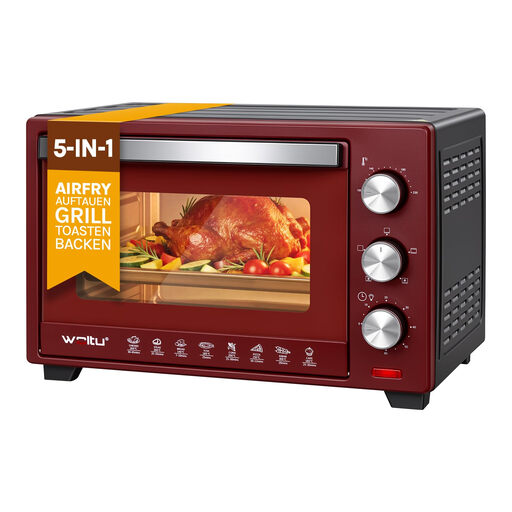
WOLTU mini convection oven, 28 l
Could work as a freestanding oven if your dish fits and there’s enough space for the appliance.
28 l; temperature control; timer.
View at Joybuy
Frequently asked questions
Can I tell whether my oven dish will fit just from the capacity in litres?
No. Compare your dish, including its handles, with the interior dimensions or the maximum dish size explicitly stated for the model. Also check that there’s enough height to slide it in.
Will any oven dish fit in an air fryer?
Not necessarily. Check that the dish is suitable for the specific appliance and really does fit in the basket. Philips lists baking sets for specific models and recommends using the model number when looking for accessories.
How much clearance does a freestanding mini oven need?
It depends on the model. Rommelsbacher specifies 4 cm of clearance at the sides and 1 m above the BG 1055/E, and says it must not be installed as a built-in appliance. The Steba KB M19 manual requires a 10 cm gap between the back of the appliance and the kitchen wall.
What should I bear in mind if the sausage in the casserole is raw?
Handle it hygienically and make sure it is thoroughly cooked through; don’t rely on browning or a general cooking time alone as proof. The German Federal Institute for Risk Assessment gives 70 °C for two minutes throughout as a guide for meat that has been safely heated. Also follow the instructions for the sausage product you’re using.
Can I use the wattage or energy rating to calculate the electricity cost of this particular casserole?
Not directly. Figures on an oven’s energy label are based on standard cycles, while wattage refers to rated power. To work out the energy use for this specific casserole, you need the kWh measured under comparable conditions.


