
Lieferung heute & morgen

Qualitätsgarantie

Willkommens-Angebote freischalten: KOSTENLOSE Lieferung | Bis zu 80 % RABATT | Kostenlose 30-Tage-JoyPlus-Testphase
App herunterladen
A 28 cm sauté pan with lid is a versatile addition to many kitchens, complementing a saucepan and a traditional frying pan. Its diameter provides plenty of room for several portions, while the taller sides make frying, sautéing, braising and steaming easier. However, if you want a pan that genuinely performs well every day, you should look beyond terms such as “non-stick” or “suitable for all hob types”.
A pan for all hob types should be explicitly approved for gas, electric, ceramic and induction hobs. Some models have a magnetic base, but provide no information about their actual suitability for particular hobs or use in the oven. It is therefore worth checking the product description and maximum temperature before buying.
A non-stick pan can make cleaning easier and reduce food sticking to the surface. However, this does not automatically mean that metal utensils, high temperatures or abrasive cleaners are suitable. Care instructions are crucial for coated models. Even surfaces advertised as scratch-resistant should ideally be used with wooden, plastic or silicone utensils unless the manufacturer states otherwise.
The “28 cm” measurement usually refers to the top rim. The actual base of the pan may be considerably smaller. For induction hobs, the base diameter is particularly important, as it affects the contact area with the cooking zone. Tall sides improve the pan’s suitability for braising, but can make it harder to turn flatter foods.
Aluminium heats up relatively quickly and is often combined with a coating. Stainless steel is durable and can withstand high temperatures when the heat is controlled correctly. Multi-layer constructions with an aluminium core combine some of these properties.
For a stainless steel pan with lid, look for a sandwich or multi-layer base. According to product details, a construction made from stainless steel, aluminium and stainless steel can provide more even heat distribution than a single-layer stainless steel body. Even so, how you use the pan remains important: preheating, choosing the right temperature and adding enough liquid when braising all affect the result.
A coated sauté pan is practical for delicate foods and dishes requiring little oil. Ceramic coatings are often described as PTFE- or PFAS-free; such claims should come directly from the manufacturer’s information. The coating is still a wear part, however. Prolonged high heat, heating the pan while empty, abrasive sponges and sudden temperature changes can shorten its service life.
A glass lid makes it easier to monitor cooking without heat and moisture constantly escaping. Look for a secure fit and a heat-resistant handle. Oven suitability cannot be taken for granted: some models are approved only up to 160 °C, while others can withstand 230 °C or 260 °C. With some pans, the lid must be removed before using the pan in the oven.
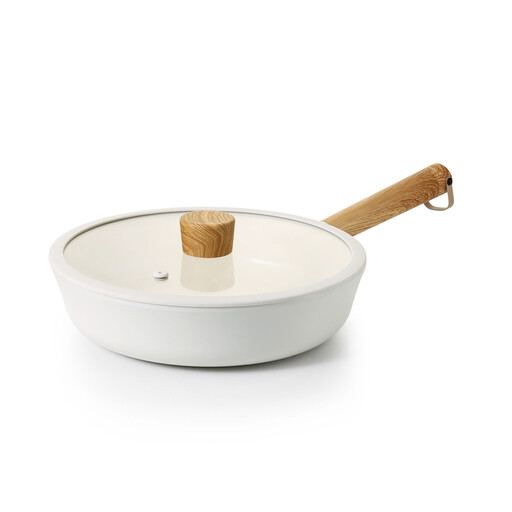
Why this product suits this profile: This deep aluminium pan with ceramic coating and glass lid handles typical cooking tasks in small to medium-sized households. According to the product details, it is suitable for gas, induction, ceramic, electric and halogen hobs.
Hob compatibility and the recommended hand-washing instructions are clearly stated. This makes it easier to match the pan to your hob and preferred care routine.
Ceramic coating, 28 cm diameter, deep sides and glass lid; according to the product description, free from PTFE, PFAS, cadmium and lead.
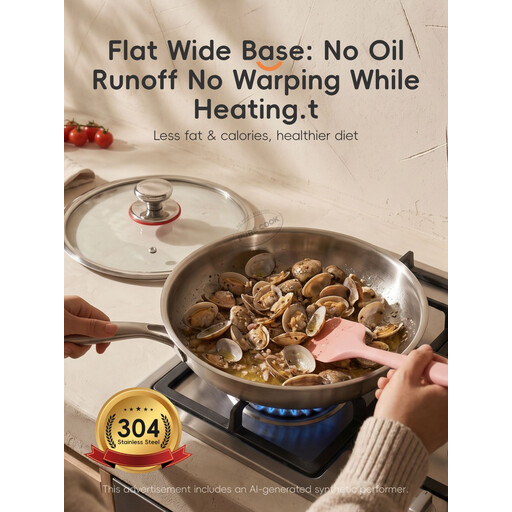
Why this product suits this profile: The three-layer construction of 304 stainless steel and an aluminium core is aimed at shoppers looking for an uncoated, temperature-resistant **28 cm sauté pan** for frying, sautéing and braising.
There is no non-stick coating whose care requirements could be misunderstood. However, the temperature must be controlled correctly to help prevent food from sticking.
304 stainless steel, aluminium core, glass lid, dishwasher suitability according to the product details, and compatibility with gas, induction, ceramic and halogen hobs.
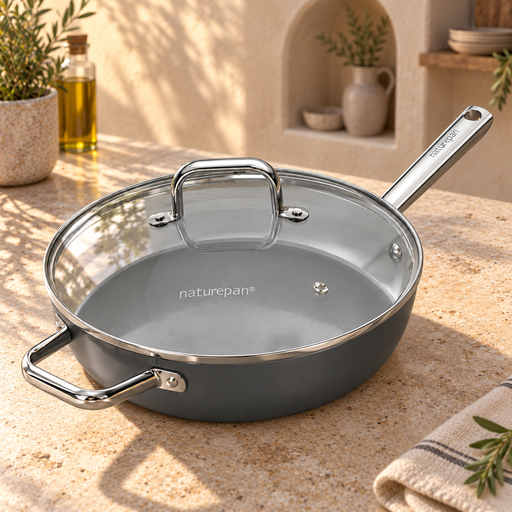
Why this product suits this profile: The tall sides and lid are ideal for larger braised dishes, sauces, vegetable dishes and one-pan meals. The manufacturer states that it is oven-safe up to 260 °C.
The details for side height, lid, hob types and oven temperature are listed separately. The glass lid must be removed before using the pan in the oven.
28 cm, tall sides, ceramic coating with diamond and titanium reinforcement according to the manufacturer, lid and suitability for several hob types.
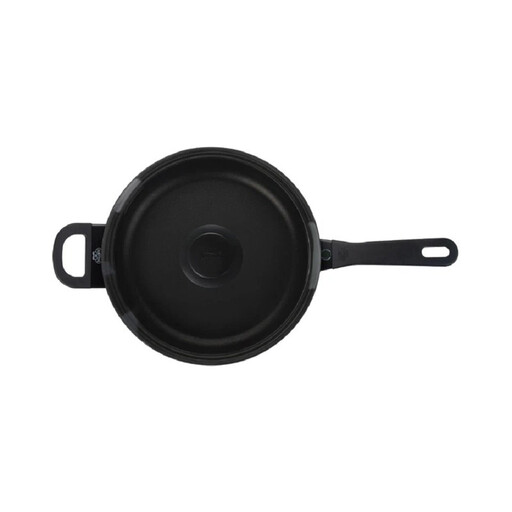
Why this product suits this profile: The tall sides, two handles and glass lid make it an appealing **28 cm serving pan** for braised dishes, pasta and sauces.
The product description specifies the coating, lid, hob compatibility and dishwasher suitability. Even so, gentle kitchen utensils are recommended for the coating.
Aluminium body, four-layer KERAVIS-Extreme coating according to the product details, Thermopoint temperature indicator and matching glass lid.
We have put together a complete, regularly updated list of products that fully meet these strict selection criteria and the safety regulations applicable in the EU.
That depends on the base. An induction pan with lid requires a magnetic or induction-compatible base. The product details should explicitly state that the pan is suitable for induction. If you are unsure, testing the base with a magnet can provide an initial indication; the manufacturer’s information is authoritative, however.
There is no reliable way to give a fixed service life. It depends on the heat used, cleaning method, utensils and frequency of use. Uncoated stainless steel is less dependent on coating care in this respect, but it requires more precise temperature control.
For many households, this diameter is suitable for around two to four portions, depending on the side height and base area. With very large quantities, the food may be packed too closely together and release water rather than brown. If you regularly cook for several people, you should also compare capacity, interior height and weight.