
Lieferung heute & morgen

Qualitätsgarantie

Willkommens-Angebote freischalten: KOSTENLOSE Lieferung | Bis zu 80 % RABATT | Kostenlose 30-Tage-JoyPlus-Testphase
App herunterladen
A sauté pan with lid combines the cooking surface of a frying pan with the capacity of a small casserole dish. It is suitable for goulash, vegetables, sauces, soups and stews. In many households, it replaces several separate cooking vessels. However, unclear product specifications and exaggerated advertising claims often lead to poor purchasing decisions.
Check these three common pitfalls before buying:
An aluminium sauté pan is relatively lightweight and can conduct heat quickly. Cast or forged aluminium provides a sturdy construction, while a capsule or bimetal base distributes heat more evenly across the cooking surface.
Look out for the following details:
For an induction sauté pan, the base diameter is also important. A small induction ring may not heat a large pan evenly. You should therefore check the size of the cooking zone and the base dimensions of your chosen model.
A coated sauté pan can make it easier to remove food and reduce cleaning time. With ceramic coatings, it should be clear whether this is a ceramic layer on aluminium or a fully ceramic body. These are different materials.
The product details may state that the pan is free from PTFE, PFAS or PFOA. These terms describe the composition of the coating in question, but are not general claims about health effects. Regardless of the type of coating, these practical rules will help ensure a long service life:
Whether a dishwasher-safe sauté pan should actually go in the dishwasher regularly is another question. Many models are described by the manufacturer as suitable for this, but gentle hand washing may help the coating last longer.
A well-fitting glass lid lets you monitor the cooking process without having to lift the lid constantly. High sides reduce splashes when frying and provide room for liquids, vegetables or pieces of meat. This makes a deep pan with lid more versatile for braised dishes, sauces and stews than a shallow frying pan with lid.
You can use these sizes as a guide:
Also consider the weight, handle shape and how easy the lid rim is to clean. A heavy casserole dish is sturdy, but less convenient to move. An aluminium body is lighter, although it may require specific care at very high temperatures.
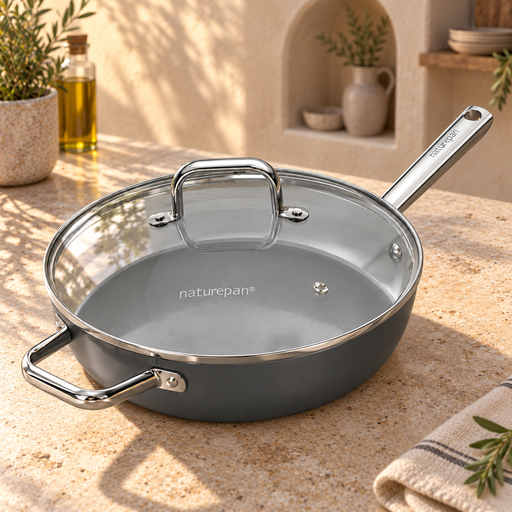
Why this product suits this profile: The 28 cm pan has high sides, a lid and is compatible with induction, gas, ceramic and electric hobs. It is suitable for family-sized portions and everyday one-pan dishes.
The specifications name the compatible hob types, a body height of 7.5 cm and an oven temperature range of up to 260 °C. According to the manufacturer, the lid should be used in the oven only as specified.
Ceramic coating with diamond and titanium particles, glass lid, stainless steel handle and, according to the product details, dishwasher-safe construction.
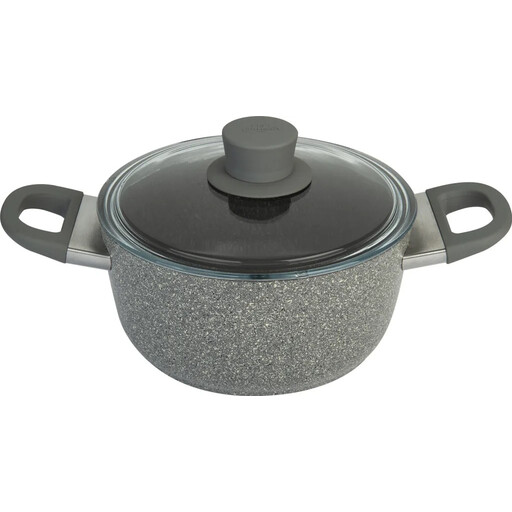
Why this product suits this profile: With a stated capacity of 4.5 l, this 24 cm pot is aimed at households looking for a versatile casserole dish for sauces, soups, larger portions and reheating.
The bimetal base and suitability for gas, induction, electric and ceramic hobs are clearly specified. This makes it easier to check hob compatibility before buying.
Forged aluminium, five-layer GRANITIUM-Extreme coating, glass lid and, according to the product details, dishwasher-safe construction.
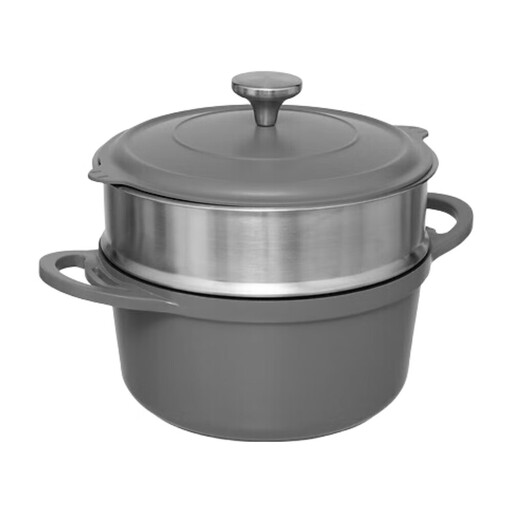
Why this product suits this profile: In addition to the 24 cm cooking vessel, the set includes a lid, a steamer basket and a wooden spoon. This suits households that want to braise, steam and combine several cooking methods.
The contents of the set are listed clearly. This means you do not need to look for a steamer basket and suitable kitchen utensils separately.
Cast aluminium for even heat distribution, lid, steamer basket and wooden spoon; according to the product description, suitable for hobs.
The lifespan of a coated pan depends more on how it is used than on any single advertising term. Heat the pan gradually and, with coated models, use predominantly medium temperatures. Allow the pan to cool after cooking before it comes into contact with water. Check the coating, handle and lid regularly. If the coating is visibly peeling or there is significant damage, the cookware should no longer be used.
For three to four portions, 24 to 28 cm is often practical. The height of the sides and the stated capacity are also important. A 28 cm sauté pan offers more cooking surface, but also requires a sufficiently large cooking zone.
This depends on the model. Check the maximum temperature, the handle material and the instructions for the lid. According to the product details, the Naturepan pan is suitable for oven use up to 260 °C; with other models, the lid may not be suitable or oven use may not be permitted.
Dishwasher suitability makes cleaning easier, but says nothing on its own about heat distribution, coating quality or size. For a longer coating lifespan, manufacturers often recommend hand washing with mild washing-up liquid and a soft sponge.
We have put together a complete, regularly updated list of products that fully meet these strict selection criteria and the safety regulations applicable in the EU.