
Lieferung heute & morgen

Qualitätsgarantie

Willkommens-Angebote freischalten: KOSTENLOSE Lieferung | Bis zu 80 % RABATT | Kostenlose 30-Tage-JoyPlus-Testphase
App herunterladen
When looking for a city e-bike for commuting, shopping or longer leisure rides, buyers often focus first on battery range and motor power. These figures alone, however, do not show whether a bicycle is genuinely suitable for everyday use. Factors such as step-through height, braking system, riding position, equipment and the conditions under which the range was measured are equally important.
The Saxonette ADVANCED SPORT City E-Bike combines a 250-watt rear-hub motor with an integrated 374-Wh battery, 28-inch wheels and a 3-speed drivetrain. It is aimed at adults looking for a practical pedelec with assistance up to 25 km/h for urban trips, short journeys and excursions. Before buying, however, it is worth checking for several common marketing pitfalls.
The claim “up to 100 km of range” is not a guaranteed real-world value. Riding style, assistance level, total weight, headwinds, temperature, tyre pressure and gradients all affect energy consumption. Those who frequently ride with high assistance or tackle numerous climbs will generally achieve a shorter range.
For the Saxonette ADVANCED SPORT City E-Bike, the range of up to 100 km comes from the product specifications and is expressly dependent on several factors and optimal conditions. For everyday planning, it is therefore advisable to allow for a sufficient reserve.
A 250-watt rear-hub motor corresponds to the standard nominal power class for a pedelec. Riding performance is also influenced by torque, assistance levels and weight distribution. The SFM rear motor in the Saxonette model is specified with 80 Nm of torque and provides assistance up to a maximum speed of 25 km/h.
A rear-hub motor can be well suited to urban riding and moderate gradients. Those tackling particularly demanding climbs or regularly carrying heavy loads should also check the permitted gross weight and whether the gearing matches their needs.
A suspension fork can soften impacts at the front wheel, but it does not replace a suitable riding position, appropriate tyres or a well-adjustable saddle. The Saxonette features an SR Suntour NEX-E25 suspension fork with steel springs and mechanical damping. It is complemented by an adjustable seat-post section and a sprung touring saddle.
The bicycle uses a hardtail design. If you are looking for full rear suspension, it is important to understand the differences between a classic city e-bike and a full-suspension model. You can find further variants and equipment options in the rear suspension bicycle category.
The integrated lithium-ion battery in the Saxonette ADVANCED SPORT has a capacity of 374 Wh at 36 V. A full charge is specified as taking approximately five hours. An integrated battery gives the bike a clean, streamlined appearance and is protected within the frame while riding. At the same time, you should check how the battery is charged and whether it is easily accessible in your home environment.
The delivery includes a battery charger, tools and an instruction manual. The battery should only be charged with the supplied charger in a dry, well-ventilated environment. It must not be opened, damaged or exposed to excessive heat.
The model uses a Shimano Alivio 3-speed drivetrain with a chain drive. This gearing is straightforward and sufficient for many urban routes. Unlike an e-bike with an internally geared hub, however, a chain drive has a different mechanical design and requires regular maintenance.
A 3-speed system offers fewer ratios than a trekking e-bike with nine or more gears. For flat routes, cycle paths and everyday journeys, this may be entirely adequate. If you regularly ride long climbs, check whether the available gearing suits your typical routes.
The product specifications list mechanical Shimano MT200 rim brakes on both the front and rear wheels. Mechanical brakes can generally be adjusted via cable tension, but they still require regular safety checks. Before every ride, inspect the brake levers, brake pads and rims to ensure they are functioning correctly.
According to the manufacturer, the 28-inch CST tyres feature reflective strips and puncture protection. This enhances everyday practicality, but it does not eliminate the need to check tyre pressure. The permitted gross weight is 130 kg, including the rider and luggage. The luggage rack is suitable for everyday transport provided its own load limit is respected.
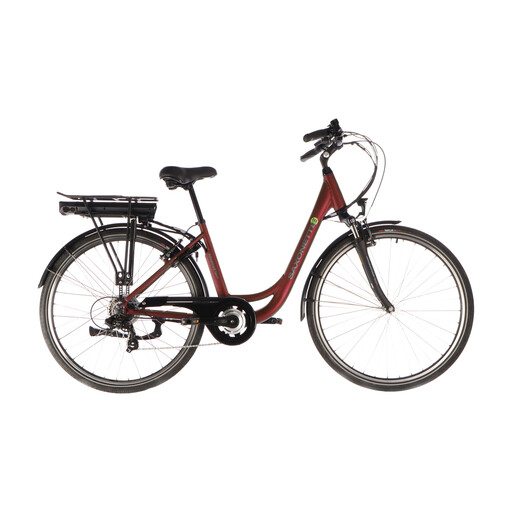
Why it fits: For urban rides, short commutes and everyday errands, with 28-inch wheels, a luggage rack and a 3-speed drivetrain.
The range is stated with the necessary qualifications. Battery capacity, motor power, charging time and permitted gross weight are clearly specified.
250-watt rear-hub motor with 80 Nm of torque, integrated 374-Wh battery, suspension fork, puncture-resistant tyres and LED lighting.
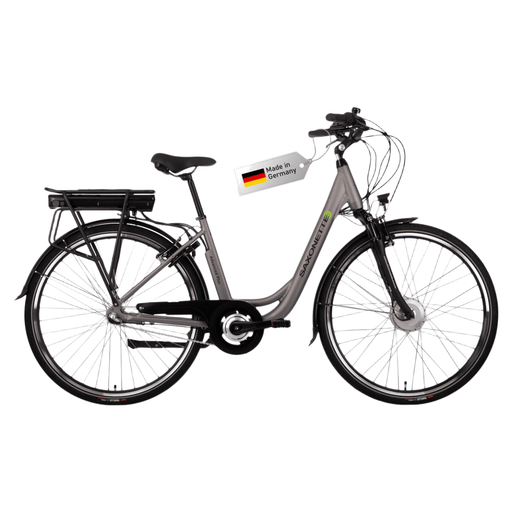
Why it fits: For riders who prioritise a low step-through, luggage capacity and easy-to-use gearing for everyday cycling.
The specifications state the actual battery capacity of 374.4 Wh and a range of up to 80 km rather than presenting a blanket idealised figure.
Low step-through, 3-speed hub gear, coaster brake with additional brakes, luggage rack and removable battery.
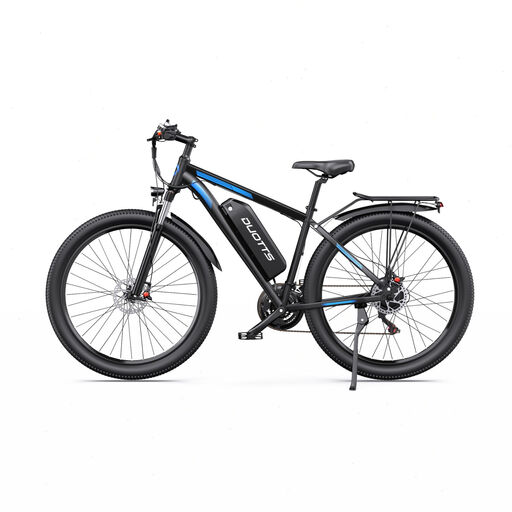
Why it fits: For buyers comparing a larger wheel format, a 48 V battery and hydraulic brakes as key equipment features.
Before buying, motor, battery and brake specifications can be matched directly to your intended use instead of relying solely on the model name.
According to the product name, a 48 V, 15 Ah battery, assistance-mode range of up to 90 km, and hydraulic brakes at the front and rear.
Explore the complete selection to compare features such as suspension, wheel size, battery capacity and intended use.
According to the product specifications, the Saxonette ADVANCED SPORT is delivered approximately 95 per cent pre-assembled. Before the first ride, the pedals must be fitted and the handlebars aligned. You should also check the bolts, brakes, gears and lighting. A final inspection by a qualified bicycle workshop is advisable, particularly if you have no previous assembly experience.
Electricity costs depend on your tariff and the amount of energy actually replenished. For a rough calculation, use: Battery capacity in kWh × electricity price per kWh. The 374-Wh battery corresponds to approximately 0.374 kWh per full charge, although charging losses must also be taken into account. Tyre care, brake checks, chain maintenance and regular inspections all affect operating safety and the service life of the components.
In Germany, a pedelec with assistance up to 25 km/h generally does not require registration in the same way as a motor vehicle. However, rides in public spaces must comply with the applicable traffic regulations and the required equipment under the StVZO. According to the product information, this model is intended for use in accordance with the German StVZO.
The product specifications state a range of up to 100 km under optimal conditions with the integrated 374-Wh battery. The actual distance depends on factors including assistance level, road surface, temperature, tyre pressure, gradients and payload.
The model is equipped for urban rides, short journeys, excursions and daily commutes, with a luggage rack, lighting, chain guard, 28-inch wheels and a 3-speed drivetrain. Before buying, check your route profile, body height, frame size and available storage or charging facilities.
The fully integrated 374-Wh lithium-ion battery is specified as taking approximately five hours to charge. Use only the supplied charger, and charge the battery in a dry, well-ventilated location away from easily flammable materials.