What should you look for when buying?
First, work out how often you need individual items dry at short notice and what size loads you typically have. Then you can weigh up the appliance type, energy consumption and space requirements.
Heat pump tumble dryer
A good fit if: you regularly use a tumble dryer and energy consumption matters over many cycles.
Things to consider: The Verbraucherzentrale rates heat pump tumble dryers as more energy-efficient than condenser dryers without a heat pump; according to AEG’s service information, they can also take longer to run.
Condenser tumble dryer without a heat pump
A good fit if: the purchase price is your main priority and you only plan to use the dryer occasionally.
Things to consider: Compare the stated energy consumption and expected use with a heat pump tumble dryer, rather than looking at the purchase price alone.
Clothes airer as your main option
A good fit if: you have enough time and space to air-dry your clothes, and would only need a tumble dryer on the odd rainy day.
Things to consider: Air-drying takes time and space. If you dry washing indoors, you should also manage the resulting moisture by ventilating the room appropriately.
Washer-dryer
A good fit if: you have very little room for a separate washing machine and tumble dryer.
Things to consider: The Verbraucherzentrale says washer-dryers use more electricity and water than separate appliances. You may also need to split a wash load before drying it.
| Buying priority |
What to check |
Who it matters most to |
| School clothes dry on time |
Duration and permitted load for the right programme; suitability for small loads |
If individual school items need to be dry by the next morning, the duration of the right small-load programme matters to me. That’s why around 29% of consumers prioritise getting individual school items dry on time. |
| Electricity consumption |
kWh per 100 Eco cycles for the same model; factor in expected use separately |
If I dry clothes often, I want to be able to estimate the electricity needed over many cycles. That’s why around 23% of consumers put ongoing electricity costs first. |
| Suitable drum capacity |
Your usual dry laundry load; the load limit for the programme you actually use |
If I have family laundry as well as school clothes to dry, I don’t want to have to plan several smaller loads all the time. That’s why around 18% of consumers prioritise a capacity that suits their usual laundry loads. |
| Space and humidity |
Appliance dimensions and door opening at the planned location; the model’s noise and condensation figures |
If I already have a clothes airer in the house, an additional tumble dryer needs to fit in a suitable spot. That’s why around 18% of consumers put available space and humidity at home first. |
| Caring for different fabrics |
Check care labels against the programme guide; check the instructions for mixed loads |
For sportswear or delicate school clothes, I want to check the care label and programme together rather than relying on the programme name alone. That’s why around 12% of consumers prioritise suitable care for different fabrics. |
Heat pump tumble dryers at Joybuy
The Joybuy products below are heat pump tumble dryers for regular laundry loads, with a range of programme options and drum capacities to suit different needs.
 No image available
Haier I-Pro 1 HD80-E929E-DE, 8-kg heat pump tumble dryer
For regular loads where moisture control is important.
According to the product description, sensor drying stops the cycle once the laundry is dry; several drying programmes are listed.
View at Joybuy
 No image available
LG RT80X7B, 8-kg heat pump tumble dryer
For households looking for an 8-kg model with programmes for different fabrics.
The product details list TurboDry and SensorDry, as well as programmes for sportswear and wool.
View at Joybuy
 No image available
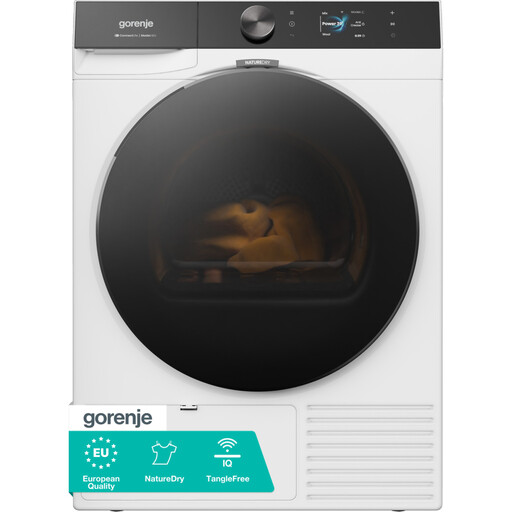
Gorenje DG89BP, 9-kg heat pump tumble dryer
For larger loads and households looking for a choice of programmes for different fabrics.
The product details list 15 programmes and a moisture sensor, including programmes for sportswear, wool and shirts.
View at Joybuy
 No image available
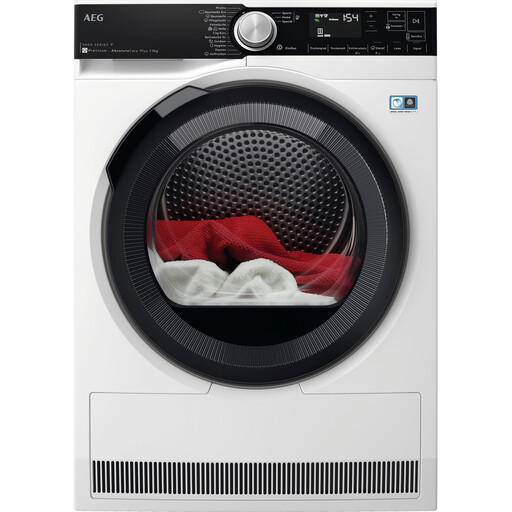
AEG TR9DW80690 9000 series, 9-kg heat pump tumble dryer
For larger household loads, with a quick programme also available for smaller loads.
The product description lists ProSense load sensing and a 3-kg quick programme. Check the programme guide to see which fabrics and load sizes are permitted.
View at Joybuy
 No image available
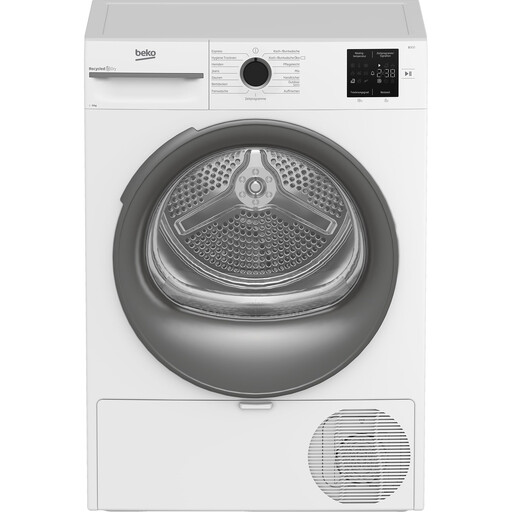
Beko BM3T39210W1, 9-kg heat pump tumble dryer
For larger laundry loads and households that need a choice of drying programmes.
The product details list 15 programmes, as well as an Express programme and a moisture sensor mode.
View at Joybuy
Frequently asked questions
Is a 30- or 40-minute programme suitable for a full load of school clothes?
Not based on the programme duration or name alone. Check the manual for the specific model to find the permitted load, fabric types and drying result; the stated capacity doesn’t automatically apply to every quick programme.
Which figure should I use to compare electricity consumption?
The EU energy label for tumble dryers shows consumption in kWh per 100 drying cycles using the Eco programme. To estimate your own costs, you’ll also need to know how many cycles you expect to run and your electricity tariff; other programmes may use more or less.
Which energy label applies when buying a new tumble dryer in Germany?
Household tumble dryers use the EU energy label, with a scale from A to G, which has been in use since 1 July 2025. Compare the label and product data sheet for the specific model, not an older A+++ rating or a different heading. The EU regulation covers the energy labelling of household tumble dryers.
What should I bear in mind when installing and caring for the appliance?
Check the dimensions and door opening against the space you have in mind, and follow the model’s installation and care instructions. If clothes aren’t drying properly, AEG’s service guide recommends checking the container, load and care symbols, among other things.
Does a tumble dryer mean I don’t need to ventilate if I still dry clothes on an airer?
No. If you air-dry clothes indoors, moisture is still something to consider. The Umweltbundesamt recommends keeping an eye on excess moisture and its causes, and ventilating appropriately.


