What to look for when buying
First, check which ingredients need to be avoided. Then compare the label on the specific variety with the school’s requirements, and check the nutritional information if needed.
| Criteria |
What to check when buying |
Who it matters most to |
| Allergens and nut rules |
Compare the ingredients and highlighted allergens for the variety with the ingredients to avoid and the school’s policy; check for possible traces separately. |
If my child needs to avoid several ingredients or the class is nut-free, I need information about the exact variety. For around 33% of consumers, avoiding a specific allergen or nuts is the top priority. |
| Gluten-free labelling |
Look for an explicit ‘gluten-free’ statement and check any other relevant allergens separately. |
If I need to avoid gluten when choosing a bar, I can’t rely on assumptions based on individual ingredients. Around 27% of consumers put gluten-free labelling first. |
| Lactose-free or vegan recipe |
Check that the specific variety carries the label you need. Don’t assume ‘lactose-free’ means ‘dairy-free’, and check for nuts in vegan bars. |
A lactose-free or vegan recipe may be essential for my family, but that doesn’t mean every other ingredient is excluded. Around 20% of consumers prioritise this requirement. |
| Ingredients and sugar |
Compare the sugar per 100 g and, if stated, per bar in the nutritional information, as well as the ingredients list. |
Even when a pack says ‘no added sugar’, I want to know how much sugar the bar contains overall. For around 20% of consumers, ingredients and sugar content are the main reasons for choosing a product. |
Gluten-free bars at Joybuy
This bar is part of the gluten-free selection for the start of the school year. It isn’t suitable if nuts, milk or soya also need to be avoided, or if the school has a nut-free policy.
 No image available
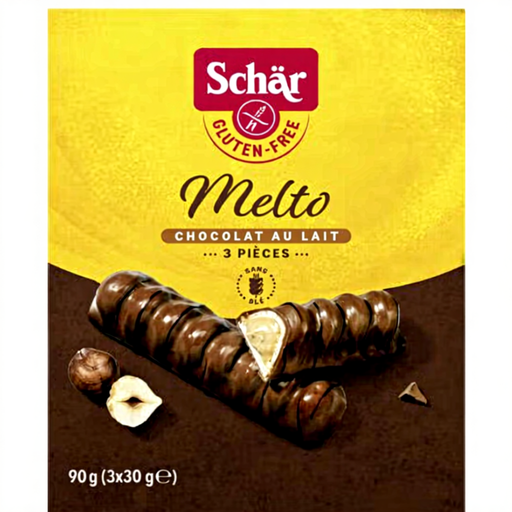
Schär Gluten-Free Melto Hazelnut Wafer Bars, 3 × 30 g
An option for a gluten-free bar selection, provided there’s no nut-free school policy or other allergens that need to be avoided.
The pack contains three hazelnut wafer bars, each weighing 30 g. This bar isn’t suitable if you have a nut, milk or soya allergy. Also check the information about possible traces on the pack you receive.
Compare the sugar content using the nutritional information on the pack.
View at Joybuy
Frequently asked questions
How do I check allergens in a packaged school snack bar?
Read the ingredients list and the highlighted allergens for the specific variety. Lebensmittelklarheit explains which 14 main allergens must be included in the labelling. If there’s a risk of traces that’s relevant to your needs, check the corresponding information on the pack too.
Is ‘gluten-free’ labelling enough to choose a bar?
The specific variety must be explicitly labelled gluten-free to answer the question about gluten, but that won’t cover other allergens. Check for nuts, milk, eggs or soya separately if your child needs to avoid them.
Does ‘lactose-free’ also mean ‘dairy-free’?
No. ‘Lactose-free’ doesn’t tell you whether a product contains milk as an allergen. Lebensmittelklarheit explains that the claim relates mainly to lactose intolerance. If milk protein needs to be avoided, check the ingredients and allergen labelling.
Is a bar with no added sugar sugar-free?
No. Ingredients such as dried fruit can contain sugar even when no sugar has been added. Compare the total sugar content per 100 g and, where available, per bar in the nutritional information.


