Families with several loads of uniform
If you want to hang clothes from separate wash loads at the same time, look for enough usable drying space and room between garments.


When you need to dry several separate loads of uniform at the same time, usable hanging space, room between garments and the maximum load matter more than a high wattage alone. A heated airer may be worth considering for individual items you need again soon. A large, unheated airer provides drying space without using electricity, but offers no active heat. When drying clothes indoors, ventilation is important, and you should check that the specific model complies with the relevant requirements before buying a heated appliance.
If you want to hang clothes from separate wash loads at the same time, look for enough usable drying space and room between garments.
If you need individual items again soon in bad weather, heat could be an option. However, how effective it is for a particular garment depends on the fabric and the time available.
You’ll need to weigh up the floor space required against the folded dimensions and whether there’s enough ventilation.
A good fit if: You want to hang separate loads at the same time and have enough floor space and ventilation. Todeco’s model has three tiers.
Things to consider: Todeco gives a maximum load of 5 kg per tier; this doesn’t tell you how long it will take to dry full loads of uniform.
A good fit if: You mainly need to dry individual items you’ll be wearing again soon, and want to fold the airer flat for storage afterwards. Adler Europe gives the folded dimensions of the AD 7821 as 113 × 52.5 × 8 cm.
Things to consider: The heating elements and dimensions don’t tell you how quickly it will dry a load of uniform or whether there’s enough room for several full loads to be hung with space between them.
A good fit if: You need space for several loads but don’t need them dry by the next morning. Leifheit gives the Classic 250 Flex a drying length of 25 m and says it can hold two to three washing machine loads.
Things to consider: The airer doesn’t provide active heat. If you dry clothes indoors, you’ll need to ventilate the room to let the moisture out.
| What you need | What to check before buying | Who is it most relevant to? |
|---|---|---|
| Space for separate loads | Check the usable number of tiers or drying length, as well as the footprint and maximum load of the specific model. | If I need to hang several separate wash loads at the same time, I need room between garments and a suitable maximum load. Around 31% of consumers are likely to need space for several loads. |
| Getting individual items ready to wear again quickly | Check whether the items you need can hang freely on the heated bars; the wattage doesn’t guarantee a particular drying time. | If I need a particular shirt or pair of trousers again soon, being able to hang that item separately matters to me. Around 25% of consumers are likely to have this as their main priority. |
| Moisture indoors | Choose a spot where you can ventilate the room and allow for regular air circulation. | If I regularly dry clothes indoors, I need to consider the extra moisture. Around 19% of consumers are likely to see ventilation as a deciding factor. |
| Different uniform fabrics | Check the care label and drying symbol on each garment; a temperature rating doesn’t mean the airer is suitable for every fabric. | For delicate uniform items, I want to follow the care instructions rather than assume that extra heat or maximum capacity is suitable. Around 13% of consumers are likely to prioritise fabric care. |
| Floor space, storage and electricity | Check the dimensions when set up and folded. For heated models, consider the rated power and how long you plan to use the airer. | If I have limited space for the airer or want to limit how long the heat is on, storage space also matters to me. Around 12% of consumers are likely to prioritise these factors. |
Having several tiers doesn’t automatically tell you how many uniform items can be hung with room between them. The size, spacing and weight of the garments all affect the usable drying space.
Plan around the uniform you actually need to dry and check the set-up dimensions and maximum load, rather than assuming the number of tiers equals a certain number of loads.
Damp clothes release water into the air. The German Environment Agency lists them as an additional source of moisture and recommends taking particular care to ventilate regularly when drying clothes indoors.
Choose a place where air can circulate, and don’t treat a heated airer as a substitute for ventilation.
Wattage figures for different models aren’t a like-for-like test using uniform loads of the same size. They don’t prove that your clothes will be dry by morning.
Compare the hanging options and dimensions first. To estimate electricity use, consider the rated power and how long you plan to run the airer, without assuming a particular drying time.
Folding heated airers, including a three-tier model that may suit separate loads hung at the same time.
The folding heated winged airers AD 7821 and AD 7829 differ in their dimensions and number of heating elements.
The range includes folding heated clothes airers. Model 850-048 is described as a two-tier design.
The Classic 250 Flex is a non-electric option to compare if you need space for several loads; it isn’t heated.
The products below include a heated winged airer and an enclosed electric clothes dryer. The latter is not an open heated clothes airer, so check which design best suits your space and the uniform items you need to dry.
 No image available
The heated centre and folding-out side wings provide separate hanging areas for several uniform items.
Power: 230 W. Dimensions: 144 × 53 × 96 cm. Foldable; maximum load: 10 kg.
Keep to the stated maximum load and ventilate regularly when drying clothes indoors. Check that the specific model complies with the relevant requirements before buying.
 No image available
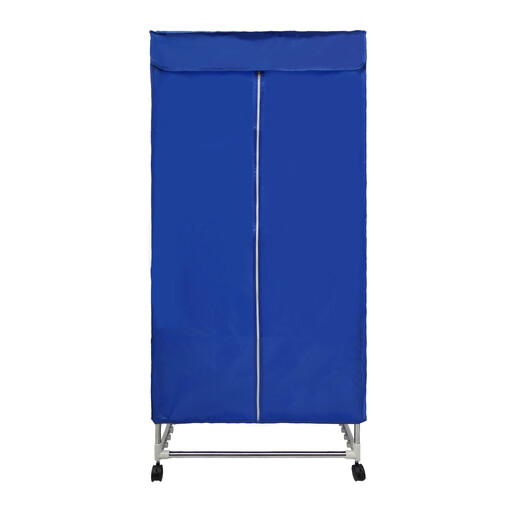
This enclosed electric clothes dryer has a different design from an open heated clothes airer.
PTC heater: 1200–1500 W. Four timer settings. Foldable frame with wheels; according to the product description, it can be adjusted to one or two tiers and can support up to 66.14 lb.
The specifications describe the appliance, not a proven drying time for uniform. Ventilate regularly when drying clothes indoors and check that the specific model complies with the relevant requirements before buying.
Check the usable drying length or hanging areas, the maximum load and the dimensions when the airer is set up. Leifheit says its unheated Classic 250 Flex can hold two to three washing machine loads; this manufacturer claim can’t be applied to heated models.
Yes. The German Environment Agency identifies damp clothes as an additional source of moisture indoors and recommends taking particular care to ventilate regularly.
Multiply the rated power in kilowatts by the estimated number of operating hours. Todeco gives 300 W for its model; assuming it ran at its rated power continuously for three hours, the calculation would be 0.9 kWh. This isn’t a measured figure for drying a load of uniform.
If a product is faulty, the seller is generally your point of contact for your statutory consumer rights. The Verbraucherzentrale states that these rights last for two years from delivery; a voluntary manufacturer’s guarantee is separate. For purchase contracts from 31 July 2026, it describes additional rules, including a possible extension of the statutory rights period if you choose a repair.
For the appliances considered here, which run on 220–240 V alternating current, the electrical component falls within the voltage range covered by the EU Low Voltage Directive. The European Commission states that the Directive applies to alternating current from 50 to 1000 V. According to Your Europe, by affixing the CE marking, the manufacturer declares that the product meets the relevant EU requirements; it isn’t an independently awarded quality mark. You’ll need to check whether a particular product meets the requirements for that specific model.