
Lieferung heute & morgen

Qualitätsgarantie

Willkommens-Angebote freischalten: KOSTENLOSE Lieferung | Bis zu 80 % RABATT | Kostenlose 30-Tage-JoyPlus-Testphase
App herunterladen
A science kit is often a popular gift for school-aged children, sparking curiosity and offering a fun gateway into the world of science. However, the vast selection can be overwhelming, and not every kit delivers on its promises. As a Joybuy Product Recommendation Officer, I see daily which products bring joy and which lead to disappointment. This guide will help you navigate the typical pitfalls and make an informed decision.
Before you choose a product, you should be aware of three common problems that can quickly spoil the fun.
To avoid the problems mentioned above, check three crucial features before purchasing. These will help you objectively assess the quality and educational value of a kit.
The manufacturer's age recommendation is the most important guide. A set for an eight-year-old has different requirements for fine motor skills and reading comprehension than an educational toy for children of preschool age.
Safety is non-negotiable. Look for the CE mark, which confirms that the product meets EU safety standards. For chemical experiments like a crystal growing kit or a DIY slime kit, it is especially important that the substances are explicitly approved for use by children and that warning labels are clearly stated. Sturdy tools and containers made of high-quality plastic prevent parts from breaking on the first use.
A good kit captivates for a longer period. Check how many different experiments are included or if the basic principle encourages your own creations. Themed sets can specifically foster interests:
Here are some recommendations tailored to different interests and age groups that meet the quality criteria mentioned above.

Why This Fits Their Persona: Ideal for kids who love being the center of attention and entertaining an audience. This set builds confidence and fine motor skills by teaching tricks, rather than just conveying knowledge.
With 25 different tricks, the magic kit offers high replay value, thus avoiding the pitfall of short-lived fun. The illustrated guide is suitable for early readers.
A comprehensive starter set with all the necessary props (hat, wand, etc.). Additional online video tutorials for key tricks make learning even easier.
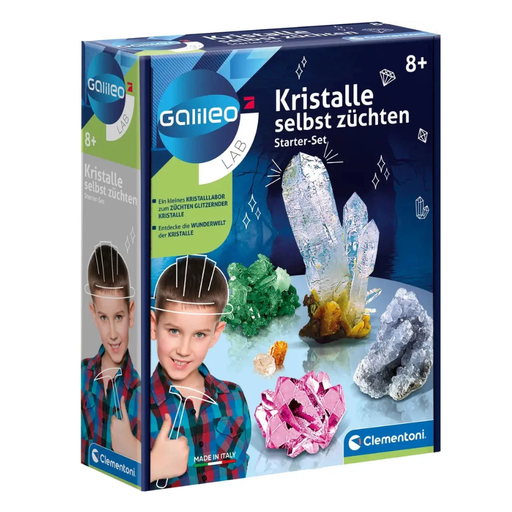
Why This Fits Their Persona: Perfect for patient observers and children with a strong interest in natural phenomena. The set makes abstract concepts from chemistry and geology tangible and visible.
The kit is designed as an all-in-one starter package, avoiding the pitfall of incomplete sets. The clearly illustrated manual prevents frustration from confusing instructions.
Promotes concentration and logical thinking, as the crystal growth process is observed over several days. The result is an impressive, self-made display piece.

Why This Fits Their Persona: For kids who love role-playing and are fascinated by espionage and technology. This gadget is a tool for adventure, not a one-off experiment.
As a standalone toy with a clear function, it offers long-lasting play. It's not a consumable kit but a reusable detective tool (batteries not included).
The encryption feature (playback only with a key card) adds an authentic touch to the game and protects "secret" messages. It encourages creative and strategic thinking during play.
We've compiled a complete, up-to-date list of products that fully meet these strict selection criteria and EU safety regulations.
For children aged 6 to 7, the ideal kits are those that offer quick, successful results and don't require complex instructions. Look for large, easy-to-handle parts, few experimental steps, and a purely visual guide. Topics like simple nature observation (e.g., an herb garden), physical water experiments, or basic building and construction sets are well-suited.
It varies greatly. Some kits, especially in chemistry or cosmetics, are often designed as all-in-one packages. Others, particularly in physics or electronics, assume that common household items like batteries, scissors, tape, or empty bottles are available. A quick look at the contents list on the packaging or in the product description is essential to avoid disappointment.
STEM (Science, Technology, Engineering, and Mathematics) toys promote important skills in a playful way. They stimulate logical thinking and problem-solving skills by helping children recognize cause-and-effect relationships. Following instructions trains concentration, while the act of experimenting itself strengthens creativity and the willingness to learn from mistakes. It's a meaningful way to get children excited about scientific topics.