
Lieferung heute & morgen

Qualitätsgarantie

Willkommens-Angebote freischalten: KOSTENLOSE Lieferung | Bis zu 80 % RABATT | Kostenlose 30-Tage-JoyPlus-Testphase
App herunterladen
A science kit for children can make science tangible: children observe, measure, mix, build and record their own results. However, not every set is suitable for every age group or learning objective. Packaging often promotes a high number of experiments, eye-catching effects or a “laboratory feel”, while important details only become clear once the box has been opened.
“20 experiments” or “more than 50 experiments” sounds comprehensive. However, what matters is whether the materials are sufficient for several rounds and how many household items are required. With a chemistry science kit, it should also be clear which substances are included and whether individual consumables need to be purchased separately.
An educational toy for children aged 8 and over can vary considerably in difficulty depending on its contents. Optical illusions and simple mixing experiments can often be carried out independently. Handling hot water, small parts, batteries, sharp tools or living organisms, on the other hand, requires adult supervision. The age recommendation therefore does not replace checking the safety instructions.
Pipettes, test tubes, moulds or a microscope make a science kit for children appealing. However, clearly explained steps, background information and questions about observations are more important for effective learning. Without these, the set may remain a one-off craft activity.
For children aged 6 to 9, topics from science for children are suitable, such as light and shadow, air, water or the human senses. From the age of 8, chemistry, biology, perception and simple changes to materials can be added. For young people up to 14, microscopy, robotics or longer-term observation projects may be interesting.
Look out for the following information:
A good science kit for children should not merely produce an effect; it should explain what is being observed. Check whether each experiment includes a learning objective, a materials list and easy-to-understand instructions. For schools, group size, repeatability and the option of structured documentation are also important.
For sets containing chemical substances, hot liquids or small components, the information should be especially comprehensive. Relevant points include:
For example, a science kit for children with a microscope should state whether batteries are included. The KOSMOS Explorer Microscope requires 2 AA batteries, which are not included. Information like this prevents extra trips and disappointment.

Why this product suits this profile: This set is designed for children aged 8 to 12 and does not require batteries. Optical illusions, 3D glasses, a Sphericon and a distorted room offer an accessible introduction to perception and STEM topics.
The instructions explain the scientific principles behind the optical effects, rather than simply delivering a brief moment of surprise.
No batteries required; ideal for first experiments in visual perception.
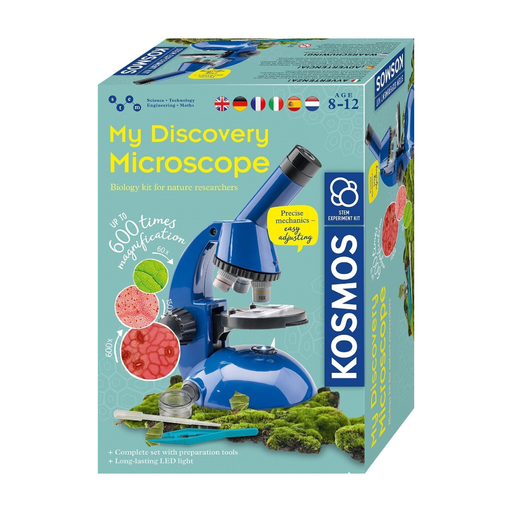
Why this product suits this profile: For children aged 8 and over, this set combines observation with biological fundamentals. The equipment includes slides, cover slips, a pipette, tweezers and sample containers, among other items.
Magnification of up to 600x and the preparation accessories supplied make the intended observation process easy to follow.
LED lighting; extensive accessories for plant, animal and fibre samples.
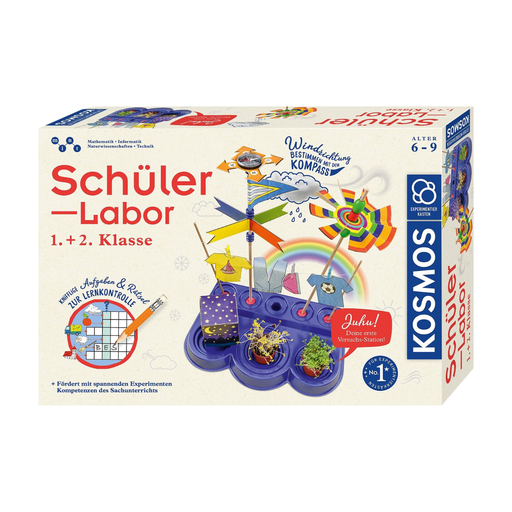
Why this product suits this profile: This set is designed for children aged 6 to 9 and covers more than 50 experiments on light, shadow, air, water, hearing and sight. This makes it suitable for use at home and as an addition to primary school lessons.
The topics are arranged by age group and accompanied by illustrated instructions and knowledge-based activities.
Wide range of topics; hands-on activities without batteries.
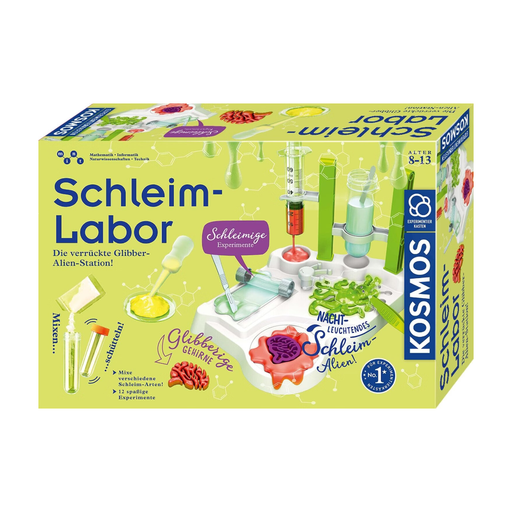
Why this product suits this profile: This large laboratory station is designed for children aged 8 and over and contains 20 experiments, including slime, fizzing liquids and colour changes.
Pipettes, test tubes and measuring cups are used specifically in the individual steps; the supervision requirement and instructions remain essential.
20 described experiments; laboratory station with several containers and tools.
We have put together a complete, regularly updated list of products that fully meet these strict selection criteria and the safety regulations applicable in the EU.
This depends on the topic and the steps involved. Simple nature and technology experiments are available for children aged 6 and over. Many chemistry, microscopy and perception sets are designed for children aged 8 and over. Small parts, hot liquids and batteries require the instructions to be followed and, where necessary, direct supervision, regardless of age.
This depends on the number of experiments, the consumables and the child’s interest. Sets with reusable tools, observation activities or a microscope can usually be used over several sessions. With consumable-based sets, such as slime or sweets laboratories, how long they can be used depends more heavily on the materials provided.
Many experiments also require water, bowls, paper or everyday household materials. Battery-powered devices may incur additional costs; the microscope mentioned above does not include the 2 AA batteries. Before buying, it is therefore worth checking the complete list of items included and the information about consumables.