Presenters with an HDMI camera
You want to record footage from a camera you already own alongside your slides. Check the HDMI signal your camera outputs and whether it’s compatible with the recording device.


If your slides and camera are already available on the computer you’re recording on, screen and webcam recording is often all you need; a capture card isn’t automatically necessary. For the HDMI signal from a camera or a second computer, an HDMI-to-USB solution is suitable, while switching between several sources at once requires a video mixer or multiple compatible inputs. Before buying, check the actual recording signal, recording resolution, USB requirements and audio setup.
You want to record footage from a camera you already own alongside your slides. Check the HDMI signal your camera outputs and whether it’s compatible with the recording device.
Your slides are coming from another computer. You’ll need a suitable way to capture its HDMI signal; if you want a separate preview, an HDMI output to a monitor may also be useful.
You want to switch between or combine your camera and slides live during the presentation. The key is how many HDMI inputs your setup needs to use at the same time.
| What you need | What to check | Who it matters most to |
|---|---|---|
| Connecting an HDMI camera | Check the camera output, supported resolution and frame rate, USB connection and exact device version. | If I want to record myself with an HDMI camera alongside my slides, its signal needs to be compatible with the capture card. Around 40 % of customers prioritise connecting a camera. |
| Recording slides from a second computer | Check the presentation computer’s HDMI output against the input and recording resolution; if needed, allow for an HDMI output to a monitor. | If my slides are on a second computer, I want to include its display in the recording and view it separately if needed. Around 30 % of customers consider a second computer first. |
| Combining sources live | Check how many HDMI inputs you need to use at the same time and what the exact mixer model can do. | If I want to switch between my camera and slides or combine them during the presentation, I need a setup that can handle these sources together. Around 20 % of customers prioritise multiple video sources. |
| Audio and recording workflow | Check your microphone and HDMI audio in the recording software, then test a short audio-and-video recording before your presentation. | If I’m recording a spoken presentation, I want to control the microphone and other audio deliberately, rather than accidentally adding the same source twice. Around 10 % of customers put audio and workflow first. |
A capture card’s supported HDMI input and its maximum recording resolution may differ. For the AVerMedia BU113, the manufacturer lists input up to 2160p60, but a maximum recording resolution of 2160p30.
For the exact model version, check the input, recording resolution and, where applicable, passthrough output separately.
A single input won’t automatically capture a camera and slides from separate HDMI sources at the same time. You may need extra recording or mixing equipment for this kind of setup.
Before buying, count how many HDMI signals need to be available at once and choose a device with the right number of inputs.
AVerMedia says that, since 17 July 2025, it has stopped issuing new serial numbers for CyberLink PowerDirector 15 with the GC573. According to the manufacturer, serial numbers that have already been issued can still be activated.
Choose your recording software independently of any software that may have been advertised as included in the past.
Cam Link 4K is designed for an HDMI camera, while Game Capture 4K S has an HDMI passthrough output.
The models listed here suit different setups: BU113 for HDMI-to-USB recording, GC311 for Full HD recording with passthrough, and GC573 for a compatible desktop PC.
The ATEM Mini Pro is an HDMI video mixer for presentations where several sources need to be combined live.
USB Capture HDMI Gen 2 is designed to connect a single HDMI source to software or a conferencing setup via USB.
This selection includes HDMI-to-USB capture cards for cameras and other HDMI sources, some with passthrough output for an additional monitor. In particular, don’t mistake the stated recording resolution for the input or passthrough resolution.
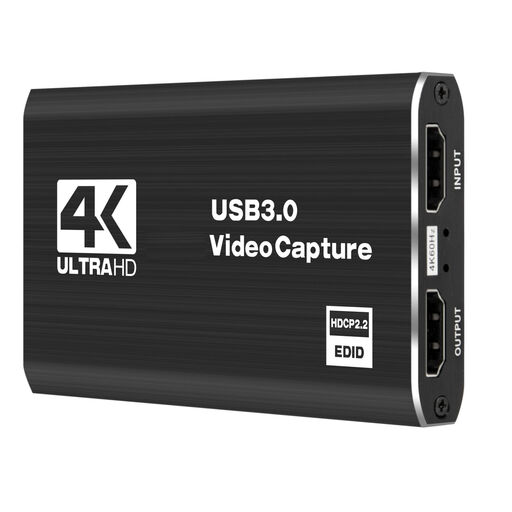 Image unavailable
For an HDMI source such as a camera, when you also want to pass the picture through to a monitor.
Listed specifications include 4K/60 Hz input and passthrough, with recording up to 1080p/60 Hz.
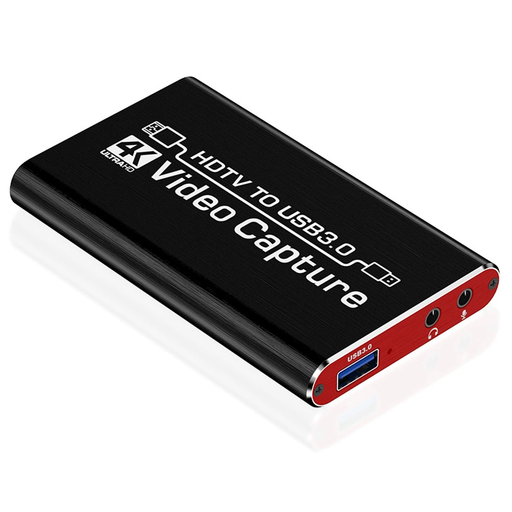 Image unavailable
For an HDMI camera or another HDMI source, when you want to include a microphone and headphones in your recording setup.
The HDMI input is listed as supporting up to 4K/30 Hz, with recording up to 1080p/60 Hz. Passthrough, a microphone port and a headphone port are also listed.
 Image unavailable
For connecting an HDMI source to your computer when you want to use OBS and send the picture to a separate screen via HDMI at the same time.
Specifications include 1080p recording and 4K HDMI passthrough. Windows, macOS and Linux are listed as compatible systems.
No, not necessarily. OBS Project lets you capture your screen, individual windows and video; first check whether you can record your existing sources directly.
Add the capture device as a video capture source and select the specific device. Set your microphone as an audio source and check whether it’s also enabled globally: OBS Project warns that adding it twice can cause an echo.
Check the supported HDMI input, recording resolution and, where applicable, passthrough output separately. For example, the manufacturer lists the AVerMedia BU113 as supporting input up to 2160p60, but a maximum recording resolution of 2160p30.
There’s no blanket yes or no. Unless it’s a purely personal or family activity, processing personal image or audio data requires an appropriate legal basis under Article 6 of the GDPR; consent is one possible basis, but not the only one. The German Data Protection Conference addresses recordings by organisations separately. The right basis in a particular case depends, among other things, on who is involved, the purpose and the context.