Who are the different types of hob suitable for?

For cooks with limited worktop space

If worktop space is limited, consider the appliance’s footprint, the pan base and the clearance needed around the hob together. For the Touch 2000, for example, CASO lists the appliance dimensions and the suitable pan size.

For cooks who already have a pan

If you want to keep using your existing stew pot, check its base first. Bosch recommends using a magnet, as induction requires ferromagnetic cookware. Rommelsbacher also describes HiLight ceramic-glass and cast-iron hobs as options for cookware that does not meet this induction requirement.

For cooks who simmer for longer

If you want to turn the heat down after bringing your stew to the boil, check the controls and how the hob type responds when you lower the heat. Rommelsbacher says cast iron retains heat for longer; for its HiLight CT 2203/TC hob, the manufacturer specifies a residual heat indicator.

What should you look for when buying?

Consideration What to check Who is this particularly important for?
Worktop space and pan size Check the appliance dimensions, cooking zone and, where applicable, weight limit against the filled pan and the space available. CASO gives specific details for the Touch 2000, including its dimensions, suitable pan size and maximum load. If your filled pan and hob need to fit on a small worktop, the appliance footprint and pan base are particularly important; around 31% of consumers prioritise these factors.
Heat control while simmering Check the controls and power settings on the specific model. Adjustable settings alone do not guarantee a consistent temperature in your stew; Rommelsbacher notes that cast iron retains heat for longer. If you want to turn the heat down in a controlled way after bringing your stew to the boil, check the controls and how much residual heat the hob retains; around 25% of consumers prioritise heat control while simmering.
Using an existing pan Use a magnet to check whether the pan base is suitable for induction, and compare its diameter with the appliance specifications. Bosch recommends the magnet test; Rommelsbacher lists HiLight and cast iron as other hob types. If you do not want to replace your stew pot, first check that it is suitable for the hob type you are considering; around 25% of consumers prioritise continuing to use their existing cookware.
Cleaning and safe use Check the surface material, residual heat indicator, and the specific model’s installation and cleaning instructions. For example, the Rommelsbacher CT 2203/TC has a residual heat indicator. If spills and hot surfaces are a concern while cooking and cleaning, clear instructions and safe handling after switching off are important; around 19% of consumers focus on these factors.

Which buying decisions could cause problems?

  • Buying an induction hob without checking your existing pan

    Induction only works with suitable cookware, and the pan base must also fit the cooking zone.

    Check that the base is magnetic and measure its diameter before choosing a model.

    If your existing pan is not suitable, you may need to buy an additional induction-compatible pan.

  • Assuming wattage or a temperature setting guarantees good simmering

    Power settings and temperature controls describe the options available; they do not tell you how the temperature will actually change inside a full pan.

    Check the controls and adjust the heat as you cook, based on how the stew is actually simmering.

  • Overlooking residual heat from cast-iron and HiLight hobs

    Rommelsbacher says cast iron retains heat for longer; for its HiLight CT 2203/TC model, the manufacturer specifies a residual heat indicator.

    Bear in mind that the surface will remain hot when you turn the heat down and after switching off, and follow the instructions for your specific model.

Which brands are worth considering?

CASO Design

Examples with published specifications include portable single induction hobs such as the Touch 2000.

  • For the Touch 2000, CASO lists features including 2000 W, ten power settings, a suitable pan size of 12–24 cm and a maximum load of 6 kg.
  • Induction-compatible cookware is required. The manufacturer’s specifications are not an independent test of how well the hob simmers a full pan.

Rommelsbacher

The specified single hobs CT 2203/TC with HiLight and AK 1599/E with cast iron represent two non-induction hob types.

  • For the CT 2203/TC, Rommelsbacher lists two heating zone sizes and a residual heat indicator; the AK 1599/E has stepless heat control.
  • Rommelsbacher says cast-iron hobs take longer to heat up and retain heat for longer. This description of the hob type is not a direct comparison between models.

Severin

The KP 1091 is a documented example of a compact, non-induction cast-iron hob with a single cooking zone.

  • For the KP 1091, Severin lists an 18.5 cm heating ring, 1500 W and stepless heat control.
  • According to the product page, repairs are not available for this model; this does not apply to the brand as a whole.

Silvercrest

The SIKP 2200 B1 is an example of a portable single induction hob.

  • The F.A.Z. Kaufkompass review dated 4 August 2026 praised its controls and long cable.
  • The same review cited noise and a rather bulky housing as drawbacks. Test results and product specifications are based on different sources.

Joybuy products for different cooking needs

This selection includes electric hobs with one cooking zone, as well as models with two zones. For the product you are considering, check for the CE marking and clear operating instructions and safety information. According to EUR-Lex, these requirements apply to appliances covered by the EU Low Voltage Directive. The CE marking is not an independent performance test.

Severin KP 1092 electric single hob with an 18 cm heating ring

Severin KP 1092 single hob, 18 cm, 1,500 W

A single cooking zone with stepless temperature control is a good option if you want to adjust the heat while simmering. According to the product description, use stable, flat-bottomed cookware and let the hob cool before cleaning.

View at Joybuy

Induction hob with IGBT technology, eight temperature settings and a timer

Induction hob with IGBT technology, 800–3500 W

This countertop induction hob may be worth considering if your pan base is magnetic and you want a choice of settings. The product title lists eight temperature settings, a timer and overheat protection; check that your pan is suitable before buying.

View at Joybuy
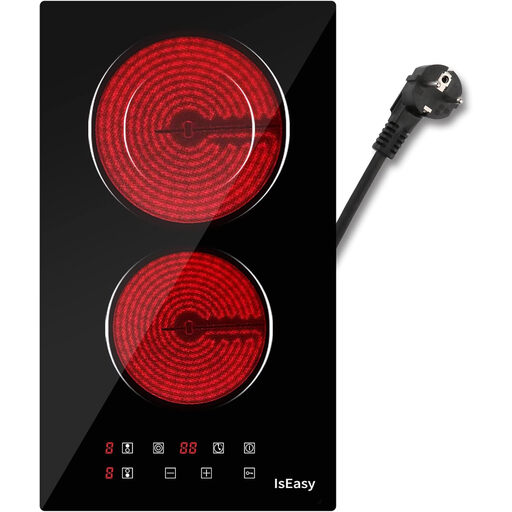
IsEasy ceramic-glass hob with two cooking zones

IsEasy ceramic-glass hob, 2 zones, 3200 W

Two cooking zones may suit you if you want to use another hob alongside your stew. The listed features include nine power settings, touch controls, a child lock and a timer of 1–99 minutes; compare the appliance dimensions with your available worktop space.

View at Joybuy

IsEasy portable induction hob with one cooking zone and 2100 W

IsEasy portable induction hob, 2100 W, 28 cm

A portable single-zone hob is an option if you are looking for a compact appliance and your pan is suitable for induction. The listed features include nine heat settings, touch controls and an eight-hour timer; the product description specifies a pan base diameter of 12–26 cm.

View at Joybuy

Induction hob with two cooking zones and five temperature settings

Induction hob with two cooking zones

Two cooking zones can be useful if you want to simmer your stew on one zone while using another. The product title lists five temperature settings; induction requires magnetic cookware.

View at Joybuy

Frequently asked questions

How can I check whether my stew pot will work on an induction hob?

Hold a magnet against the base of the pan and compare its diameter with the hob specifications. Bosch recommends the magnet test to check induction compatibility. If you are using a large, full pan, also check the stated weight limit.

Do I need to have a hob installed for a portable cooking appliance?

The portable single hobs described here are freestanding appliances. Even so, follow the connection and placement instructions for your specific model, as being portable does not mean it is suitable for every location.

How should I prepare and clean up after making a seafood stew?

Handle raw fish and other uncooked ingredients hygienically, and avoid transferring them to ready-to-eat food. The German Federal Institute for Risk Assessment explains this risk as cross-contamination. Let the cooking surface cool before cleaning, as directed in the appliance manual, and rely on a residual heat indicator only if your specific model is stated to have one.

What should I know about returns and faults when buying online?

For online purchases by consumers, you generally have a 14-day right to cancel, as explained by the Verbraucherzentrale. Your statutory rights against the seller are separate from any voluntary guarantee; check the terms of the specific offer.

What product safety marking is important in Germany?

Mains-powered hobs covered by the EU Low Voltage Directive must carry the CE marking. EUR-Lex also lists clear operating instructions and safety information among the relevant requirements. CE is a conformity marking, not an independent quality seal.