Craft stories recorded at a fixed table
If you’re recording at a prepared spot with a computer, you can use a microphone positioned close to the speaker and check the sound during a test recording.


For a seated craft interview, your choice will mainly depend on your recording device and where you position the microphone. A desk microphone placed close by works well at a fixed computer setup; a lapel microphone moves with the speaker’s head; a directional microphone needs careful positioning; and a portable recorder lets you record without a computer, but will also pick up the room. Before the interview, check the entire recording setup and agree with the interviewee whether and how the recording may be used later.
If you’re recording at a prepared spot with a computer, you can use a microphone positioned close to the speaker and check the sound during a test recording.
If the interviewee moves around a little or you don’t want a microphone in front of them, a lapel microphone paired with a compatible smartphone could be a good option.
If you visit different workshops or homes and don’t want to use a computer, a portable recorder is one possible recording solution.
Best suited to: recording at a fixed computer setup, where the interviewee can comfortably speak into the microphone.
Things to consider: USB-C or XLR must match your recording device. If the speaker moves closer to or further from the microphone, their voice may sound louder or quieter.
Best suited to: situations where the microphone should be worn by the speaker rather than placed on the table.
Things to consider: the receiver must be compatible with your smartphone. According to RØDE, the Wireless Micro transmitters don’t record audio themselves, so the connected device must do the recording.
Best suited to: situations where you don’t want a lapel mic and can position the microphone close to the seated speaker, but out of shot.
Things to consider: positioning, distance and connection all need to be right. A directional design won’t automatically make a noisy room quiet.
Best suited to: recording in different locations without a computer running.
Things to consider: depending on its position and the room, the built-in microphones will also pick up background noise. It’s still important to listen to a test recording.
For a seated interview, first decide whether the microphone should be close to a fixed position, worn by the speaker, placed out of shot or used independently of a computer.
| Priority | What to check before buying | Who is it important to? |
|---|---|---|
| Clear speech at a fixed position | Comfortable microphone positioning and a suitable USB or XLR connection; headphone monitoring for a test recording. | If I’m recording at a fixed spot, I want the voice to stay close to the microphone and be easy to check during a test recording. Around 36% of consumers prioritise clear speech from a fixed seated position. |
| Discreet microphone setup | Receiver version and smartphone connection; number of transmitters needed and recording in the app you’ll use. | If the interviewee turns their head, I don’t want to keep adjusting the distance to the microphone. Around 29% of consumers prioritise a discreet setup that allows the speaker to move freely. |
| Recording without a computer | Storage media and power supply; recorder positioning and the ability to listen back on location. | When interviewing in different locations, I want to be able to record without a computer running. Around 21% of consumers prioritise recording anywhere. |
| Microphone out of shot | Mounting position and compatibility of the USB or 3.5 mm TRS output with the recording device. | If the microphone needs to stay out of shot while filming, I need a suitable position close to the interviewee. Around 14% of consumers prioritise keeping the microphone out of shot. |
The Wireless Micro transmitters send audio to a connected device but, according to RØDE, don’t record it themselves. If recording fails on your smartphone, there won’t be a backup on the transmitters.
Before the interview, use the app you’ll actually be recording with to check that it creates and plays back a file.
Built-in microphones pick up the room as well as the speaker’s voice. A portable recorder is no substitute for suitable positioning or listening to a test recording.
Choose the quietest spot you can and listen back from the actual seated position before the interview. The Library of Congress recommends testing your equipment before an interview.
These are different ways of connecting to a recording device. A microphone will only work with a compatible input or the accessories designed for it.
Make a note of the exact recording device and check its inputs against the specific microphone version.
An XLR setup may require a suitable cable and an audio interface or mixer. The XLR cable is not included with the FIFINE AM8.
The ATR2100x-USB is an option for recording speech at a fixed computer setup, with USB-C and an alternative XLR output.
Wireless Micro is designed for smartphone recording with clip-on transmitters. VideoMic GO II is a directional alternative for compatible camera, mobile device or computer setups.
The H1essential is a portable recorder option for recording without a computer connected throughout.
The DR-05XP is a portable recorder with built-in microphones and an input for an external microphone.
The MV7+ is a USB-C/XLR option for a fixed speech-recording setup.
This selection includes close-positioned USB/XLR microphones, lapel microphones for compatible recording devices and portable recorders for conversations recorded without a computer running.
 No image available
For a fixed seated setup where you want to position the microphone close by and monitor the recording on a computer.
Dynamic microphone with a cardioid polar pattern, desk stand, USB-C and XLR connections, and a headphone socket. According to the product description, RGB lighting and function buttons are only available over USB. XLR requires a separate cable and an audio interface or mixer; the cable is not included.
 No image available
For positioning a microphone on the speaker rather than on the table, provided the 3.5 mm connection is compatible with your recording device.
The product description lists a clip, an omnidirectional microphone, a 3.5 mm connection, an adapter kit and a windscreen. Smartphone, computer and camera setups are listed as possible uses; check the specific wiring before you buy.
 No image available
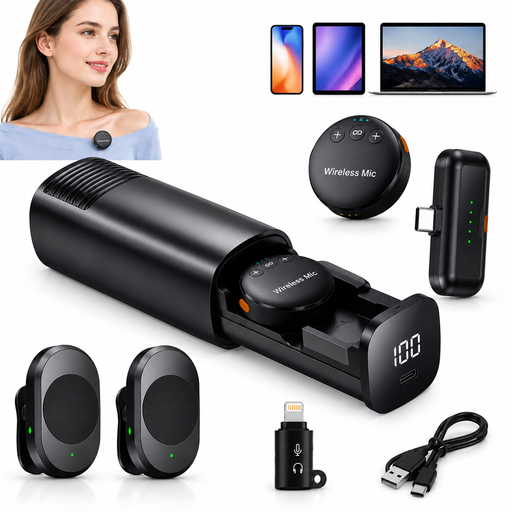
For conversations where one or two microphones need to be worn by the speaker, with recording handled by a compatible smartphone or camera.
The product description lists two transmitters, one receiver, omnidirectional microphones, and USB-C and Lightning connections. It also specifies 2.4 GHz, latency under 20 ms, a range of up to 40 m and a 500 mAh charging case. Check that the receiver is compatible with your recording device and that your app can record audio.
 No image available
For conversations in different locations when you want to record without a computer running and listen back through headphones on the spot.
The product description lists two omnidirectional microphones, USB-C, a 64 GB TF card and headphone playback. Recording time is listed as up to 22 hours. One-touch recording is also included.
 No image available
For recording where the conversation takes place, with additional text processing, provided the listed features suit your intended workflow.
The product name lists 32 GB of storage, one-button recording, real-time transcription, translation into 58 languages and 30 hours of battery life. The description also lists a conversation mode with a four-microphone array. Before you buy, check the conditions for transcription and translation, and whether your required language is supported.
Make a short test recording from the actual seated position and listen back to it. Check the connections, storage media or recording app, and power supply. The Library of Congress recommends testing equipment and microphones before an interview begins.
No. According to RØDE, the Wireless Micro transmitters don’t record internally; the connected device must record the audio.
Section 201(1) of the German Criminal Code (StGB) covers the unauthorised recording of another person’s non-public speech. The Federal Ministry of Justice and the Federal Office of Justice list this as a criminal offence. Before recording, check that you are legally entitled to do so; simply being present during a conversation does not give you permission to record it secretly.
No. Recording and any later use should be discussed separately, with agreement on each intended purpose. The Oral History Association recommends discussing retention and access in advance. Processing personal data requires a legal basis; the Federal Commissioner for Data Protection and Freedom of Information and the European Data Protection Board list consent as one possible legal basis, but not the only one.
Decide in advance where the recording and accompanying information will be stored, and who will be able to access them later. The Oral History Association recommends discussing retention, access and informed consent while preparing the project.