For second-hand records in an open-plan kitchen, choose a turntable with the right speed and stylus for your records, and a phono, line or Bluetooth connection that works with your existing set-up. Then think about your routine: would you prefer fully automatic operation or manual control? Denon, Dual, Audio-Technica and Sony offer different speeds, connection options and automatic functions, depending on the model. You’ll also need a dry, clean spot away from food and drink, where the turntable won’t be knocked or vibrated. A dust cover doesn’t remove the need to keep it at a safe distance.
Who is this selection for?
Listeners with an existing hi-fi system
If you want to keep using your existing speakers, check the phono or line signal path and, where relevant, Bluetooth compatibility. Denon, Audio-Technica and Sony list these connection options for their respective models.
Listeners in an open-plan kitchen
When you’re cooking or eating, straightforward controls and a spot away from food and drink matter. The Library of Congress recommends keeping food and drink away from sound recordings; Audio-Technica advises placing the AT-LP120X away from speakers to avoid vibration.
Collectors of older records in different formats
Before choosing a speed and stylus, distinguish standard vinyl LPs and singles from possible shellac records. Dual lists three speeds for the CS 518, while Audio-Technica notes that shellac requires a suitable SP stylus.
What should you look for when buying?
Start by identifying your record material and the speed you need, then check how the turntable will connect to your existing system. Controls, space and maintenance can help you narrow down the right type of turntable.
| Consideration |
What to check |
Who it matters most to |
| Connecting to your system |
Check the phono and line inputs, and the preamp switch on the specific model. If you’re using Bluetooth, check the receiver too. |
If I want to keep using my existing speakers, I’ll check the signal path before choosing a turntable. Around 28% of consumers say connectivity is their top priority. |
| Record format and stylus |
Check the record material and label. For shellac, check for 78 rpm, a suitable SP stylus and compatibility; Dual and Audio-Technica list these requirements for specific models or styli. |
If I’m sorting second-hand records into LPs, singles and possible shellac records, I want to choose the right speed and stylus. Around 22% of consumers put compatibility with their records first. |
| Controls |
Check automatic start, return and stop individually for the exact model; these functions are not the same as a simple tonearm lift. |
If I don’t want to stay by the turntable while cooking or eating, I care about what happens at the end of a record. Easy operation is the priority for around 22% of consumers. |
| Placement |
Choose a dry, clean, level surface away from food, drink and speaker vibrations. Allow room for the cover to open and for the connections. |
If I want to set up a turntable in an open-plan kitchen, I need a protected spot that stays clear during everyday use. Around 17% of consumers prioritise placement. |
| Stylus and care |
Check whether the stylus or cartridge can be replaced, and identify the right spare parts for the specific model. |
If spare parts and maintenance matter to me in the long term, I’ll check the exact design rather than relying on the words ‘replaceable stylus’. Around 11% of consumers prioritise ease of maintenance. |
Common misconceptions
-
‘Second-hand’ automatically means 78 rpm
Second-hand records may be standard vinyl LPs or singles. A 78 rpm setting alone doesn’t make a standard vinyl stylus suitable for shellac.
Identify your records first, then check the speed and stylus compatibility. Shellac may also require a suitable SP stylus or cartridge.
-
‘With preamp’ means ‘with speakers’
An integrated phono preamp provides the right signal path, but it doesn’t replace speakers or the amplification you need.
Check the turntable’s output against the inputs on your system, and see what other equipment and cables you’ll need for playback.
-
A dust cover protects against everything in the kitchen
A cover shields the turntable, but it doesn’t make food, drink or vibration harmless. The Library of Congress recommends keeping food and drink away from sound recordings.
Choose a dry, clean spot with minimal vibration, separate from the cooking and eating area.
-
A replaceable stylus and a replaceable cartridge are the same thing
Audio-Technica lists the stylus as replaceable on the AT-LP60X, while the cartridge is integrated into the headshell. Dual lists a detachable headshell for the CS 518.
For the exact model, check separately which parts can be replaced and which spares are compatible.
Depending on the model, you may need a suitable SP stylus or model-specific spare parts. Check compatibility before counting on being able to replace anything later.
Key brands to consider
Audio-Technica
The AT-LP60X is a fully automatic option for 33⅓ and 45 rpm records, with a switchable phono preamp.
- Audio-Technica lists a replaceable stylus.
- On the AT-LP60X, the cartridge is integrated into the headshell; the listed speeds don’t include 78 rpm.
Dual
The CS 518 is a manual option with three speeds and a detachable headshell.
- Dual lists 33, 45 and 78 rpm, adjustable anti-skating and a switchable MM preamp.
- For shellac, check that you have a suitable SP stylus or cartridge and the right settings; automatic start and stop aren’t listed.
Denon
The DP-300F is a fully automatic option for 33⅓ and 45 rpm records, with a switchable preamp.
- Denon describes automatic start and return, as well as adjustable tonearm functions.
- The two listed speeds don’t include 78 rpm records; these details apply to the DP-300F, not to every model in the range.
Sony
The PS-LX310BT is an option if you have compatible Bluetooth playback or a suitable phono or line connection.
- Sony lists automatic start, return and stop for this model.
- Sony says the cartridge head isn’t replaceable; the listed speeds are 33⅓ and 45 rpm.
Pro-Ject
The E1 Phono is aimed at buyers who want a pre-set 33/45 rpm turntable with an integrated preamp.
- Pro-Ject lists a built-in, switchable preamp and a dust cover for the E1 Phono.
- The listed features don’t confirm 78 rpm playback; check the exact E1 variant before buying.
Joybuy products
The Joybuy products below range from fully automatic turntables to models with additional playback features. Check each model’s listed features against your record formats, audio connections and available space.
 No image available
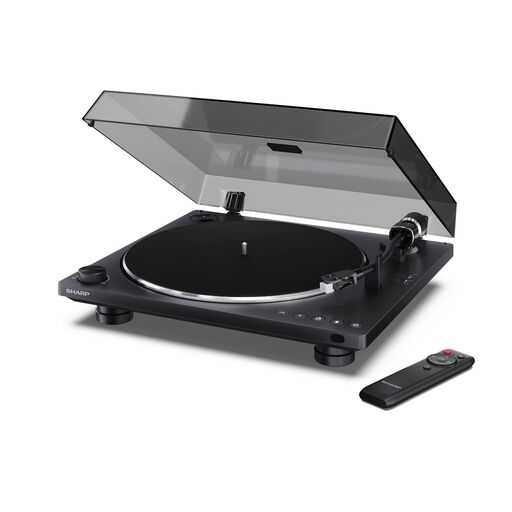
SHARP RP-TT95
An option if you’re looking for fully automatic operation; check that the connection works with your existing system.
Features listed in the product name: Bluetooth 5.4, USB-C recording, Audio-Technica cartridge and dust cover.
View at Joybuy
 No image available
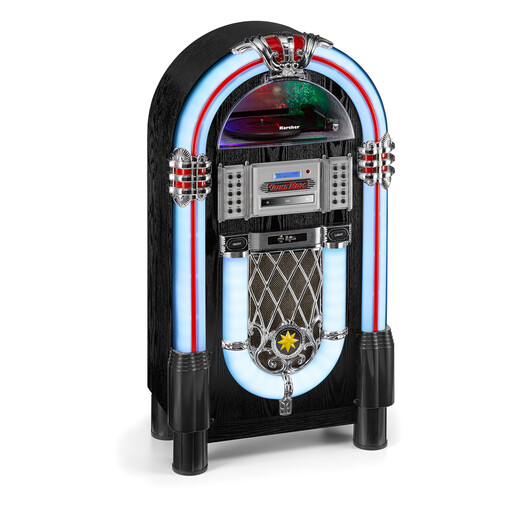
KARCHER 6608D Jukebox
A possible choice if you’re considering playback features beyond a turntable; check that the specific device supports the speeds your records need.
Features listed in the product name: CD player, Bluetooth audio streaming, FM and DAB+ radio, and MP3 playback via USB or SD card.
View at Joybuy
 No image available
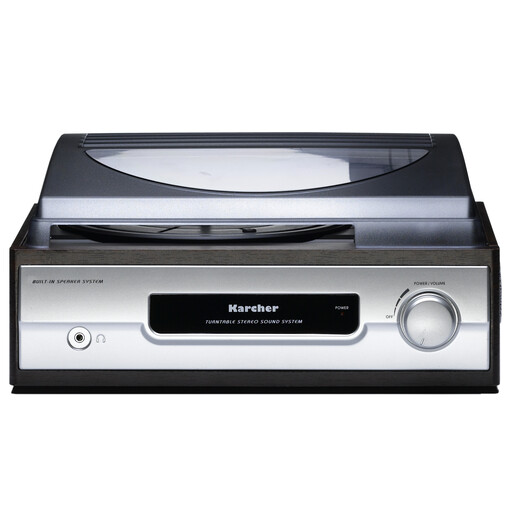
Karcher KA 8050 retro turntable
An option if you want to play 33 or 45 rpm records and use the built-in speakers.
Features listed in the product name: 33/45 rpm, automatic stop at the end of a record, headphone socket and line output.
View at Joybuy
 No image available
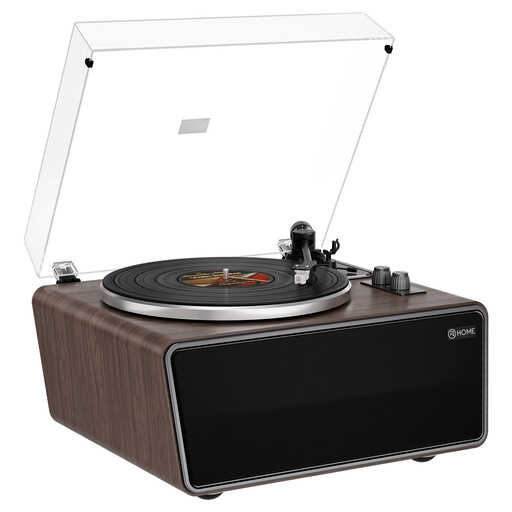
XJ-HOME XJ-H01
An option if you’re considering a model with built-in speakers; check that its connections work with your system.
Features listed in the product name: four built-in speakers, phono preamp and AT-3600L-MM cartridge.
View at Joybuy
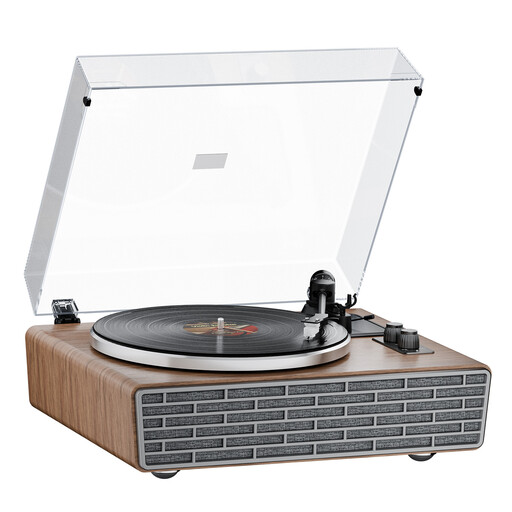 No image available
XJ-HOME XJ-H02
An option if you want built-in speakers and a dust cover; still check that your chosen spot is protected from food, drink and vibration.
Features listed in the product name: Bluetooth, four built-in speakers, transparent dust cover, belt drive and AT cartridge.
View at Joybuy
Frequently asked questions
Can I connect active speakers directly to a turntable?
This can work if the speakers have a suitable line input and the turntable’s integrated phono preamp is switched on. Check the sockets, switch setting and cable required for both devices; a phono output isn’t the same as a line output.
Is a 78 rpm turntable all I need to play an old shellac record?
No. The SP stylus or cartridge must also be suitable for both the record and the turntable. You can’t tell whether a record is made of shellac just from the fact that it’s second-hand.
How should I handle dusty second-hand records in an open-plan kitchen?
Keep food and drink away from your records, handle grooved records by the edge and label, and keep the playback area clean. The Library of Congress recommends using canned air to remove loose dust; mould or unusual residue needs separate assessment using a method suitable for the material.
What are my rights if a newly purchased turntable is faulty?
In Germany, the seller is generally responsible under a two-year statutory warranty for defects that were present when the item was handed over. The Verbraucherzentrale distinguishes this statutory protection from a voluntary guarantee; your specific rights depend on the circumstances.
Can an old turntable go in the general rubbish?
No. The German Environment Agency explains that electrical and electronic waste in Germany must be collected separately from unsorted household waste.


