What should you look for when buying?
Start by thinking about what matters most to you: available space, when seeds are added, loaf size or day-to-day cleaning.
| Priority |
What to check when buying |
Who it matters most to |
| Storage and counter space |
Measure the width, depth and height of your storage space and worktop separately. Also allow for the lid opening and follow the setup instructions for the specific model. |
If I need to put the bread maker away after baking, I need to consider more than just its dimensions: I also need to know how much room it takes up in use. Around 33% of consumers prioritise finding the right storage space. |
| Adding seeds |
Check the manual to make sure the dispenser is suitable for your seeds, the quantity you need and the programme you’ve selected. |
If I don’t want to stay by the appliance while the programme is running, automatic dispensing is important. Around 27% of consumers prioritise this convenience. |
| Loaf size |
Compare the amount of bread in your recipe with the stated loaf sizes; don’t confuse bread weight with the maximum amount of flour. |
If I regularly bake a particular amount of seeded bread, the loaf size needs to suit my needs. Around 20% of consumers prioritise getting the right bread quantity. |
| Cleaning and running costs |
Read the care instructions for the bread pan and kneading blade. Work out electricity and ingredient costs based on your recipe and tariff. |
If I want to keep the post-baking clean-up to a minimum, I check how easy the appliance is to clean and what it might cost to use. Around 20% of consumers give these factors the most weight. |
Bread makers at Joybuy
This selection of bread makers at Joybuy includes appliances with stated loaf sizes and automatic ingredient dispensing. Check the manual for each model to make sure the dispenser is suitable for the seeds in your recipe.
 No image available
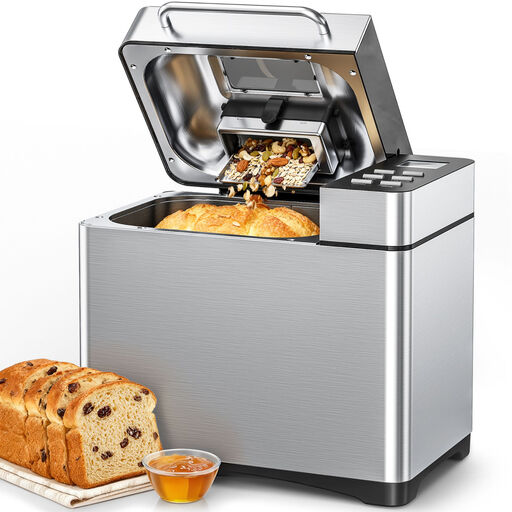
HavenWell bread maker, 19 programmes
An option if you want to choose between several loaf sizes and have ingredients dispensed automatically. Check that the dispenser is suitable for your seeds.
The product title lists 3 loaf sizes, 3 crust settings, a 15-hour timer and 1 kg. The product description mentions a fruit and nut dispenser.
Joybuy
 No image available
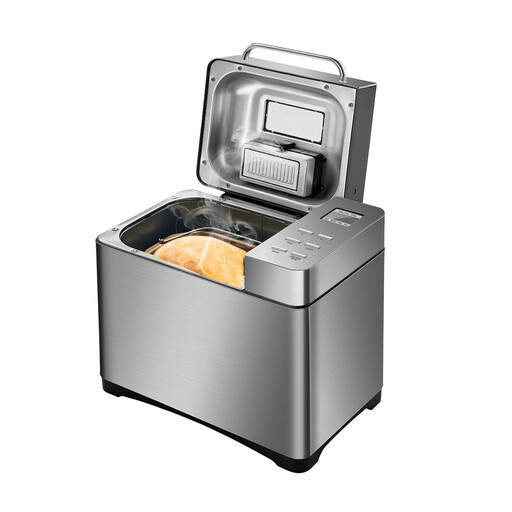
Bread maker, 650 W, 19 programmes
An option if you’re looking for several loaf sizes and an automatic fruit and nut dispenser. Check that the dispenser is designed for the seeds you want to use.
Features listed include 3 loaf sizes, 3 crust settings, a 15-hour timer, 1 hour of keep-warm time, a coated bread pan and a capacity of 2.2 lbs.
Joybuy
 No image available
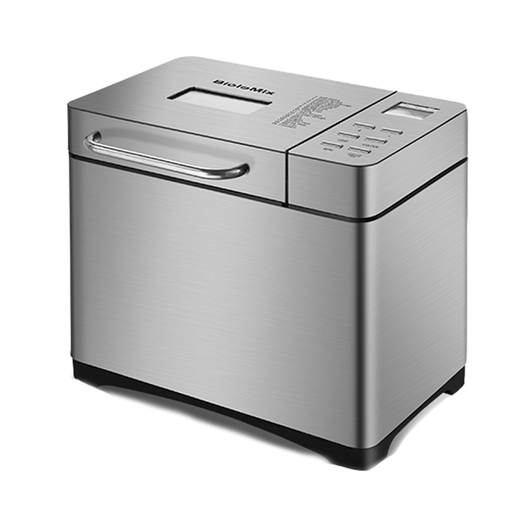
BioloMix BBM013 bread maker
An option if you want automatic ingredient dispensing and a choice of baking programmes. Check the manual to see how to use the dispenser with your seeds.
The product title lists 17 menus. The product description mentions a fruit and nut dispenser, a 15-hour timer and a 1-hour keep-warm function.
Joybuy
Frequently asked questions
Is it enough for the appliance’s dimensions to fit neatly in my cupboard?
No. Also check the space needed while it’s in use, whether the lid can open fully and the setup instructions for that model. Panasonic Germany lists the SD-PN100’s dimensions as 255 × 307 × 290 mm; these aren’t a guarantee of the clearance needed during use.
Can I put seeds in any dispenser described as a nut dispenser?
Not necessarily. Rommelsbacher lists seeds for the BA 550, and Gastroback lists seeds and kernels for model 42823; Panasonic Germany describes the SD-PMC100 as having a raisin/nut dispenser. Check the manual to make sure your seeds, the quantity and the programme you’ve chosen are suitable.
Can the Rommelsbacher BA 550’s bread pan and kneading blade go in the dishwasher?
Rommelsbacher advises against putting the BA 550’s bread pan and kneading blade in the dishwasher and recommends washing them by hand to protect the non-stick coating. Don’t assume this model-specific guidance applies to other appliances.
What labelling and documents should I check for an electric bread maker?
Check the manufacturer and product details, as well as a German-language manual with the required instructions for use and warnings. The European Union explains that CE marking is required for product types where applicable harmonised rules require it; it is a manufacturer’s declaration, not a general independent quality mark. The Federal Network Agency lists these documents and details among the checks it carries out as part of its market surveillance. Parts that come into contact with food must also comply with the rules for food contact materials explained by the European Commission.
Who should I contact if I find a fault after buying in Germany?
The seller, not automatically the manufacturer, is responsible for your statutory warranty rights; a voluntary guarantee is separate. The Verbraucherzentrale explains that, as a rule, the seller is responsible for ensuring the goods were free from defects when handed over for two years after purchase. It also states that for purchase contracts from 31 July 2026, the warranty period can be extended once by twelve months if you choose a repair when a fault occurs.


