Choose seeded crispbread by checking the ingredients of the specific product, rather than relying on labels such as ‘wholegrain’, ‘with seeds’ or ‘gluten-free’. Wasa lists both wheat and sesame in its Sesame & Wholegrain variety, so it is not suitable if you need to avoid sesame. If you need to avoid gluten, look for an explicit gluten-free label, then check for any other ingredients and traces that are relevant to you.
Who should take particular care when checking?
People with a sesame allergy
If you need to avoid sesame, check the ingredients list on every seeded crispbread. Wasa explicitly lists sesame seeds in its Sesame & Wholegrain variety. By contrast, a crunchy texture alone tells you nothing about which seeds another variety contains.
People with grain or gluten requirements
Depending on your needs, you may need to check which grains are listed or look for an explicit gluten-free label. The Burger Fibre Crispbread listed by REWE contains rye, wheat and oats, among other ingredients. Even a gluten-free variety should still be checked for any other ingredients that matter to you.
People who need to take trace warnings into account
If possible accidental allergen traces are part of the way you have been advised to manage your allergy, check for warnings such as ‘May contain traces of …’ as well as the ingredients. Such a warning does not prove that traces are actually present, nor does it give a complete picture of your individual risk.
What should you check when buying?
Start with the ingredient you need to avoid. Then check for other grains, an explicit gluten-free label if needed, and any trace warnings relevant to your allergy management plan on the current packaging.
| What to check |
What to look for |
Who should take particular care |
| Sesame as an ingredient |
Check the current ingredients list for sesame and sesame seeds; don’t rely on the product name or picture. |
If I need to avoid sesame, the actual recipe determines whether a seeded crispbread is suitable for me. Around 42% of consumers check for sesame as an ingredient first. |
| Grains and gluten |
Check which grains are listed and, if you need to avoid gluten, look for an explicit gluten-free label on the exact variety. |
If I need to avoid certain grains or gluten, the words ‘wholegrain’ are not enough. For around 33% of consumers, grains or gluten are the main concern. |
| Traces and ingredients |
Compare the ingredients and any trace warnings on the current packaging with your individual allergy management plan. |
If accidental traces are relevant to my decision, I need to check the current information even when buying the product again. Checking for traces is the priority for around 25% of consumers. |
Common mistakes when checking product information
-
Assuming ‘with seeds’ means it’s suitable for people with allergies
Sesame may be one of the seeds being promoted. Wasa says its Sesame & Wholegrain variety contains 11% sesame seeds, so it is not suitable for people who need to avoid sesame.
First check which ingredient you need to avoid, then read the ingredients list for the variety you’ve chosen.
-
Assuming ‘gluten-free’ means ‘free from all allergens’
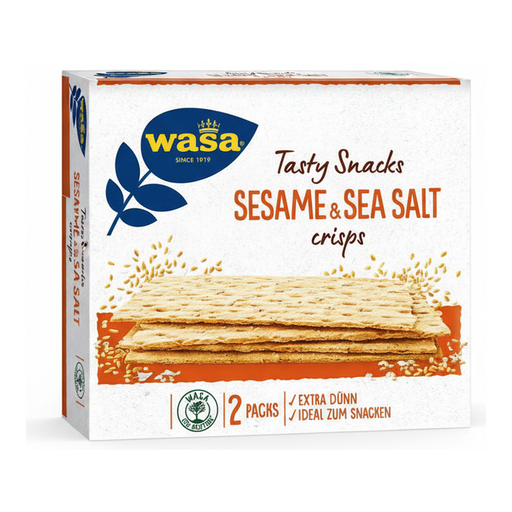
REWE lists Wasa Sesame & Sea Salt as gluten-free, but the product name also specifies sesame. So the gluten-free label does not answer the question of whether it contains sesame.
If you choose a gluten-free variety, also check for any other ingredients that are relevant to you.
-
Treating trace warnings as ingredients, or ignoring them
‘May contain traces of …’ warns of possible accidental contamination. It does not prove that the allergen is actually present in the product, nor does it rule out risk altogether.
Take any warnings into account when deciding what to buy, in line with your individual medical allergy management plan.
-
Checking an old product picture instead of the packaging
REWE notes that the product design may differ from the picture. A picture alone is therefore not a reliable way to check the current ingredients.
Read the information on the pack you receive, even if you’ve bought the same variety before.
Brands and ranges to help you choose
Wasa / Wasabröd
The documented varieties show why sesame and gluten need to be checked separately.
- Wasa lists wholegrain wheat flour, wheat flour and 11% sesame seeds in its Sesame & Wholegrain variety.
- REWE lists Sesame & Sea Salt as gluten-free; this does not make a product containing sesame suitable for someone with a sesame allergy.
Burger
The Burger Fibre Crispbread listed by REWE is an example of a recipe containing several grains and seeds.
- The ingredients include rye, wheat, oats, linseed and sesame, among other things.
- REWE also mentions possible traces of milk and other cereals containing gluten.
EDEKA Bio / EDEKA Herzstücke
EDEKA24 lists EDEKA Bio 3 Seed Crispbread, among other products.
- The range name helps you search for a seeded variety.
- When choosing a product because of an allergy, the ingredients and allergen information for that specific product matter—not ‘organic’ or ‘3 seeds’.
ALDI / GUT BIO / GOLDÄHREN
ALDI SÜD lists GOLDÄHREN Sesame Crispbread and GUT BIO Organic Three Seed Crispbread.
- The two product names distinguish a sesame variety from a three-seed variety.
- A vegan label does not tell you whether the product contains sesame, particular grains or other relevant allergens.
REWE
REWE product pages for Wasa and Burger can give you an initial overview of specific varieties.
- The listed Burger Fibre Crispbread has an ingredients list and a trace warning.
- Before eating the product, check online information and product pictures against the actual packaging.
Ryvita
Ryvita provides information about a sesame crispbread recipe in its British range.
- The British product page lists rye and 11% sesame seeds for this variety.
- You can’t use this information to determine the recipe or labelling of a variety sold in Germany; check its own packaging.
Seeded crispbread on Joybuy
The varieties below have sesame in their product names. If you need to avoid sesame, this selection is no substitute for looking specifically for a different recipe. For each variety, check the current ingredients list, other allergens and any trace warnings that are relevant to you.
 No image available
Wasa Delicate Crisp Oats & Sesame crispbread, 230 g
For shoppers looking for a variety with oats and sesame: the product name lists both. Before buying, check the exact ingredients list and any information about other allergens on the current packaging.
View on Joybuy
 No image available
Wasa Round Sesame & Sea Salt crispbread, 190 g
A round variety with sesame and sea salt, according to the product name. If you need to check for particular grains or possible traces, look at the information on the 190 g pack rather than assuming it’s the same as other Wasa varieties.
View on Joybuy
 No image available
Wasa Sesame & Flaxseed crispbread, 210 g
The name lists sesame and linseed. If either matters to you, check the current 210 g pack to confirm which ingredients are actually included and which trace warnings apply.
View on Joybuy
 No image available
Alnatura Organic Sesame Crispbread, 250 g
A sesame variety for shoppers whose individual requirements allow them to eat sesame. Before deciding, check the ingredients and any trace warnings on the current 250 g pack; ‘organic’ is not an allergen label.
View on Joybuy
Frequently asked questions
Does sesame have to be listed on packaged crispbread?
Yes. If sesame is present as an allergenic ingredient in the finished product, it must be emphasised in the ingredients list in Germany. The German Food Federation lists sesame among the allergens that must be declared. Check the ingredients list on the specific pack even if sesame isn’t mentioned in the product name.
Does ‘May contain traces of milk’ mean that milk is an ingredient?
No. A trace warning refers to possible accidental contamination and is not the same as a declared ingredient. Whether you can choose crispbread with this warning depends on your individual medical allergy management plan.
Is vegan seeded crispbread suitable for people with allergies?
The word ‘vegan’ alone isn’t enough to tell you. ALDI SÜD lists both vegan sesame crispbread and a vegan three-seed variety; check the ingredients and allergens on the pack you choose.
Is ‘wholegrain’ enough if I need to avoid gluten?
No. Wholegrain doesn’t mean that a crispbread is gluten-free: for example, the Burger Fibre Crispbread listed by REWE contains rye and wheat. If you need to avoid gluten, look for an explicit gluten-free label on the exact variety and check separately for any other allergens that are relevant to you.
How should I store crispbread after buying it?
Follow the storage instructions on the pack. For Burger Fibre Crispbread, REWE says ‘Store in a dry place’; for other varieties, check their own instructions and the best-before date.


