
Lieferung heute & morgen

Qualitätsgarantie

Willkommens-Angebote freischalten: KOSTENLOSE Lieferung | Bis zu 80 % RABATT | Kostenlose 30-Tage-JoyPlus-Testphase
App herunterladen
A self-adhesive floor transition strip can cover gaps, edges and small height differences between laminate, tiles and carpet without needing a drill or adhesive. However, not every transition strip is suitable for every surface. Incorrect measurements, unsuitable adhesive or a poorly prepared floor often cause the strip to come loose after a short time or become a trip hazard.
A narrow floor transition strip won’t reliably cover a wide gap. Before buying, measure the entire area that needs covering. This includes not just the visible gap, but also the adjoining edges and any unevenness.
A width of 4 cm works well for many typical doorways. For larger gaps or significantly different floor heights, however, a different profile may be needed.
Adhesive tape generally sticks best to clean, dry, smooth and grease-free surfaces. Dust, loose paint flakes, damp substrates or heavily textured tiles can affect adhesion. On newly laid floors, any residue from cleaning or maintenance products should also be removed.
Before fitting, it’s a good idea to test the strip on a small, inconspicuous area. For porous screeds, rough concrete or very uneven surfaces, a mechanically fixed transition strip may be more suitable.
Vinyl and PVC profiles can easily adapt to some unevenness. However, they are not a substitute for a levelling bar where there are pronounced height differences. So check beforehand whether the strip actually sits flat on both floor coverings. The edges must not lift up, as this increases the risk of catching.
The dimensions determine whether a self-adhesive floor strip is right for your particular spot. For the options featured here, the format is:
A 304 cm long transition strip can often be fitted in one continuous piece. This reduces additional joints where dirt could collect or the strip might lift. Still, measure carefully and only cut to size after a dry fit.
A vinyl transition profile is flexible and can conform to slightly uneven surfaces. PVC or vinyl is also easy to clean and suitable for areas with normal foot traffic. However, the actual durability depends on how well the surface is prepared, the adhesive area and daily wear and tear.
For a transition between tiles and carpet, also check that the carpet is firmly fixed and no loose edge protrudes from under the strip. With laminate, remember to allow for the necessary expansion gap. The transition strip must not fix the floor so tightly that it can no longer expand.
A grey transition strip often complements grey tiles, stone-effect floors or neutral laminate decors. A contrasting colour can make the transition point more visible. This is particularly relevant where many people walk past or where the floor colours are very similar.
Don’t choose the colour based solely on the product image, as screens can display colours differently. If a seamless visual match is important, compare the strip with a sample of your existing flooring if possible.
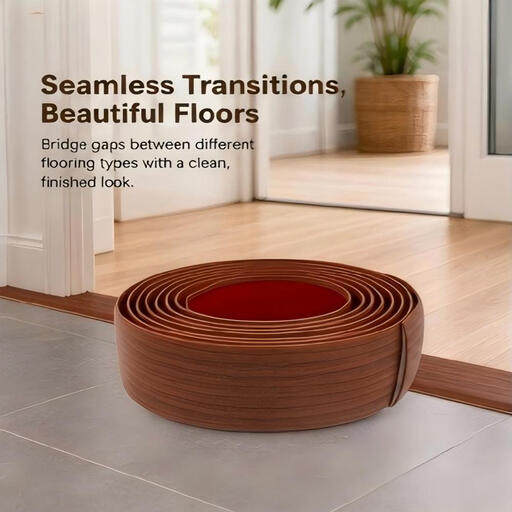
Why this product fits the profile: The 304 cm long, self-adhesive floor strip is ideal for DIYers who want to cover a longer transition without specialist tools. It can be cut to the required size.
The low-profile design at 0.3 cm height reduces an unnecessarily high edge. The adhesive surface is applied directly to the prepared substrate.
304 cm length, 4 cm width and flexible vinyl construction; fitting by cutting to size, peeling off the protective film and pressing into place.
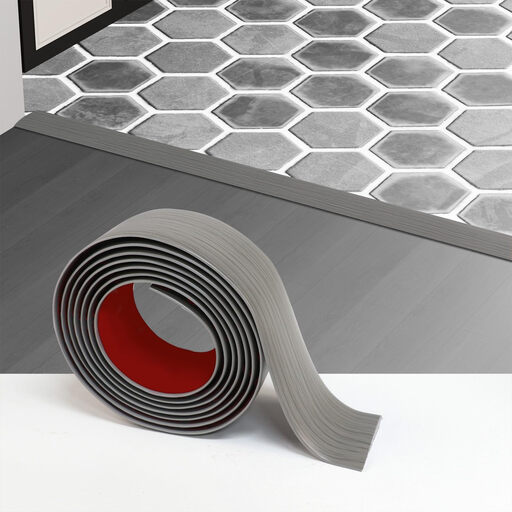
Why this product fits the profile: The grey finish blends well with many neutral floor colours. This profile suits buyers who want to match dimensions, a subtle look and a low profile precisely.
The clearly stated dimensions make it easy to check before buying. The low height limits the risk of a noticeable, raised edge.
Grey surface, flexible vinyl, 304 cm length and self-adhesive backing for smooth, prepared substrates.
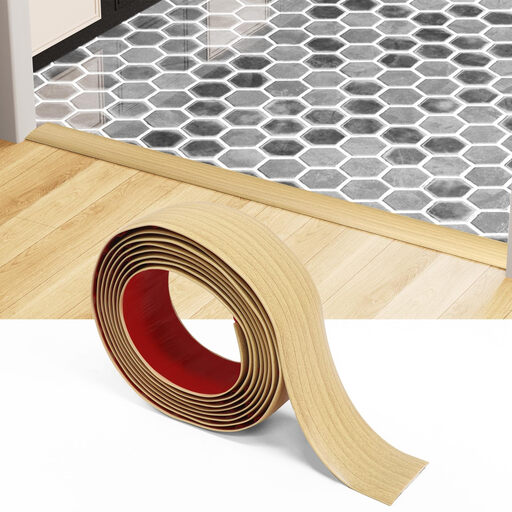
Why this product fits the profile: The yellow colour can make a transition between laminate, tiles or carpet more visible. This is relevant for busy areas with contrasting floor colours.
The contrasting colour makes the transition point more noticeable. Before fitting, still check that the 4 cm width and 0.3 cm height suit the gap.
Aspen Yellow as a highly visible colour option, 304 cm length, flexible PVC-vinyl construction and simple peel-and-stick fitting.
We’ve put together a full, regularly updated list of products that meet these strict selection criteria and comply with EU safety regulations.
There’s no one-size-fits-all answer. The quality and cleanliness of the surface, daily wear and tear, moisture and correct fitting all play a decisive role. On smooth, dry surfaces, the adhesive bond can last longer than on dusty or porous substrates.
Yes, a suitable transition profile for tiles and carpet can cover both floor coverings. However, check the height difference before buying. The carpet must be firmly fixed, and the strip should sit flush on both sides.
Removal is generally possible, but it may leave adhesive residue or damage delicate surfaces. If needed, gently warm the strip and remove it slowly. So make sure the final position is exactly right before fitting.