
Lieferung heute & morgen

Qualitätsgarantie

Willkommens-Angebote freischalten: KOSTENLOSE Lieferung | Bis zu 80 % RABATT | Kostenlose 30-Tage-JoyPlus-Testphase
App herunterladen
A beautifully laid floor enhances any room. But often, an unsightly gap remains—the transition between two different flooring types, like from laminate to tile, or an expansion joint in a doorway. These gaps are not just a visual blemish, but also a tripping hazard and a dirt trap. A self-adhesive transition strip offers a quick and straightforward solution that requires no drilling or special tools.
However, not all products are created equal. Many DIY enthusiasts invest in a supposedly simple solution, only to find that the strip comes loose after a short time or the material can't withstand the rigors of daily life. This guide will show you how to avoid common purchasing mistakes and select the right profile for your project.
The selection of floor profiles is vast, but some product features quickly reveal themselves as weak points. Pay attention to these three points to avoid a costly mistake.
To avoid the problems mentioned above, you should check three key technical parameters before buying. These largely determine the functionality and longevity of your new self-adhesive transition rail.
The material is crucial for adaptability and durability. While classic profiles are often made of rigid aluminium and need to be screwed down, a flexible transition strip made from high-quality vinyl offers significant advantages. Vinyl is robust enough for everyday use but also pliable enough to conform to minor irregularities in the subfloor. This ensures a gap-free, secure finish, especially for an adhesive floor trim that must lie directly on the floor.
A no-drill transition rail stands or falls on the quality of its adhesive strip. Look for products with a strong, permanently elastic adhesive. Equally important is preparing the subfloor: the surface must be completely clean, dry, and free of grease for the adhesive to achieve its full bonding power. Thorough cleaning before installation is therefore essential.
The dimensions of the profile must match the gap.
Based on the criteria above, we have put together a selection of products suitable for different user profiles and requirements.
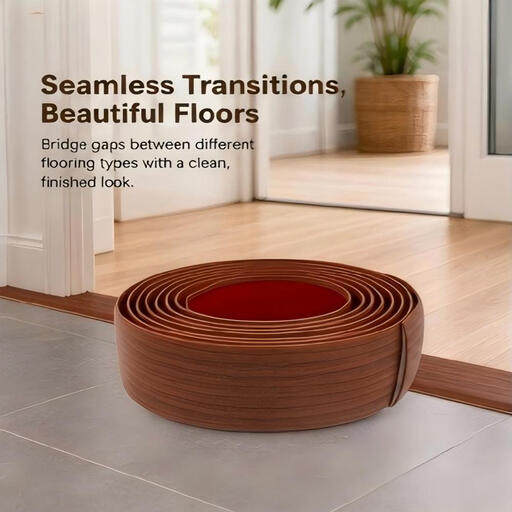
Why This Fits Their Persona: Ideal for users looking for a universal and cost-effective solution for multiple doorways or long transitions. The length of over 3 metres minimises waste and is often sufficient for several projects.
The flexible vinyl material adapts to slight floor unevenness, preventing gaps (avoids Trap 2). The continuous adhesive strip ensures a permanent hold when installed correctly (avoids Trap 1).
Generous 304 cm length for large areas. Easy to cut to size with scissors or a utility knife.
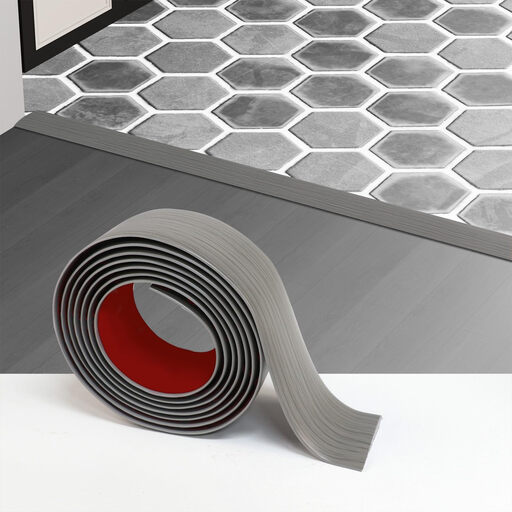
Why This Fits Their Persona: Perfect for modern living spaces where aesthetics play a major role. The neutral grey tone harmonises excellently with concrete-look tiles, grey laminate, or vinyl flooring.
The material is solid-coloured, not just coated. This makes it more resistant to scratches and wear than cheap profiles with printed-on colour (avoids Trap 3).
Enables a colour-coordinated and unobtrusive joint cover. The slim 0.3 cm profile creates a subtle, modern look.
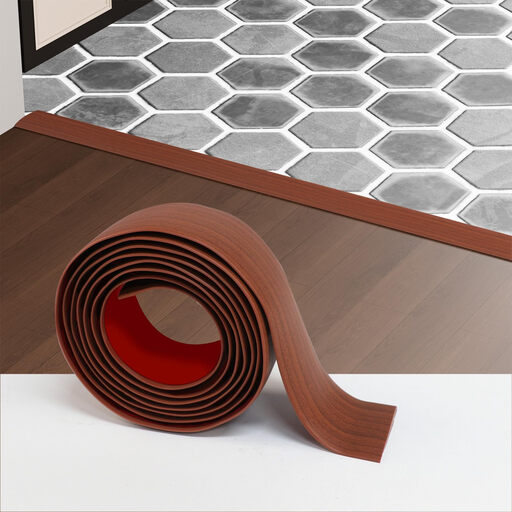
Why This Fits Their Persona: Ideal for anyone wanting to create a seamless transition to wood floors or wood-look laminate. The shorter 122 cm length is perfect for single doorways and avoids unnecessary waste.
The realistic wood grain is integrated into the material, not a cheap foil, making it more resistant to abrasion (avoids Trap 3). The flexible vinyl ensures a flush finish (avoids Trap 2).
Aesthetically pleasing wood look for a harmonious overall appearance. Practical length for standard doors.
We have compiled a complete, real-time list of products that fully satisfy these strict selection criteria and UK safety regulations.
The lifespan depends heavily on the quality of the adhesive, correct installation, and the level of foot traffic. When properly applied to a clean, dry surface, a high-quality self-adhesive floor profile can last for several years. In areas with very high traffic or high moisture, its lifespan may be shorter.
Installation on carpet is not ideal. Self-adhesive profiles require a smooth, firm, and clean surface for optimal adhesion. Carpet fibres do not provide a stable bonding surface. For a transition from a hard floor to a carpet, the strip should be attached to the hard flooring, merely overlapping the edge of the carpet.
Removability depends on the adhesive and the subfloor. The strip can usually be removed more easily by gently heating it with a hairdryer. Any remaining adhesive residue can then be removed with a suitable cleaner (e.g., alcohol- or citrus-based). It is advisable to test the cleaner on an inconspicuous area first.