
Lieferung heute & morgen

Qualitätsgarantie

Willkommens-Angebote freischalten: KOSTENLOSE Lieferung | Bis zu 80 % RABATT | Kostenlose 30-Tage-JoyPlus-Testphase
App herunterladen
By Joybuy Product Recommendation Officer, 28 August 2026
Daily litter box scooping is a chore few cat owners enjoy. A self-cleaning litter box promises a clean, odour-free environment and more quality time with your pet. However, the market is flooded with models that often fail to deliver on their promises in practice. Before you make a significant investment, it's crucial to know the typical weaknesses that can quickly turn a supposed convenience into an expensive headache.
Many devices suffer from three central problems:
To avoid a bad purchase, you should focus on core technical features rather than marketing promises. Three parameters are crucial for everyday functionality and safety.
An automatic litter box should perform the cleaning process completely autonomously and reliably. Pay attention to the operating principle. Modern sifting drums that separate clean litter from clumps are often more effective than simple rake systems. A critical factor is the material composition of the drum and the base mat. Non-stick materials or special elastic mats prevent wet clumps from sticking to the bottom—one of the most common causes of malfunctions. Also, check which types of cat litter are compatible. Flexible systems that work with bentonite, tofu, or mixed litters offer you more freedom.
Your cat's safety is the top priority. A high-quality device never relies on a single sensor. Look for a multi-stage safety system that includes at least the following components:
Only the combination of these technologies ensures that the cleaning cycle will not start or continue under any circumstances as long as your cat is in or near the device.
An odour-free litter box needs more than just a lid. Effective systems combine a hermetically sealed waste container with active odour neutralisation. This can be achieved through special deodorant modules that specifically neutralise odour molecules like ammonia.
For a litter box for multiple cats, capacity is also key. Pay attention to the volume of the interior and especially the waste container. A waste bin with a capacity of 7 litres or more can last up to two weeks for a single cat without being emptied, significantly reducing maintenance in a multi-cat household. An app-controlled litter box offers the added advantage of sending you notifications when the bin is full and allowing you to check the level at any time.
Instead of presenting an overwhelming list, we are highlighting one model that meets the above criteria for a specific type of user.
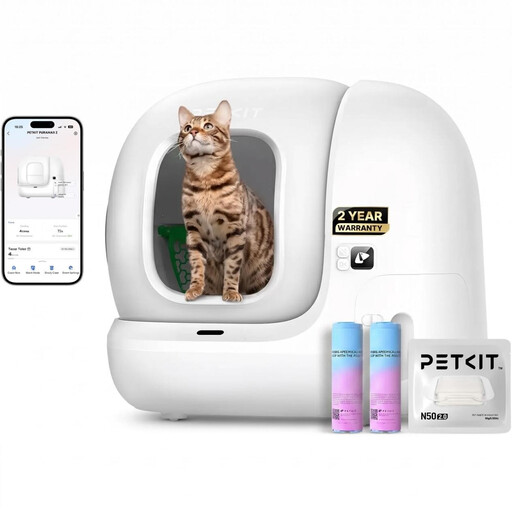
Why This Fits Their Persona: This model is aimed at users seeking a fully automated, secure, and data-driven solution for their multi-cat household. The app-based control and monitoring, including health tracking for each cat, satisfies the desire for control and convenience. The large capacity of 76 litres in the main chamber and 7 litres in the waste bin is ideal for multiple pets. Anyone considering buying the PETKIT Pura Max 2 is investing in a comprehensive solution.
The Tri-Proof Mat with its elastic edge prevents litter from sticking. The XSecure safety system combines thermal, infrared, weight, and anti-pinch sensors, directly addressing safety concerns. The N50 2.0 Deodorizer actively neutralises odours rather than just masking them.
Comprehensive safety system and app control for health monitoring. Compatible with common types of clumping litter. Large capacity for longer maintenance intervals.
We have compiled a complete, real-time list of products that fully satisfy these strict selection criteria and UK safety regulations.
Acclimatisation requires patience. First, place the new device next to the old litter box without turning it on. Fill it with your cat's usual litter. Once your cat accepts and uses the new box, you can remove the old one. Only activate the automatic cleaning function after a few days so your cat can get used to the device without being startled by noises or movements.
Models from established manufacturers equipped with multi-stage safety systems (weight, infrared, anti-pinch) are considered very safe. However, it is essential to check the safety system's specifications before purchasing. Always place the device on a flat, stable surface and ensure that cats under 6 months of age or below the manufacturer's specified weight (e.g., 2 kg) do not use the device.
The frequency depends on the number of cats you have and the capacity of the waste bin. For a model with a 7-litre bin, like the PETKIT Pura Max 2, the interval for a single cat can be about 15 days. For two cats, this period shortens to about a week. Most models with app connectivity will send a notification when the bin needs to be emptied.