
Lieferung heute & morgen

Qualitätsgarantie

Willkommens-Angebote freischalten: KOSTENLOSE Lieferung | Bis zu 80 % RABATT | Kostenlose 30-Tage-JoyPlus-Testphase
App herunterladen
Investing in a Tyre Pressure Monitoring System (TPMS) for your motorhome or trailer is a decision that enhances both safety and efficiency. However, the market is saturated with an overwhelming variety of options, and not every system is suited for the unique demands of recreational vehicles. Misleading claims and incompatible technology often lead to poor investments. This guide highlights the common pitfalls to avoid and clarifies which technical specifications truly matter.
Many systems are primarily designed for passenger cars and are simply marketed as "suitable" for motorhomes. This leads to practical issues that compromise their function and reliability.
solar-powered tyre pressure monitoring. In practice, the solar panels are often too small or of low quality to reliably and continuously power the display module, especially with suboptimal placement on the windscreen or during winter months. A dead display unit while driving makes the entire system worthless.trailer tyre pressure monitoring system and the receiver in the cockpit can exceed the range of many wireless systems. This results in sporadic or permanent signal loss, making the monitoring unreliable.To avoid these problems, three core technical aspects should be verified before purchasing. These define the real-world usability of a system for motorhome tyre safety.
The most important parameter is the supported pressure range. Check the manufacturer's recommended tyre pressure for your fully loaded motorhome. Select a TPMS with a maximum measurement range at least 20% above this value to ensure a safe margin. Simultaneously, monitoring both tyre pressure and temperature is critical. A rising tyre temperature can be an early warning sign of impending damage, even before a significant pressure loss is measurable.
For retrofitting a TPMS, external tyre pressure sensors are the most practical solution. They are simply screwed onto the tyre valves in place of the valve caps.
Internal sensors are mounted inside the tyre and are better protected, but they require professional installation at a workshop, incurring additional costs. For most DIY retrofits, external sensors are the more balanced choice.
A reliable power source is essential. For systems with solar-powered tyre pressure monitoring, pay attention to the capacity of the integrated battery. An additional USB charging port is a must-have to ensure functionality even in low sunlight. A smart display with automatic brightness adjustment and a sleep mode that deactivates the unit when stationary and reactivates it upon movement conserves the battery and significantly enhances user convenience.
Instead of making a blanket recommendation, we have identified products that match specific user profiles and their requirements.
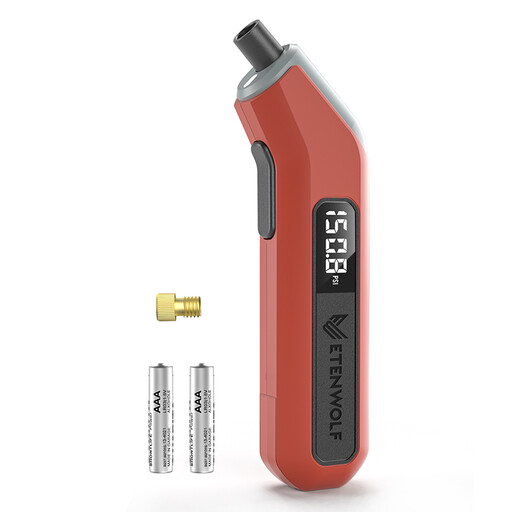
Why This Fits Their Persona: Ideal for users who prefer a cost-effective, straightforward solution for manual tyre pressure checks before each trip, without dealing with the installation and configuration of a permanent system.
This device completely bypasses the pitfalls of signal transmission and power supply by performing a direct, manual measurement. Accuracy does not depend on wireless technology or battery charge.
The measurement range of up to 200 PSI (approx. 13.8 Bar) is sufficient for virtually any motorhome or trailer. The backlit display ensures excellent readability.
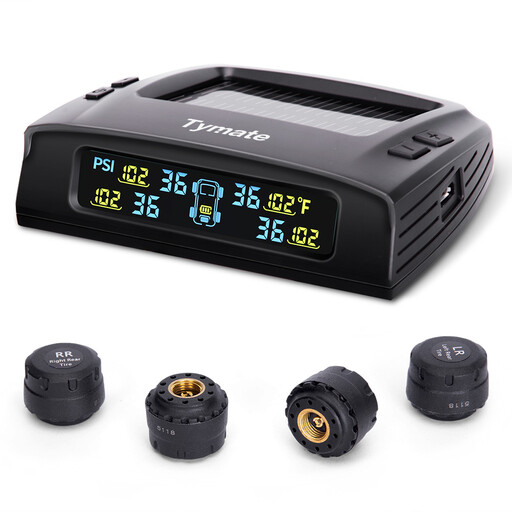
Why This Fits Their Persona: Suitable for drivers of standard motorhomes, camper vans, or SUVs looking for a balanced system with simple installation and reliable everyday performance.
With a pressure range of 0–8 Bar (0–116 PSI), it is clearly defined for this vehicle class, avoiding the pitfall of unsuitable passenger car systems. The combination of a solar panel and a USB charging option secures the power supply.
Features a colour display with smart backlighting and 6 alarm modes. The automatic sleep and wake-up mode ensures convenient use and conserves battery life.
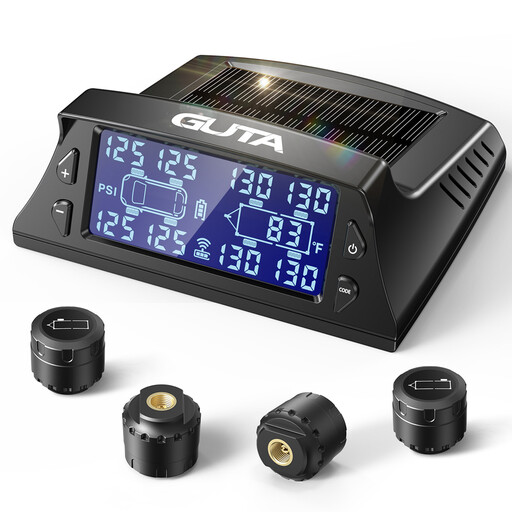
Why This Fits Their Persona: Designed for owners of large motorhomes, fifth-wheels, or rigs who require high tyre pressure and stable monitoring over long distances.
The wide measurement range of 0–13 Bar (0–188 PSI) directly addresses the pitfall of inadequate pressure ranges for heavy vehicles. It explicitly notes the need for a repeater for vehicles over 20 feet.
High pressure coverage and a long sensor battery life of approx. 4 years (according to the manufacturer) make it a robust solution for intensive use.
We have compiled a complete, up-to-date list of products that fully meet these strict selection criteria and UK/EU safety regulations.
1. How easy is it to retrofit a TPMS on a motorhome? Retrofitting a system that uses external tyre pressure sensors is very simple and takes only a few minutes. The sensors are screwed directly onto the existing metal valves. Afterwards, the display unit is placed in the cockpit and switched on. Calibration or a visit to a workshop is generally not required.
2. How long do the batteries in the external tyre pressure sensors last? The battery life in the sensors varies by manufacturer and model. They typically use coin cell batteries (e.g., CR1632 or CR2032). According to manufacturer specifications, the lifespan is usually between 2 and 4 years. On most systems, the batteries can be replaced by the user.
3. Does a tyre pressure monitoring system also work with a trailer? Yes, many systems are explicitly suitable as a trailer tyre pressure monitoring system. The crucial factor here is the wireless range. For long rigs (vehicle + trailer), a repeater or signal booster may be necessary to ensure a stable connection between the sensors on the trailer and the display in the towing vehicle. Some manufacturers offer this as an optional accessory.