
Lieferung heute & morgen

Qualitätsgarantie

Willkommens-Angebote freischalten: KOSTENLOSE Lieferung | Bis zu 80 % RABATT | Kostenlose 30-Tage-JoyPlus-Testphase
App herunterladen
A selfie stick tripod should do several jobs: let you take hands-free selfies, capture group photos, keep video calls steady and give you the right angle for vlogging. In practice, models differ not just in their features, but also in how stable they are, how securely they hold your phone and how easy they are to use.
Many buyers focus first on maximum height or extra features, which can lead to avoidable mistakes. A long telescopic pole can become top-heavy when your phone is extended. A Bluetooth remote is of little use if it won’t reliably pair with your device. And a smartphone tripod with a seemingly versatile feature set isn’t necessarily suitable for outdoor photography or moving shots.
A folding phone tripod that extends to a greater height needs a sufficiently wide base and sturdy joints. The higher you position your phone, the more it will be affected by wind, minor knocks and the weight of the device. A mini smartphone tripod is often enough for tabletop shots. For full-length photos or livestreams, a larger base is a better choice.
When choosing a Bluetooth selfie stick, check whether a remote is actually included, what range is specified and what type of battery or power supply it needs. Several models specify a range of up to 10 metres, but this can be affected by walls, other wireless signals and your smartphone’s software.
A phone holder must fit your device’s width and lock securely into place. A 1/4-inch thread is a common fitting for cameras and accessories, but it doesn’t replace a suitable phone clamp. With magnetic holders, also check whether your phone or a compatible case supports the attachment.
For travel, a lightweight design and compact packed size are useful. According to the product specifications, the Rollei Smartphone Traveler Tripod weighs 595 g, folds down to 39 cm and extends to a maximum height of 120 cm. This type of travel tripod is suitable for standard shots on level ground.
A smaller tabletop phone tripod is easier to pack in your rucksack, but it gives you a lower shooting position. Before buying, consider whether you’ll mainly use it at your desk, when travelling or outdoors.
The maximum load capacity must be suitable for your smartphone and any attached accessories. According to the manufacturer, the Rollei Easy Creator MonkeyPod can support up to 2 kg. A smartphone gimbal, on the other hand, has specific payload limits for its motor. Never switch on a gimbal without a smartphone mounted correctly, as this can put strain on the motors.
Before each shoot, check:
A selfie stick with a remote makes it easier to take group photos and shots from further away. A selfie stick tripod with a light can be useful for video calls or indoor shots, but it won’t replace even room lighting. For video on the move, a smartphone gimbal is a different type of product: its electronic stabilisation uses motors and usually requires a battery.
If you only need a fixed frame, a standard selfie stick tripod is often the simpler option. For dynamic vlogs, automatic subject tracking or frequent changes of direction, a gimbal can offer extra features.
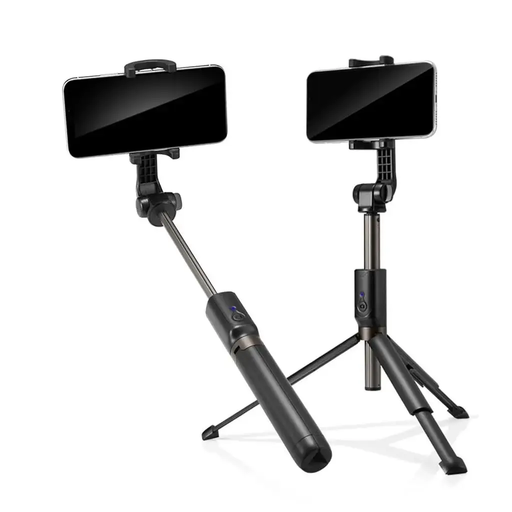
Why this product suits this user: This model combines a telescopic pole, phone holder and Bluetooth shutter in a compact design. It’s ideal for selfies, group photos and the occasional video while you’re out and about.
The specifications state that it’s compatible with Android and iOS smartphones via Bluetooth, and that it has a built-in shutter button. Your phone still needs to be secured firmly in the holder before use.
Telescopic design, ergonomic grip and foldable construction for easy transport and storage.
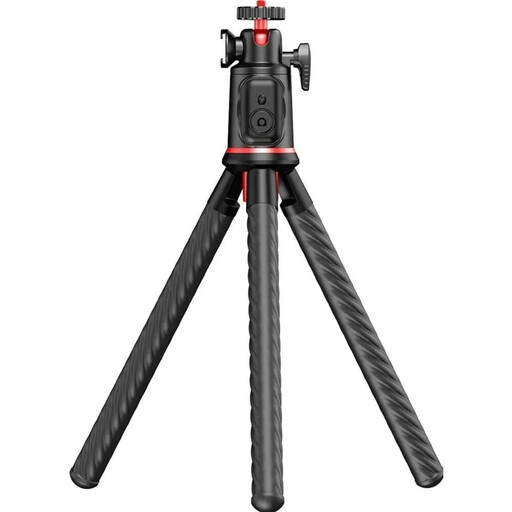
Why this product suits this user: According to the product specifications, its flexible legs can stand on level surfaces or wrap around suitable structures. It’s designed for vloggers and smartphone photographers who want to shoot from different angles.
Its maximum load capacity of 2 kg, 1/4-inch thread and removable phone holder are all clearly specified. Make sure the flexible legs are securely attached before letting go.
360° ball head, cold shoe mount for a microphone or LED light, and Bluetooth 5.4 remote with a specified range of up to 10 m.
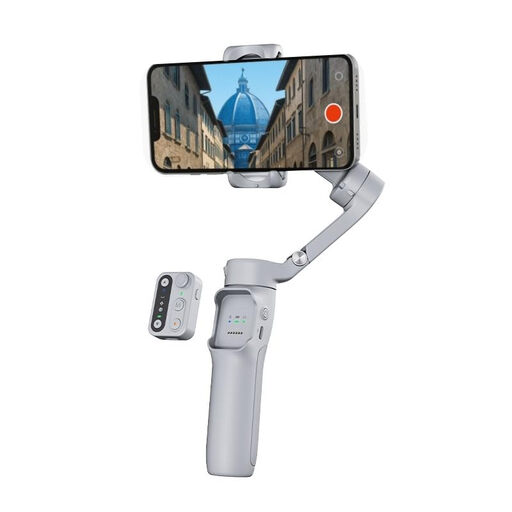
Why this product suits this user: For vloggers, livestreamers and travellers who often film on the move, a smartphone gimbal offers motorised stabilisation and several shooting modes.
The product information states a maximum battery life of 11 hours and clearly sets out the payload, charging and moisture limits. This helps you plan longer shoots.
3-axis stabilisation, foldable body, remote control with a stated range of up to 10 m, and support for portrait and landscape orientations.
We’ve put together a complete, regularly updated list of products that meet these strict selection criteria and fully comply with the safety regulations in force in the EU.
Switch on the remote, open your smartphone’s Bluetooth settings and select the device name shown. Then open the camera app. Some models require you to activate the shutter button once or remove a battery tab before use. If the shutter doesn’t work, disconnect the device and pair it again.
Its lifespan depends on the joints, clamps, how it’s transported and the loads it carries. Store the tripod somewhere dry, don’t force it when extending it and never exceed the stated load capacity. If your model uses a coin cell or built-in battery, the power supply is another part to keep in mind.
A built-in light can be useful in dimly lit rooms, for video calls or for short social media clips. For regular vlogging, also consider the light’s position, battery, holder stability and heat output. If you mainly take photos in daylight, you may not need this feature.