
Lieferung heute & morgen

Qualitätsgarantie

Willkommens-Angebote freischalten: KOSTENLOSE Lieferung | Bis zu 80 % RABATT | Kostenlose 30-Tage-JoyPlus-Testphase
App herunterladen
A sensor night light can automatically illuminate dark paths, so there is no need to search for a switch during the night. For families, an LED night light is ideal for hallways, staircases or children’s rooms, for example. Sensor-activated lighting can also be practical in bathrooms, bedrooms or wardrobes.
However, models vary considerably in terms of sensor type, light colour, power supply and installation. A bargain purchase may prove unsuitable if the light is too bright, the sensor responds inappropriately or the wall socket is blocked.
A night light with a twilight sensor responds to the brightness in the room. It switches on when it gets dark and off again when there is sufficient ambient light. This is suitable for a hallway that should remain subtly lit or for a wall socket in a children’s room.
A night light with a motion sensor works differently: it only activates when movement is detected and switches off again after a certain period. This principle can save energy in bathrooms, on staircases or inside cupboards. In a bedroom or baby’s room, however, the desired position or furniture may restrict the motion sensor’s effectiveness.
The measurement in Kelvin describes the colour of the light:
A warm white night light with low brightness can feel more comfortable in sleeping areas than a cooler light colour. In a hallway or on a staircase, however, the key consideration is whether edges and obstacles are clearly visible. The lumen rating helps with this assessment: a model rated at 20 lm produces a different level of illumination from one rated at 40 lm, even if both are described as “soft”.
A plug-in night light needs neither batteries nor charging breaks, but it does require a free wall socket. A rechargeable night light can be positioned flexibly in a room or cupboard, but must be charged regularly via USB.
Before buying, you should also check whether the model is intended exclusively for dry indoor areas. An IP20 rating, for example, indicates use indoors without protection against water. Damp environments have different requirements, so an IP20 night light should not be placed directly in areas exposed to splashing water.
Pay attention to the specific sensor type and the range stated by the supplier. The PIR sensor in the Aigostar NL01, for example, is specified as offering up to 7 m detection range and a 120° detection angle. Another model may cover only around 3 m. That is often sufficient for a small hallway, but may not be enough for a longer staircase.
The switch-off time is also relevant for a motion sensor. According to the product description, the GRIFEMA model switches off after 60 seconds without detected movement. A twilight sensor, on the other hand, remains active depending on the ambient brightness.
For a children’s room night light or a night lamp in a baby’s room, low brightness levels and controlled light output are important selection criteria. Claims such as “easy on the eyes” should not automatically be treated as a technical guarantee. Instead, check the lumen rating, Kelvin rating, beam angle and available dimming levels.
The GRIFEMA night light offers five brightness levels from 20 to 100 per cent and a colour temperature of 2,700 Kelvin. According to the product data, the 2-piece set with light sensor operates at 0.3 W, 2,800 to 3,000 Kelvin and offers stepless dimming from 10 to 100 per cent.
For electrical products used by families, a sturdy housing, a suitable operating voltage and clear safety information are important. CE and RoHS markings may be considered when assessing a product, but they do not replace checking the specific instructions for use.
You should also check:
An LED night light with an integrated light source does not require a bulb replacement. Figures such as 10,000 or 25,000 hours of service life are manufacturer specifications for intended use and are not a guarantee of a specific actual operating time.
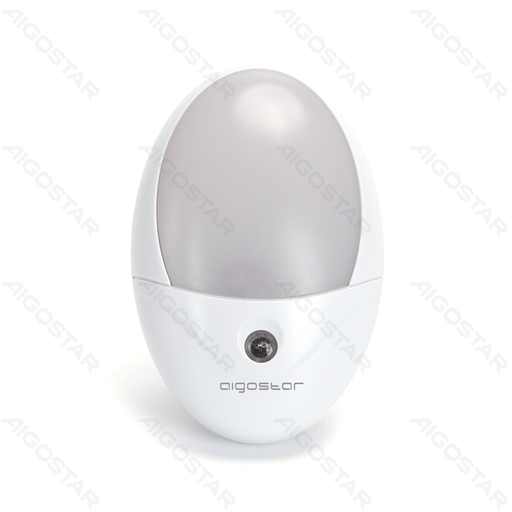
Why this product suits this profile: According to the product data, this plug-in night light needs neither batteries nor charging. The PIR sensor detects movement in dark surroundings, making it suitable for hallways, bathrooms or staircases.
The sensor type, range of up to 7 m and 120° detection angle are clearly specified. This makes it easier to assess suitability than a vague claim about “smart” functionality.
Warm white light at 3,000 K and 20 lm; direct mains operation without battery replacements.

Why this product suits this profile: The five brightness levels allow you to adjust the light for a children’s room, hallway, kitchen or staircase. The combined motion and twilight sensor activates the light only in darkness and when movement is detected.
The specifications of 0.5 W, 3 m range, 120° detection angle and 60-second switch-off time make its operation and functionality clear.
2,700 K warm white light; five adjustable brightness levels and fire-resistant PC/ABS housing according to the product description.
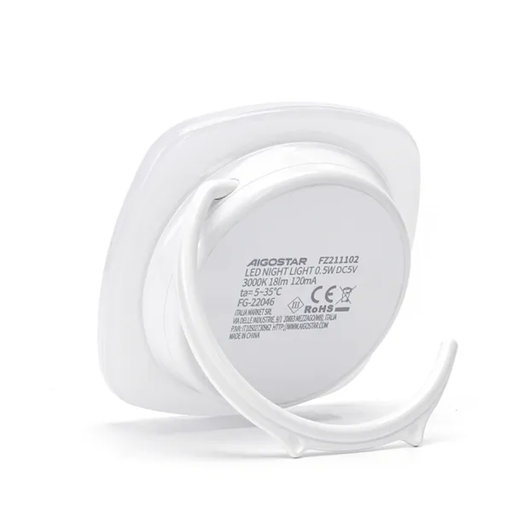
Why this product suits this profile: This rechargeable night light is designed for areas without a free wall socket, such as cupboards, shelves or hallways. The integrated 500 mAh battery is charged via USB.
The power supply is clearly specified. The product also offers a 3.5 m detection range, 3000 K and automatic activation via the PIR sensor.
USB charging instead of disposable batteries; warm white light at 18 lm and compact dimensions of 110 × 110 × 37.1 mm.
We have put together a complete, regularly updated list of products that fully meet these strict selection criteria and the safety regulations applicable in the EU.
Position a sensor night light so that the sensor is not blocked by furniture, curtains or decorations. In a hallway, the beam of light should reach the floor and any potential trip hazards without shining directly at eye level.
With a plug-in night light, the wall socket must not be damaged or loose. Devices with IP20 should not be placed in the immediate vicinity of water. A night lamp in a baby’s room is not a toy and should be mounted or positioned out of children’s reach. Rechargeable models should only be charged with a suitable USB power source and must not be used if the battery has swollen.
An integrated brightness sensor measures the ambient light. If it falls below the threshold set by the manufacturer, the light switches on. In daylight or when the room is sufficiently bright, it switches off again. The actual response may be affected by lamps, windows or a covered sensor surface.
This depends on its power rating and operating time. A 0.5 W model uses 0.5 Wh per hour of operation in theory. A 0.3 W night light uses less over the same period. With a motion sensor, consumption may be lower still because the light is only active when movement is detected. Running costs depend on the actual electricity price, the selected brightness and the daily operating time.
Depending on the model, the product data may specify an intended LED service life of 10,000 or 25,000 hours, for example. These figures are manufacturer specifications and depend, among other things, on temperature, mains quality and usage. With rechargeable versions, the battery’s service life is also relevant. Therefore, as well as checking the LED specification, look at the charging instructions, replacement options and warranty terms.