
Lieferung heute & morgen

Qualitätsgarantie

Willkommens-Angebote freischalten: KOSTENLOSE Lieferung | Bis zu 80 % RABATT | Kostenlose 30-Tage-JoyPlus-Testphase
App herunterladen
A sensory floor mat for children can combine movement, colour perception and active play. The products available also vary considerably: liquid floor tiles respond to pressure, while an EVA foam puzzle mat mainly provides a cushioned, flexible play surface. Water play mats with small movable elements are another option for babies.
Before you buy, take a close look at the material, set size and intended use. Bright colours and terms such as “interactive” alone won’t tell you whether a mat is suitable for a child’s bedroom, a nursery or a more heavily used space.
A set of four or six tiles can look generous in product photos. In reality, many models have individual tiles measuring around 30 × 30 cm or 12 × 12 inches. To create a continuous surface, compare the dimensions of each tile with the area you want to cover.
Liquid tiles often focus on the interactive surface, so they’re better suited to defined play zones than to covering an entire floor.
A non-slip underside can improve grip, but how well it works depends on the floor. Dust, moisture, carpet fibres and uneven surfaces can all affect stability. Before use, place the tiles on a clean, dry and as level as possible indoor floor.
With a non-slip play mat, you should also check the joins between the pieces. Raised edges or puzzle pieces that aren’t fully connected can get in the way during play.
Liquid floor tiles contain a sealed layer of liquid. Before each use, check that the surface and edges are undamaged. If a tile is leaking, stop using it.
EVA foam can usually be cleaned with a slightly damp cloth. Even so, follow the care instructions for your particular mat. For nurseries, schools or commercial playrooms, it’s also worth considering how often the mat will need to be cleaned and moved.
Sensory floor tiles made from PVC have a sealed construction that creates the visible movement of the liquid. They’re suitable for visual and tactile play, but shouldn’t automatically be treated as full fall protection.
An EVA puzzle mat is made up of interlocking foam pieces. It’s versatile enough for crawling areas, playrooms and light yoga or fitness exercises. Look for:
Work out how many pieces you’ll need before you buy. For example, a set of 18 square pieces can cover a considerably larger area than a four-piece set of liquid tiles. Edge strips are also worth considering, as they finish off the outer edges and can help reduce trip hazards.
A compact set may be enough for a small sensory area. A classroom or larger activity zone, however, will need several sets and careful planning.
Choose a sensory floor mat for children that’s suitable for their age and the activity. Young children should be supervised while they play. This is particularly important with water play mats, which are designed for tummy time and reaching for movable elements.
Liquid tiles are intended for indoor use. They shouldn’t be used as climbing equipment or seating, or as a substitute for a certified sports flooring solution.
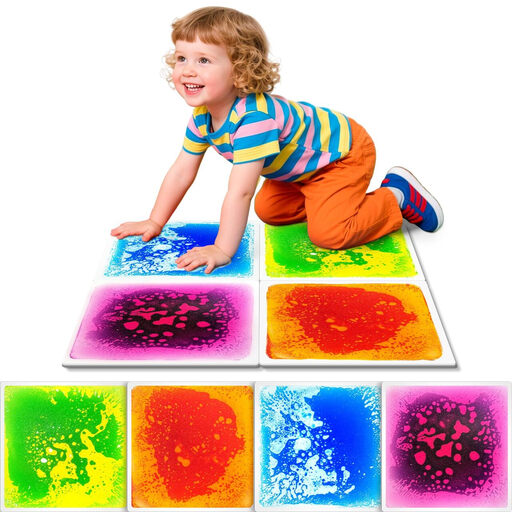
Why this product suits this profile: Four PVC tiles, each measuring 11.8 × 11.8 inches, are ideal for creating a compact sensory area in a playroom or other indoor space.
The clearly stated four-piece set makes it easier to plan the area and avoids mistaking a small set for a complete floor mat.
PVC construction, visible movement of the liquid when pressed and, according to the product description, an easy-care surface.
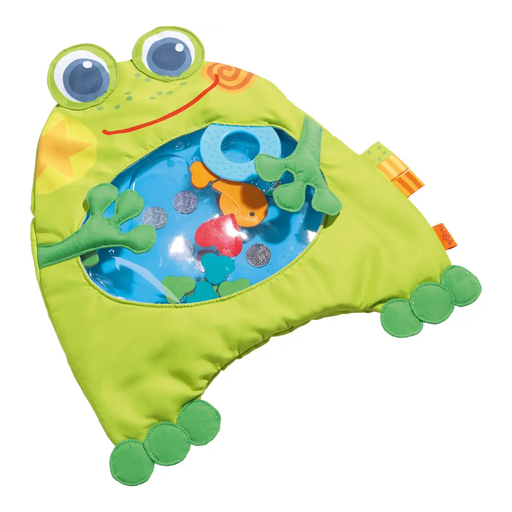
Why this product suits this profile: This compact water play mat is designed for babies aged six months and over. It combines a soft fabric surface with movable elements.
The product details specify an age recommendation, a safety closure and the need for supervision, making its intended use clearer.
Measures approximately 32.3 × 21.6 × 9.3 cm, with a soft fabric cover and built-in features for little hands to explore, including a mirror, leaves and a fish.
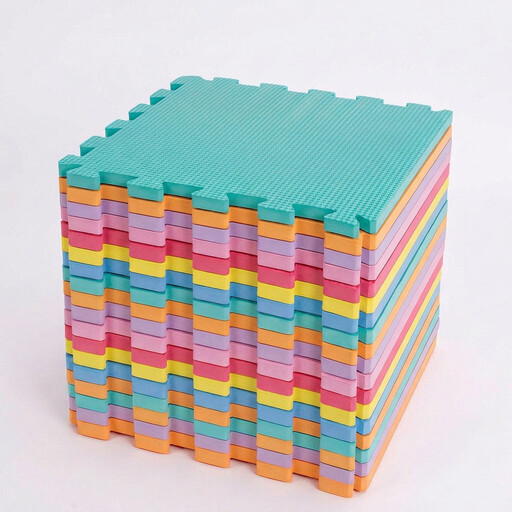
Why this product suits this profile: The 18 EVA foam pieces, including edge strips, provide a flexible base for playrooms, crawling areas, classrooms, and yoga or fitness exercises.
The interlocking design and included edge pieces reduce the number of loose individual mats and make it easier to adjust the play area.
EVA foam, 18 square pieces measuring 12 × 12 inches and, according to the product description, straightforward assembly and cleaning.
For a larger visual play area, a 9-piece set of Liquid Sensory Floor Tiles may be worth considering. Each tile measures 12 × 12 inches and, according to the product description, has a reinforced PVC underside. Another option in metric dimensions is the set of four liquid floor tiles measuring 30 × 30 cm, featuring an ocean design. Both options are intended for indoor use.
We’ve put together a complete, regularly updated list of products that meet these strict selection criteria and fully comply with the safety regulations in force in the EU.
Place the mat on a clean, dry and level indoor floor. Connect EVA pieces fully and check the edges. Liquid tiles should lie flat; check them for cracks or leaks before use.
Its lifespan depends on the material, level of use, cleaning and storage. EVA mats should be stored dry and without being sharply folded. Check the seals on liquid tiles regularly. Damaged pieces should be removed from the play area.
For larger areas that are used regularly, modular EVA puzzle mats are usually more practical, as they can be extended, cleaned and moved as needed. Liquid tiles are better suited to a separate interactive play station. In both cases, take the child’s age, supervision, floor type and the manufacturer’s guidance into account.