
Lieferung heute & morgen

Qualitätsgarantie

Willkommens-Angebote freischalten: KOSTENLOSE Lieferung | Bis zu 80 % RABATT | Kostenlose 30-Tage-JoyPlus-Testphase
App herunterladen
Sensory toys for babies and toddlers should spark curiosity, encourage little ones to reach, listen and observe, and be suitable for their age. There’s a wide choice, from soft cloth books and water play mats to musical baby toys and activity centres. But bright lights and a long list of features don’t necessarily make a toy practical for everyday use.
Before buying, parents, expectant parents, grandparents and other family members should look out for three common pitfalls:
For baby toys from 6 months, the recommended age should match your child’s abilities. Check whether any parts can come loose, whether there is a small parts warning, and whether the toy should only be used under supervision.
For toys designed for early development, useful basic features include grasping, pressing, turning and observing. A motor skills toy for toddlers can be more complex, but it should still be stable and free from sharp edges.
Look for clear information about materials such as ABS plastic, polyester or PVC, and check that surfaces are smooth and free from rough edges. A CE marking indicates that the manufacturer declares the product meets the relevant EU requirements. However, it is not an independent quality mark. The EN 71 series covers safety requirements for toys.
For electronic products, the battery compartment, speaker and controls should be protected. For water play mats, practical features include a secure valve, a robust outer cover and a surface that’s easy to clean.
Music, lights and movement can engage a child’s visual and auditory senses. Adjustable volume or a quiet mode is particularly useful at home, in shared spaces and when travelling. For a baby musical instrument, it’s also worth checking whether your child can operate the controls independently.
A good toy doesn’t need to stimulate every sense at once. A soft activity book with crinkle paper and a mirror is well suited to quiet moments, while a musical activity table needs more space and active supervision from an adult.
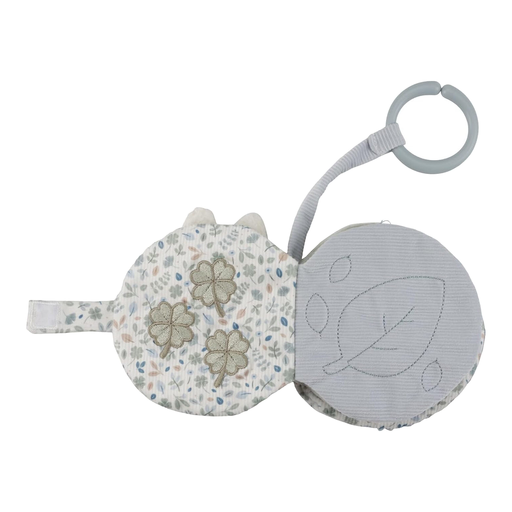
Why this product suits this profile: This soft activity book is compact, suitable from birth and, according to the product information, can be attached to a pushchair. It’s a good choice for families looking for a space-saving learning toy for babies.
Instead of relying on batteries or continuous sounds, it features crinkle paper, a mirror and a soft surface. The product information also includes a small parts warning, which you should check before use.
Compact dimensions of 13,5 × 13,5 × 6 cm, an attachment ring for outings and several tactile features.
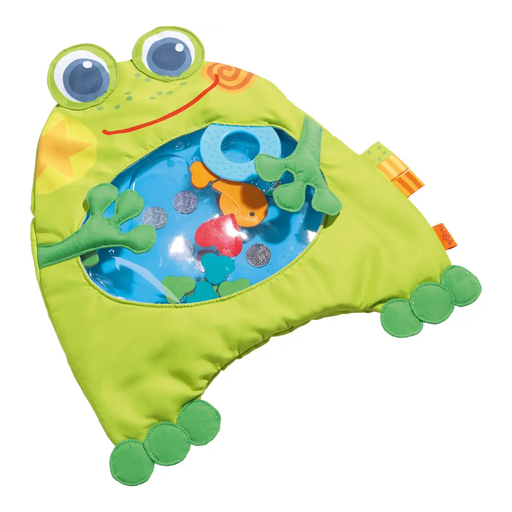
Why this product suits this profile: This water play mat is listed as suitable for children from 6 months and is designed for tummy time. It has moving features such as a mirror, leaves, a heart and a fish, with no batteries required.
The product description specifies a safety valve and a soft fabric cover. This makes its construction easier to understand than that of products whose inner workings aren’t clearly described.
No batteries needed, a soft play surface and stated dimensions of 32,3 × 21,6 × 9,3 cm.
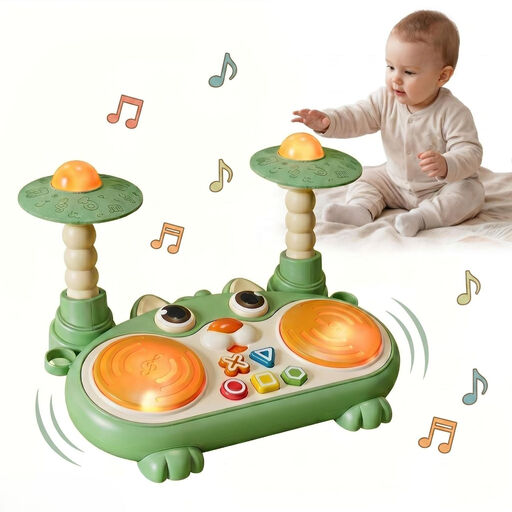
Why this product suits this profile: This multifunctional toy combines drum pads, lights, animal sounds, and shape and colour sorting. According to the product information, it’s suitable for ages 6 to 36 months.
Each feature is linked to a specific action: tapping, pressing or sorting. According to the supplier, the surfaces are made from BPA-free ABS and have rounded edges. It’s still worth checking the volume before use.
Four play areas in one product, a non-slip base and battery operation (batteries not included).
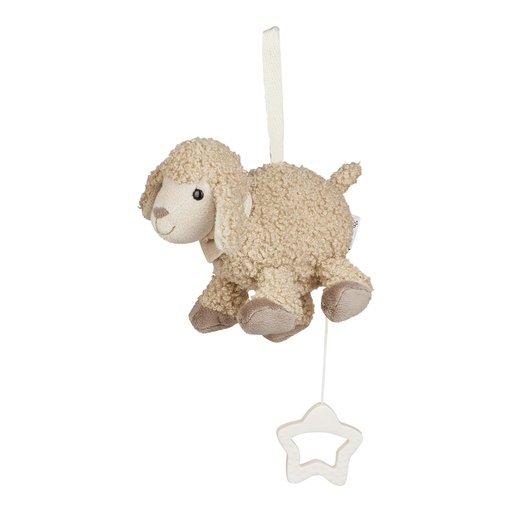
Why this product suits this profile: According to the product information, this mechanical music box is suitable from birth and doesn’t need batteries. It’s a good fit for families who prefer a simple musical toy for babies at home and on the go.
Its function is simple and doesn’t rely on electronics with changing sounds or flashing lights. The mechanism can be removed before washing the soft toy.
Suitable from birth, measures 13 × 6 × 22 cm, and comes with a removable music box and fastening ribbons.
We’ve put together a comprehensive, regularly updated list of products that meet these strict selection criteria and the safety regulations in force in the EU.
It depends on the type of product. Soft books and simple grasping toys are often suitable from birth, while water play mats and some activity centres for babies are recommended from 6 months. Always check the specific age guidance and warnings, and take your child’s development into account.
There’s no single volume limit that applies to every toy. Choose products with volume control and don’t hold speakers right next to your child’s ear. If you’re unsure, use the toy only for short periods and keep it at a greater distance.
There’s no one-size-fits-all time limit. Watch to see whether your child remains engaged and relaxed. If frequent changes in lights or sounds, or general restlessness, seem overwhelming, it’s a good idea to take a break. Switching between active motor skills toys and quieter tactile activities adds variety.