
Lieferung heute & morgen

Qualitätsgarantie

Willkommens-Angebote freischalten: KOSTENLOSE Lieferung | Bis zu 80 % RABATT | Kostenlose 30-Tage-JoyPlus-Testphase
App herunterladen
Diving into the world of sewing can be a rewarding experience—whether it's to repair clothes, create personalised gifts, or discover a new creative hobby. However, the search for the right sewing machine for beginners is often fraught with uncertainty. The market is flooded with models whose marketing promises create more confusion than clarity. Many newcomers invest in a device that quickly proves to be unsuitable or frustrating. Before you make a decision, it's crucial to understand the typical pitfalls that can lead to a bad buy.
The 3 Most Common Traps When Buying a Beginner's Sewing Machine:
To avoid a purchase mistake, you should focus on the parameters that are crucial for a smooth start. Instead of being dazzled by marketing buzzwords, check the following objective criteria.
To begin with, a handful of stitches is perfectly sufficient. Make sure the machine reliably performs at least the following options:
Some models also offer a buttonhole stitch or a blind hem stitch, which can be useful for more advanced projects. A simple sewing machine with 5 to 12 solid stitch programs is an excellent choice for beginners.
Consider where and how you want to sew. A small sewing machine or a portable sewing machine is ideal if you have limited space or want to use the device flexibly in different locations. The power supply also plays a role here:
A mini sewing machine is often a good choice as a second device or as a sewing machine for kids making their first attempts at sewing under supervision.
An uncomplicated setup is crucial for beginners. A good entry-level machine should make the process as simple as possible. Look for features like:
Based on these objective criteria, we have identified some products that are suitable for different beginner profiles.

Why This Fits Their Persona: Ideal for anyone who wants to try sewing on a minimal budget or only needs to perform occasional simple repairs. Its compact size and uncomplicated design take the fear out of the technology.
This model avoids the 'feature overload' trap. It focuses on a single, basic stitch, making it extremely easy to use. The printed threading guide simplifies getting started.
Can be operated with both a power adapter and batteries (battery-powered sewing machine), making it very flexible. Operation via button or foot pedal is intuitive.

Why This Fits Their Persona: Perfect for beginners who want to do more than just repairs, tackling their first creative projects like pillowcases, simple bags, or clothing alterations.
This model avoids the 'missing basic features' trap. With 12 stitch patterns and a reverse sewing function, it offers everything needed for a creative start without being overwhelming.
The combination of useful features like an LED light, thread cutter, and two speed levels offers great convenience. The automatic bobbin winder simplifies preparation.
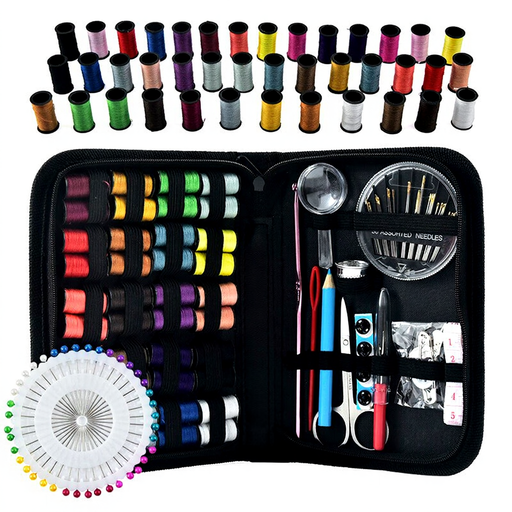
Why This Fits Their Persona: For anyone who doesn't need a sewing machine but wants to be prepared for any small hand repair—from a torn-off button to a burst seam. Ideal for the home, office, or travel.
This kit completely bypasses the need for a machine investment. It provides a manual yet comprehensive solution, thus avoiding the learning curve and space requirements of an electric machine.
Comprehensive kit with 24 thread colours, various needles, scissors, measuring tape, and threading aids in a compact case. You're immediately prepared for almost any manual repair task.
We have compiled a complete, up-to-date list of products that fully meet these strict selection criteria and safety regulations.
1. Can you sew denim with a mini sewing machine? Most mini sewing machines are designed for light to medium-weight fabrics like cotton, linen, or viscose. Sewing thick denim, especially in multi-layered areas like hems, typically exceeds their capability and can lead to needle breakage or motor damage. For occasional, small repairs on thin denim, it might work with a special denim needle, but for regular work with denim, a more robust model is required.
2. Is a battery-powered sewing machine powerful enough? A battery-powered sewing machine is an excellent solution for portability and smaller sewing projects. The power is sufficient for most standard fabrics. However, if you plan to work with thicker materials or sew for extended periods, it is advisable to use the included AC adapter. This ensures constant and maximum motor power, which is needed for more demanding tasks.
3. How much should a good sewing machine for beginners cost? Price is not always an indicator of suitability. A functional and reliable sewing machine for beginners doesn't have to cost a fortune. Models in the sub-€100 price range can already offer all the necessary basic functions for getting started. More important than the price is that the machine meets the core parameters mentioned above: reliable basic stitches, a reverse sewing function, and ease of use.