Choose a sewing machine based on whether it can stitch the thickest folded section of your planned bag neatly in a test piece. A versatile domestic machine may be enough for the occasional simple bag; if you regularly work with layers that shift or vary in thickness, adjustable presser-foot pressure and suitable feed features are worth considering. Manufacturers’ descriptions of individual features are no substitute for testing with your fabric, thread and needle.
Who sews multi-layer board game bags?
Sewists tackling thick seam intersections
When folded hems or reinforced areas create several layers, the key question is whether the machine can handle the thickest seam you plan to sew. extremtextil’s buying guide and SCHMETZ’s advice both treat thick, firm materials as specific fabric and needle considerations.
Sewists working with layers that slip
When sewing several pieces of fabric together, you want them to feed through evenly without shifting against each other. Brother, Janome and W6 Wertarbeit describe feed or pressure settings on some of their models that are relevant when choosing a machine for this kind of work.
Occasional sewists making bags and other projects
If you plan to sew other things as well as bags, a versatile range of stitches and easy-to-control operation may be important. TÜV SÜD covers choosing a sewing machine for different types of work, while manufacturers’ descriptions show how features vary between models.
What should you look for when buying?
| Priority |
What to check |
Who is this important to? |
| Thick seam intersections |
Test the thickest section you plan to sew, using all the intended layers, thread and a suitable needle. |
If I’m sewing folded edges and extra layers together, I want to know whether the machine can handle that exact section. This is the main priority for around 36% of consumers concerned about thick seam intersections. |
| Even fabric feed |
Check the feed system and, if available, the adjustable presser-foot pressure on the specific model. |
If several pieces of fabric tend to slip against each other while I’m sewing, an even feed matters to me. Around 29% of consumers are mainly concerned with feeding several layers evenly. |
| Controlled sewing |
Check whether you can adjust the speed and control the needle position when turning corners. |
When sewing short seams and bag corners, I want good control over the speed and needle position. Around 21% of consumers put control while sewing first. |
| Other sewing projects |
Think about which stitches and materials you’ll actually want to use beyond making bags. |
If I’m planning to use the machine for other projects too, the stitches I need for those projects matter more than a long list of programmes. Around 14% of consumers name versatility as their main priority. |
Avoiding buying mistakes
-
Assuming lots of stitch programmes mean it can handle thick seams
A wide choice of stitches tells you little about how well the machine feeds your thickest seam. Test it with a sample piece rather than relying on the programmes alone as proof of suitability.
Features you’re unlikely to use for your sewing projects could make your purchase unnecessarily expensive.
-
Focusing only on the machine, not the needle and seam
Your needle needs to suit the material. For its domestic needle system 130/705 H-J, SCHMETZ lists a Jeans needle as an option for firm canvas and thick layers of fabric; even so, test the full combination of materials with a sample piece.
Remember to allow for suitable needles and thread if needed.
-
Assuming a specialist straight-stitch machine is automatically more versatile
Specialist machines may be limited to one stitch type and can be bulkier. Before buying, list all the sewing tasks you need to do and check whether the machine can handle them.
If you need additional stitch types, you may need extra equipment.
Sewing machine brands to consider
Brother
For the Innov-is F400, Brother describes a rectangular feed system; the Innov-is A65, meanwhile, has 60 stitches. These are manufacturer specifications for the respective models, not confirmation that either can sew a particular thick bag seam.
- The feed system on the Innov-is F400 is a specific feature to consider when comparing how machines feed fabric.
- The A65’s stitch count alone doesn’t tell you whether it can handle your thickest seam.
Janome
Janome Germany lists adjustable presser-foot pressure, continuous speed control and a needle stop for the Sewist 625 E.
- These settings are useful to consider when sewing layers of varying thickness and guiding fabric around corners.
- The manufacturer’s statement about sewing performance on thick fabrics is not an independently verified limit; test your material with a sample piece.
W6 Wertarbeit
W6 Wertarbeit lists adjustable presser-foot pressure, speed control and a selectable needle stop for the N 3300 Pro.
- These settings may be useful when working with varying fabric layers and sewing with greater control.
- They don’t guarantee a particular maximum layer thickness. A test rating quoted on the manufacturer’s website is no substitute for testing your own materials.
Sewing machines at Joybuy
This selection includes a hand-operated machine for thick materials as well as compact electric domestic models. Compare their stated material limits and features with the thickest folded section of your bag.
 No image available
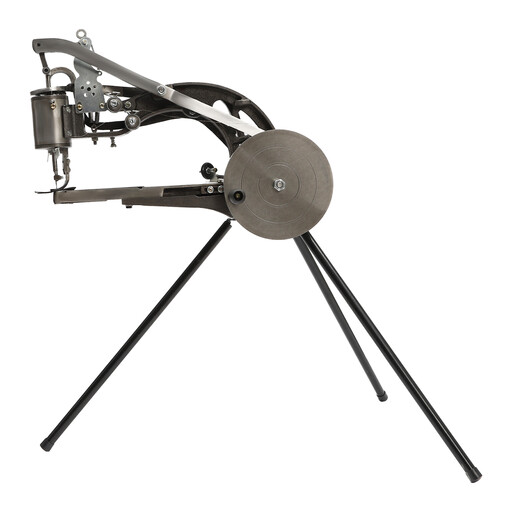
Hand-crank sewing machine for leather and thick materials, 6 mm stitch length
Could be worth considering for manually guided sewing on bags or canvas; test the actual bag seam with a sample piece.
The product name specifies a 6 mm stitch length, material thicknesses of 3–5 mm and a head that rotates through 360°.
Operated manually with a hand crank; according to the product information, moving parts need regular lubrication.
View at Joybuy
 No image available
Electric sewing machine for beginners, 12 stitch programmes
Could be worth considering for simple household sewing and other projects; check its material limit against the thickest section of your bag.
The product name specifies 12 stitch programmes, two speeds, and forward and reverse sewing. The product description specifically refers to up to six layers of lightweight denim and gives a maximum material thickness of 2.5 mm.
View at Joybuy
 No image available
Mini sewing machine, 12 stitches, pink
Its compact design could be useful for simple sewing and alterations; before buying, check that it can handle the folded layers in your bag.
The product name specifies 12 stitch types, dual power and accessories.
View at Joybuy
 No image available
IAGREEA electric sewing machine, 6 V, 1 A, with accessories
Could be an option for simple straight seams around the home; check whether its fixed stitch will work for your bag pattern.
The product information lists 6 V, 1 A, a foot pedal, a thread guide hook, an empty bobbin, a spare needle and a needle threader, as well as operation with four AA batteries.
According to the product information, the machine has a fixed straight stitch and no reverse function.
View at Joybuy
Frequently asked questions
What should I bear in mind when sewing firm layers of fabric?
Start by sewing a sample piece with all the planned layers and the thickest fold. For firm canvas, SCHMETZ lists a Jeans needle from its domestic needle system 130/705 H-J as one possible option; the needle size and machine compatibility must suit the material and model.
Is an overlocker the only machine I need for board game bags?
Not necessarily, especially if you also want to sew bag pieces together and work around corners. TÜV SÜD describes overlockers as mainly used for sewing and trimming fabric edges at the same time; choose based on the steps involved in your pattern.
Who is responsible if a product develops a fault after purchase in Germany?
The seller is generally responsible for statutory consumer rights. Verbraucherzentrale explains that consumer purchases are covered for up to two years; this is separate from any additional manufacturer’s warranty. The rights available in a specific case depend on the purchase and the fault.
What labels and documents should I check on an electric sewing machine?
The Bundesnetzagentur lists checks including the CE marking, identifiable product and manufacturer details, and German-language instructions with the required warnings. A visible mark alone doesn’t prove that the machine can handle your fabric layers.


