Beginners making cotton scrunchies
If you want to start with straightforward sewing steps and a speed you can control, lightweight cotton fabrics are a good choice. KATTUN-Stoffe.de recommends lightweight cotton fabric for beginners.


For short seams when making scrunchies at the kitchen table, first check whether you can easily control the speed, and whether the machine’s weight, controls and accessories suit a workspace you need to set up and put away. The number of decorative stitches is not a reliable guide. For jersey, it’s important to have suitable stretch stitches and test a seam on your own fabric. If you only make simple scrunchies from lightweight cotton now and then, a mechanical machine could also be an option.
If you want to start with straightforward sewing steps and a speed you can control, lightweight cotton fabrics are a good choice. KATTUN-Stoffe.de recommends lightweight cotton fabric for beginners.
If you want to sew jersey as well as woven fabrics, check that the machine has suitable stitches and feeds fabric properly. A test using the material you actually plan to sew will help you assess this.
If you put your machine away after sewing, factor its weight, storage requirements and controls into your choice. Depending on the model, features such as a start/stop button, accessories and a cover may be more or less useful.
A good fit if: you sew often and will actually use the speed control or start/stop button.
Things to weigh up: A wider choice of programmes alone is no proven advantage for sewing a simple fabric tube. The machine and its accessories will also take up space.
A good fit if: you only make simple scrunchies from lightweight cotton occasionally. TÜV SÜD associates mechanical machines with simple sewing tasks and occasional use.
Things to weigh up: You’ll make more adjustments by hand, including stitch length, stitch width and, where necessary, thread tension. You won’t have the convenience features found on the computerised models mentioned above.
A good fit if: as well as making scrunchies, you regularly want to neaten fabric edges or work with stretch fabrics.
Things to weigh up: An overlocker trims and neaten edges at the same time. Check whether it can also handle all the sewing and finishing steps required for the way you make scrunchies.
| What matters | What to look for when buying | Who is this particularly important to? |
|---|---|---|
| Control over short seams | Speed control and easy-to-reach controls; if needed, a needle stop position with the needle up or down. | If I want to guide the fabric tube and finish the seam neatly, being able to control the speed matters to me. Around 36% of consumers prioritise speed control. |
| Cotton and jersey | For jersey, check that the machine has suitable stretch stitches and feeds fabric properly. Test the seam on your own fabric using the needle and thread you plan to use. | If I want to sew both woven fabric and jersey, suitable stitches and smooth feeding matter more than lots of decorative stitches. Around 29% of consumers put the ability to switch between fabrics first. |
| Setting up and putting away at the kitchen table | Check the weight, the space it needs and whether a cover is included. Allow extra room for accessories. | If I need to clear the table after every sewing session, I want to be able to store the machine and its accessories easily. Around 21% of consumers consider setting up and putting away the most important factor. |
| Making several scrunchies in a row | Check whether the specific model has features such as an automatic thread cutter or needle threader. | If I’m making several scrunchies in one sitting, I want to cut down on repetitive tasks. Around 14% of consumers focus mainly on the workflow when making several items. |
For a simple fabric tube, the basic sewing steps are what matter. A high number of programmes doesn’t prove that you’ll have better control over short seams.
Start by checking the speed, controls and suitability for the fabrics you plan to use.
The right stitches and settings depend on the model. A fabric list is no substitute for testing the machine with your own layers of fabric.
Test the stitch, needle and fabric feed on a leftover piece of your jersey.
An unsuitable seam may mean you need to carry out extra tests or sew it again.
Weight, accessories and controls vary from one model to another. An extension table or other accessories may need extra room for use and storage.
Measure the available space and check what’s included with the exact version you’re considering.
As well as space for the machine, allow room for accessories, the foot pedal, the cover and your sewing materials.
For its computerised Innov-is A65, Brother lists several features that may come in handy when sewing short seams.
The 230DC Limited Edition combines speed and fabric adjustment features with accessories that need room at the kitchen table.
According to W6 Wertarbeit, the N 3300 Pro lets you adjust the speed and presser-foot pressure.
The manufacturer’s website describes the bernette 37 as a compact computerised model with speed and start controls.
The Joybuy products below are electric sewing machines for home use or mini sewing machines. Check whether the listed stitches and controls suit your fabric and the space available at your kitchen table.
 No image available
Two speed settings may be useful for short seams if you want to choose the pace.
12 stitch types; single and twin needles; 2 speed settings; sewing kit included.
 No image available
The selectable speeds and forward and reverse functions may be useful for sewing short sections.
12 stitch programmes; twin thread; 2 speeds; forward and reverse sewing; foot pedal and hand switch; LED light; thread cutter; accessories.
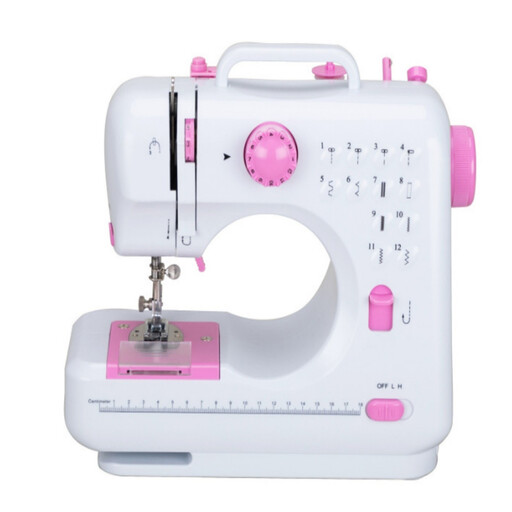 No image available
The product listing describes this model as a mini portable sewing machine. Check whether its shape and controls suit your workspace.
12 stitches; dual power; LED light; pink.
 No image available
This mini model is described as a portable sewing machine. Before choosing it, check that its listed features suit the steps involved in your project.
12 built-in stitches; reverse sewing; portable mini design; purple.
A straight stitch may be enough for a simple scrunchie seam: one published scrunchie tutorial uses it for the short fabric edge and recommends lightweight cotton fabric for beginners. So if you only sew projects like this occasionally, you could also consider a mechanical machine; a computerised model isn’t essential.
Follow the instructions for the specific model. Among other things, the Janome 230DC Limited Edition manual says to unplug the machine after use and before cleaning, switch it off when making adjustments around the needle area, and keep lint away from the ventilation openings. These manufacturer instructions apply to this model.
No. If a product is faulty, your statutory rights are against the seller. A guarantee is an additional voluntary offer, and its scope depends on its terms. The Verbraucherzentrale recommends checking who the seller is and what guarantee promises apply to the specific offer.
Goods sold in the EU must meet the relevant product safety requirements. If CE marking is required for a product, its absence is a warning sign. A sewing machine that has reached the end of its life must not go in general waste. It should be taken to an authorised collection point, such as a local council recycling centre. Retailers’ take-back obligations depend on the legal requirements that apply.